

Stop defaulting on the third shot and start choosing it.
Most rec players have one third shot. They drive everything because they do not trust their drop, or they drop everything because they fear getting attacked at the kitchen.
Both habits give away points. The third shot is supposed to be a choice, not a reflex.
This drill builds the choice.
Why this drill matters
The third shot is the most consequential ball in any rally. It either gets the serving team to the kitchen with a chance to win the point, or it pins them back and lets the returners take control.
The right third shot is dictated by the return. A short, sitting-up return usually wants a drive. A deep, low return usually wants a drop. Most rec players ignore the signal entirely and just hit their favorite shot.
When you train both shots in alternation, your body learns to feel the difference. When you then add reading the return, you stop guessing and start choosing.
How to set it up
- Full court. Doubles formation if you have four players. Half court works fine for two.
- One player is the server. One player is the returner.
- Serve, receive a return, hit the third shot. Stop.
- Reset and serve again.
The point is to isolate the first three shots, not to win full rallies.
The base pattern
The server hits a fixed sequence:
- Third shot one: a drop.
- Third shot two: a drop.
- Third shot three: a drive.
- Repeat.
Yes, the pattern will sometimes be wrong for the return you actually got. That is the point of the early levels. You are learning the feel of both shots from the same position before you start choosing between them.
What a good drop looks like
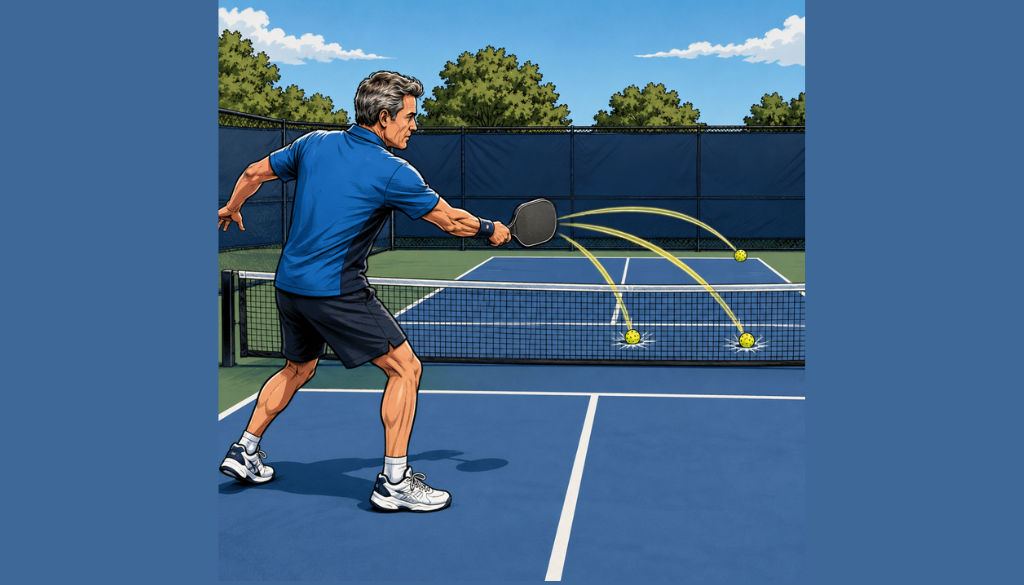
- Arc that peaks above the net by 2 to 3 feet.
- Lands in or near the kitchen.
- Soft enough that the receiver has to move forward to handle it.
- Hit with a relaxed, low-to-high motion, not a flat push.
What a good drive looks like
- Low, with topspin shape, not a flat poke.
- Aimed at a body, hip, or seam, not at a sideline.
- Fast enough to take time away, but not so hard you cannot recover.
- Hit with the legs and core rotation, not just the arm.
If your drop floats high and lands at the service line, you have given the receivers a free attack. If your drive sails long or pops up off a low ball, you have handed the rally over.
Reading the return
Once you start making the choice instead of following the pattern, this is the simple cue system:
Drive when
- The return is short, landing inside the service line area.
- The return is high, above your hip at contact.
- You are balanced and stepping forward into the ball.
Drop when
- The return is deep, pushing you near or behind the baseline.
- The return is low, below your hip at contact.
- You are off-balance, moving back, or rushed.
If two of the three cues say drive, drive. If two of the three say drop, drop.
These cues are guidelines for advancing rec players, not universal laws. As your skills grow, the exceptions will multiply. For now, they will get you the right shot 80 percent of the time.
There is also one read beyond the ball itself. Look at where the receivers are positioning. If they are crashing the kitchen aggressively, a drive at their feet or a soft roll past them is harder to defend. If they hang back to drive the fifth or seventh shot, a well-paced drop gives you free distance to come up. Match your shot to the ball and to the people.
Common mistakes
- Driving a low, deep ball. Without serious topspin, that drive ends up in the net or sailing long. If you cannot lift the ball, drop it.
- Dropping a sitting ball. A high, short return is a free chance to apply pressure. Defaulting to a soft drop here gives the receivers a free reset.
- Changing the pattern too early. In Levels 1 and 2 below, hold the pattern even when it feels wrong. The reps are training your hands, not your decisions yet.
- Driving with the arm only. Power should come from the legs and rotation. A wristy swing tires fast and lands inconsistently.
Level variations
Beginner: Learn the Feel
- Hold the pattern strictly. Two drops, one drive, repeat.
- Returner feeds a consistent, medium-deep return every time.
- Goal: 6 of 8 drops land in the kitchen, and 6 of 8 drives stay low and in.
- Focus only on clean contact. No live play after the third shot.
This level is about your hands knowing the difference between the two motions when nothing else is changing. Your job is not to win the rally. It is to feel a drop and a drive in the same body.
Intermediate: Start the Read
- Keep the pattern as the default, but add one rule. If the return clearly demands the other shot, you may swap.
- A return that lands inside the service line lets you drive even when the pattern says drop.
- A return that pins you behind the baseline lets you drop even when the pattern says drive.
- Returner now mixes return depth and pace. Some deep, some shallow, some with slice.
- After each rep, say out loud whether you followed the pattern or swapped, and why.
- Goal: across 20 third shots, get 75 percent or better on the right call.
This level is where the brain catches up to the body. You are not just executing two shots anymore. You are watching the return and naming the shot it is asking for.
Advanced: Live Decision Game
- The pattern is gone. Every third shot is a free choice based on the return you receive.
- Returner plays a real return: depth, slice, occasional short angle, occasional high floater.
- After the third shot, play the rally out live for up to five balls.
Scoring rules to keep decisions honest:
- Plus 1 for winning the rally with the right shot for the return. Example: drove a short return, dropped a deep return.
- Zero for winning the rally with a forced shot that did not match the return.
- Minus 1 for losing the rally on a forced wrong shot. Example: drove a deep low return into the net, or dropped a sitting ball into the receivers’ strike zone.
- Play games to 11. The scoring rewards reading, not just winning.
At this level, players also start mixing in soft drives, roll volleys, and the occasional third-shot lob. Those are real options at higher levels, but they sit on top of the drop and drive foundation. Get the core choice automatic first. The other tools come later.
This is where the drill earns its keep. You will see your own defaults clearly, and the loss column will show you exactly where your one-trick habit is costing points.
When the rules bend
A few real exceptions are worth knowing, even if you should not lean on them yet.
- A deep, low ball can be driven if you have a reliable heavy topspin roll. The ball lifts over the net, dives down inside the line, and pressures opponents who expected a drop. This is a 4.5-plus tool. Build the basic drive first.
- A third-shot lob is situational and opponent-dependent. It works best against teams who crash the kitchen aggressively without watching for it. Used as a default, it gets smashed. Used once or twice a game against the right opponent, it can swing the match.
- Your own skill profile matters. If your drive is dramatically more reliable than your drop, or vice versa, lean into your strength in matches while you build the weaker shot in practice. The goal is balance over time, not pretending you already have it.
- Partner and formation matter too. Talk before the point about which shot you are looking for, especially in stacked formations or when one partner is already creeping forward. The third shot belongs to the hitter, but the plan belongs to the team.
Why this drill belongs in your rotation
Players who can only drop are predictable. Players who can only drive are unstable. Players who can do both, and read which one the return is calling for, win the third-shot battle.
The first four shots of any rally decide who reaches the kitchen with control. The third shot is your half of that conversation.
Train both shots. Train the read. Then the choice gets obvious.