


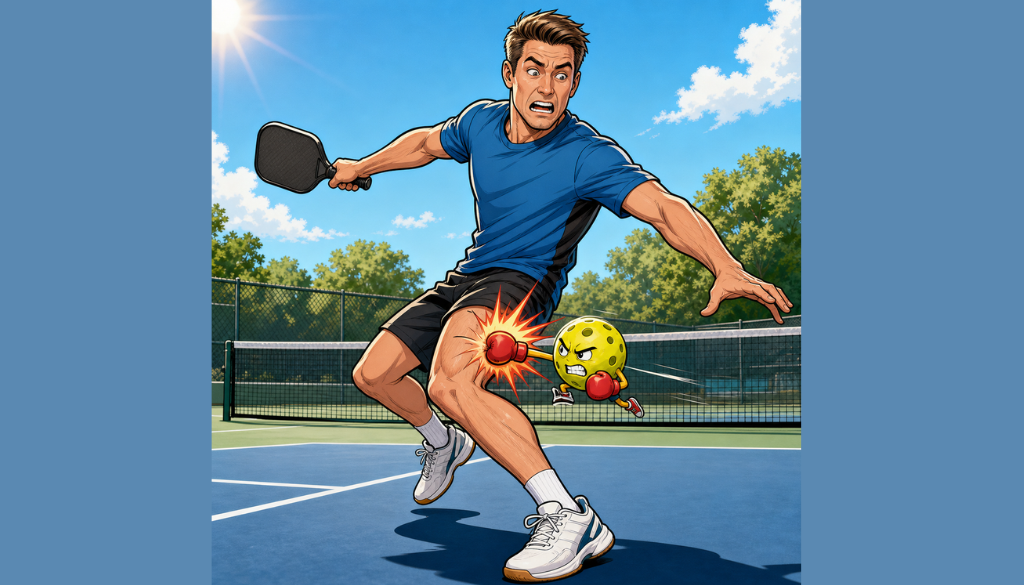
You walk off the court feeling great, maybe a little tired. Then you wake up. Your quads are locked up, your legs feel like lead. You’ve been telling yourself it’s the heat, a lack of stretching, or just getting older.
But what if all those excuses were wrong? New research into what happens to your muscles during a hard session reveals the surprising movement that actually causes your worst soreness—and it has nothing to do with running.
Once you know the real culprit, you’ll start thinking about recovery very differently.
The Real Culprit
It’s not the running.
It’s the stopping.
Researchers measured what happens to the front quad muscle during repeated sprints with different stopping conditions — free stops, moderate braking, and hard, short-distance braking.
The results were immediate and clear: the harder the stops, the more the quad stiffened and thickened across sets. So, athletes performing hard stops showed significantly more quad stress than those who decelerated naturally.
Crucially, the damage markers didn’t peak right after the session. They peaked a full 24 hours later and remained elevated for up to 72 hours—three days after the tests. This 24-hour lag is the missing link explaining why your legs feel fine walking off the court, but ruined the next morning.
Why Pickleball Is a Stopping Sport
Think about what you actually do out there.
Sprint to the kitchen. Plant and stop. Pivot for a wide ball. Stop again. Push back from the net and brake. In a hard 45-minute session, you make dozens of these explosive braking movements — and each one loads the front of your thigh in a specific, cumulative way.
The rally isn’t the problem. The deceleration is.
That’s why your legs feel okay walking off the court but wake you up the next morning. The muscle fibers are still responding to the mechanical stress of stopping. The repair process is still catching up.
Play two days in a row and you may be starting fresh while your quads are still working through yesterday’s damage.
Four Things to Do With This
- Respect the 24-hour lag. If you played hard yesterday and feel okay this morning, don’t treat that as a green light. Peak soreness often shows up mid-morning — not at the 8 a.m. warmup.[Text Wrapping Break]
- Ease into your stops during warmup. Don’t make explosive stops until your quads are warm. Gradual deceleration drills — not sprint-and-slam — get the tissue ready without front-loading the damage.[Text Wrapping Break]
- Watch your session density. Back-to-back days work for a lot of players. But if your quads are the specific issue, you may not be giving the tissue enough time between sessions.[Text Wrapping Break]
- Get more protein in your diet. Muscle repair requires amino acids. The sooner your body has the building blocks after a hard session, the faster the process starts.[Text Wrapping Break]
If the Soreness Keeps Hanging Around
Dietary protein helps. Sleep helps. But if you’re playing four or five times a week and still waking up with heavy quads, your muscle repair system may not be keeping up with the demand.
As you get older, your body becomes less efficient at synthesizing muscle protein from food alone. You need more to trigger the same repair response you’d have gotten at 35.
Advanced Amino Formula from Advanced Bionutritionals was built for exactly that gap. It delivers all eight essential amino acids your muscles need to rebuild — in a form your body absorbs quickly. Not a protein powder. A targeted recovery tool for people putting real stress on their legs and wanting to feel ready for the next session.
Special for The Fit Pickler Readers: Click any link in this article and you unlock an exclusive discount for Advanced Amino Formula. Your savings are applied automatically at checkout. And you’re backed by a 90-day money-back guarantee — try it for three months, and if it’s not right for you, send it back for a full refund.