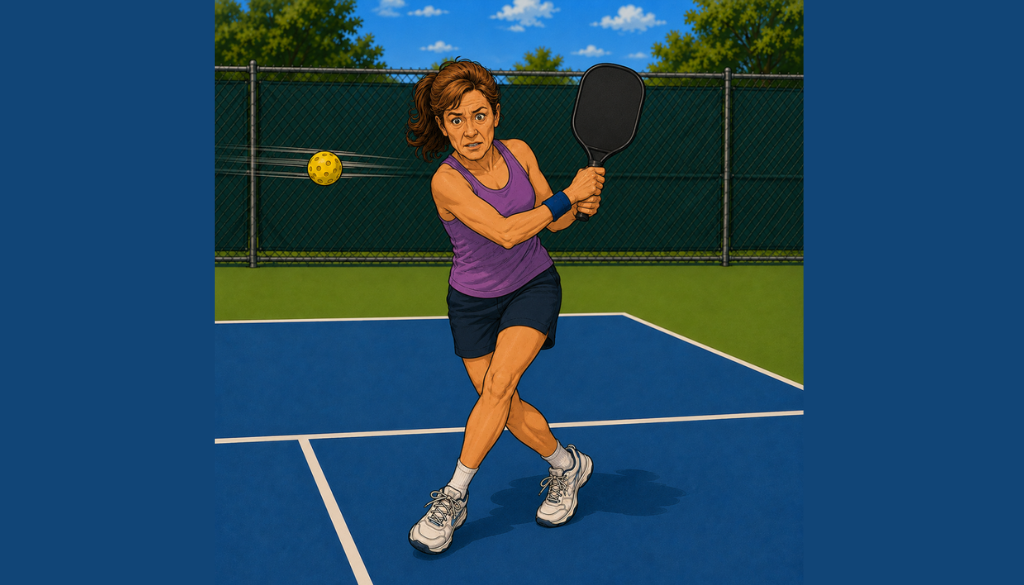


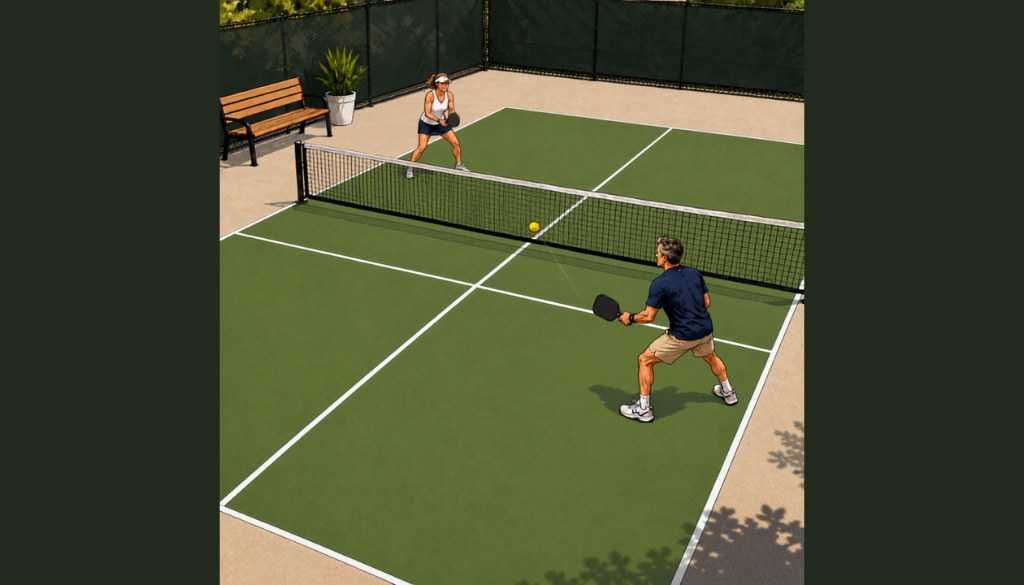
Watch a high-level dink rally and you’ll notice something that surprises many recreational players.
The best players aren’t always looking to speed the ball up.
In fact, some of the most effective offensive dinking barely looks offensive at all.
Instead of trying to end the point, they’re gradually making life more difficult for their opponents.
One dink pulls the opponent a few inches wider.
The next pulls them a little farther.
Then another.
Eventually the court starts to open, recovery becomes more difficult, and the opponent is forced into a weaker shot.
The pressure wasn’t created by power.
It was created by positioning.
That’s exactly what the Crosscourt Pressure Ladder is designed to teach.
The drill helps players learn how to create sharper angles one step at a time without sacrificing control. Instead of immediately aiming for the most aggressive dink possible, players learn how to build pressure gradually and recognize when they’ve created an advantage.
Why This Drill Matters
Many players understand that wide dinks are effective.
What they don’t always understand is how those angles are created.
A common mistake is trying to hit the perfect angle too early in the rally. The player sees an opportunity, aims close to the sideline, and either misses the shot or leaves the ball high enough to be attacked.
The problem isn’t the idea.
The problem is the timing.
Good players rarely jump from a neutral dink to an extreme angle. They build toward it.
Each shot creates a slightly more uncomfortable contact point. Each shot requires a slightly bigger recovery. Each shot pulls the opponent a little farther from their ideal position.
Eventually the angle becomes available naturally.
The Crosscourt Pressure Ladder teaches players how to recognize and create that progression.
Setting Up the Drill
Two players begin a cooperative crosscourt dink rally.
The first few dinks should be comfortable and relatively neutral.
After every successful exchange, the next ball must be placed slightly wider than the previous one.
The change should be small.
Think inches, not feet.
The objective isn’t to hit a winner. The objective is to gradually move the opponent farther from the center of their side of the court while maintaining control.
Continue building angle only as long as you can stay balanced, keep contact out in front, and still clear the net safely.
Continue building angle until one of three things happens:
- A player misses.
- A player can no longer create additional angle without taking excessive risk.
- A ball becomes clearly attackable.
At that point, restart the drill and begin again.
What To Focus On
The most important skill in this drill is patience.
Most recreational players try to create too much pressure with a single shot. They see a little opening and immediately go hunting for the sharpest angle available.
Better players understand that pressure compounds.
Think of the rally as a staircase.
Every successful dink should move your opponent one step farther away from where they want to be.
That doesn’t sound dramatic, but it becomes surprisingly effective after several exchanges.
Pay close attention to your balance as the angles increase. The wider you try to hit, the more important footwork becomes. Players who reach for the ball or lean outside their base quickly lose control of the rally.
This is also a great drill for learning how much angle your current skill level can safely create. Most players discover they can generate more pressure than they thought without aiming anywhere near the sideline.
The Hidden Lesson
The biggest lesson in this drill has very little to do with angle.
It has to do with recognizing when you’ve already won the exchange.
Many players keep trying to create more and more angle long after they’ve forced their opponent into trouble.
Imagine you’ve pulled your opponent several feet off the court. They are stretched wide and recovering late.
That next ball doesn’t necessarily require an even sharper angle.
In many cases, the correct play is to hit back behind them, attack the open middle, or simply continue the rally and let their poor positioning create the next opportunity.
The Crosscourt Pressure Ladder teaches players to recognize how advantages are created, not just how angles are hit.
That’s an important distinction.
Common Mistakes
The most common mistake is trying to skip steps.
Players attempt a dramatic angle before they’ve earned it and end up creating errors instead of pressure.
Another mistake is focusing entirely on the ball and ignoring the opponent. The purpose of the drill is not to see how wide you can hit. The purpose is to see how your opponent responds as the angle changes.
Many players also forget to recover after hitting a wide dink. The wider the shot, the more important it becomes to regain balance and prepare for the next ball.
Finally, players often assume every successful angle should be followed by another angle. Sometimes the best follow-up is the simple shot that exploits the space you’ve already created.
Beginner Variation
Begin with a cooperative crosscourt dink rally and require every third ball to be slightly wider than the previous one.
This creates a slower progression and allows players to learn the concept without feeling rushed.
Focus on consistency first.
Intermediate Variation
Every ball must be incrementally wider than the previous one.
Players should challenge themselves to maintain long rallies while gradually increasing the angle.
The objective is to discover how much pressure can be created before control begins to break down.
Advanced Variation
Once a player creates an attackable ball, the rally becomes live.
Players may speed up, counter, or finish the point however they choose.
This variation teaches players how angle creation leads naturally into offense rather than treating the dink rally and attack phase as separate skills.
Drill Session
Start with five minutes of cooperative crosscourt dinking.
Then spend ten minutes working through the ladder progression, gradually increasing the angle with each successful exchange.
Once players are comfortable, move into the advanced version and play live points whenever an attackable ball appears.
The focus should remain on building pressure, not rushing the finish.
Final Thought
Most players think of offense as something that starts when the ball gets high enough to attack.
Good players know offense often starts much earlier.
It starts with moving an opponent a little wider.
Then a little wider.
Then a little wider still.
The Crosscourt Pressure Ladder teaches players how to create those opportunities without forcing them.
Because the best dinkers don’t win rallies by taking huge risks.
They win them by making every ball slightly more uncomfortable than the last.