


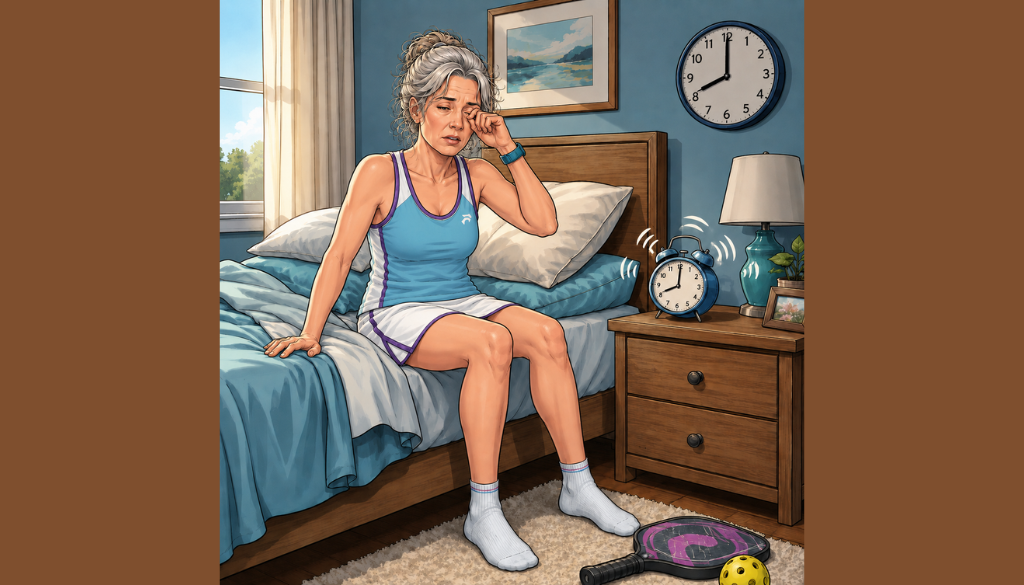
You sleep 7, maybe 8 hours. You wake up and still feel like you borrowed someone else’s body.
Your timing is off. Your legs feel heavier than they should. By the second game of open play, you’re not quite late—but you’re not quite there, either. A half-step slower than you know you can be.
Most players assume the problem is hours. Get more sleep, problem solved. But that’s the wrong number.
The Number That Actually Predicts How You’ll Play
The number that matters is sleep efficiency—the percentage of your time in bed that your body actually spends in deep, restorative sleep.
Most adults land around 85%. That sounds decent. But it means roughly 1 in 7 minutes you’re in bed, you’re awake, restless, or drifting in and out of shallow sleep. Your body never fully gets there.
A research team studying elite athletes found that a simple bedtime habit pushed that number to 93%. Players were awake 47% less during the night. They woke up fewer times. They logged a full extra hour of actual sleep—without adding a single hour in bed. And they reported noticeably better morning alertness and less fatigue.
The habit: two kiwis, one hour before bed.
Why a Fruit Changes Your Sleep Biology
This isn’t a sedative effect. The kiwi doesn’t knock you out. What it does is quietly support the systems your body already uses to fall and stay asleep.
Kiwis contain compounds that support serotonin—the molecule that plays a key role in sleep onset and keeping your circadian rhythm in sync. They’re also high in Vitamin C and polyphenols, which help reduce oxidative stress. That matters because oxidative stress is one of the lesser-known drivers of poor sleep quality.
Here’s the part most people don’t know: kiwis contain actinidin, an enzyme that supports digestion. And gut health turns out to be closely tied to sleep regulation—more than most players realize. There’s also a folate connection. Low folate status has been linked to insomnia in some populations. Kiwis are a solid source.
None of this is complicated. The kiwi isn’t doing one big thing. It’s feeding several small systems that together determine whether you stay asleep or stare at the ceiling at 3am.
It’s worth noting—this was a small study, and results vary. But the risk-to-reward ratio is hard to argue with. It’s fruit.
The protocol is simple: two kiwis, one hour before bed, for two to four weeks. Track how you wake up—not just how many hours you logged. Track your energy at the second game of the morning. Track whether your timing feels sharper.
Sleep quality is what shows up at the kitchen line. Hours in bed is just a number.
The Bottom Line
- Sleep efficiency—not hours—is what determines how you feel on court
- A small but compelling study found that 2 kiwis, 1 hour before bed, improved sleep efficiency from 85% to 93%
- Kiwis work by supporting serotonin, reducing oxidative stress, and feeding the gut-sleep connection—not by sedating you
- Give it 2-4 weeks and track quality: how you wake up, energy level, on-court sharpness
Try this before your next session. The grocery store is an easier first step than most sleep fixes.
See you out there. Stay sharp. Keep playing.