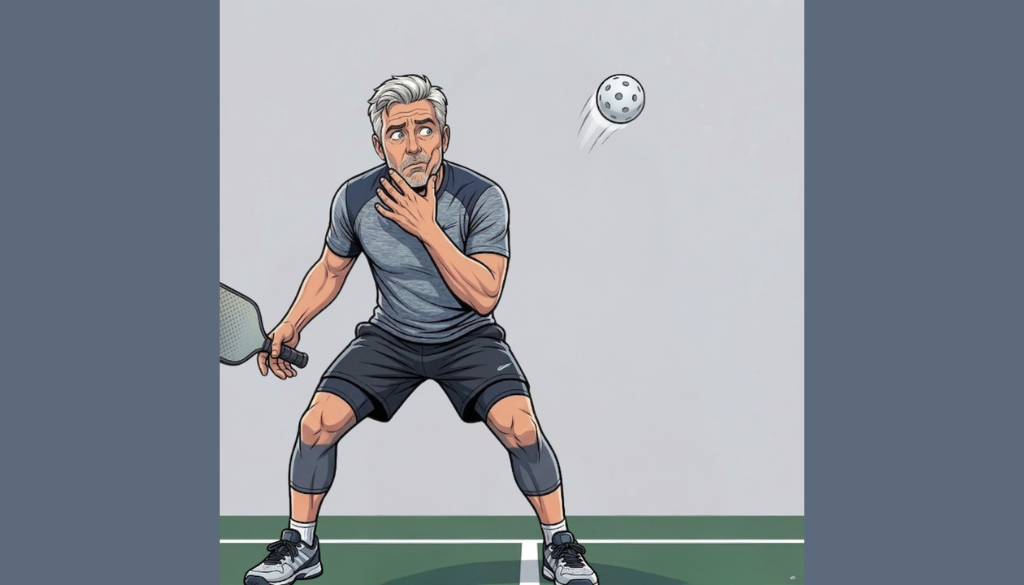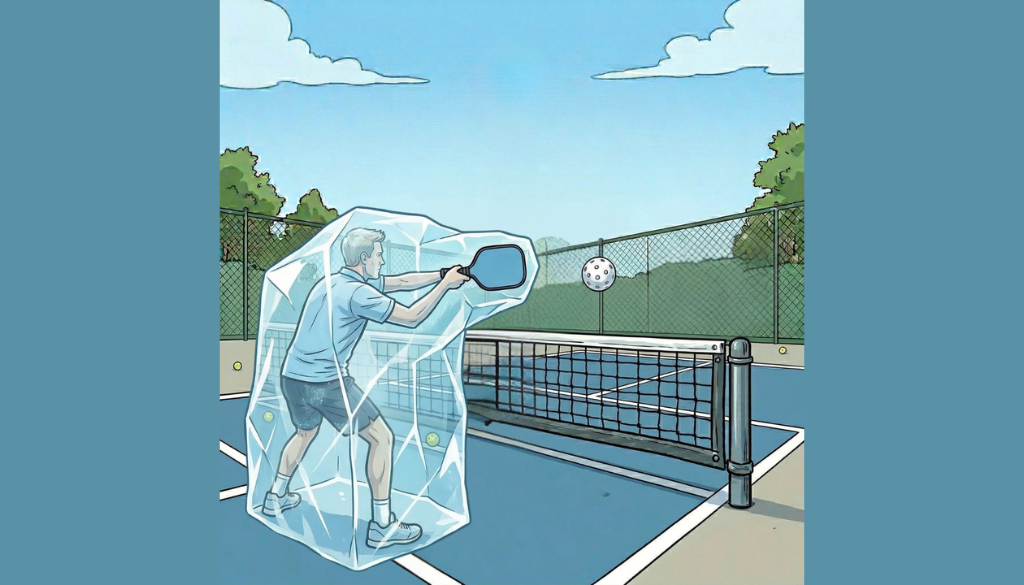


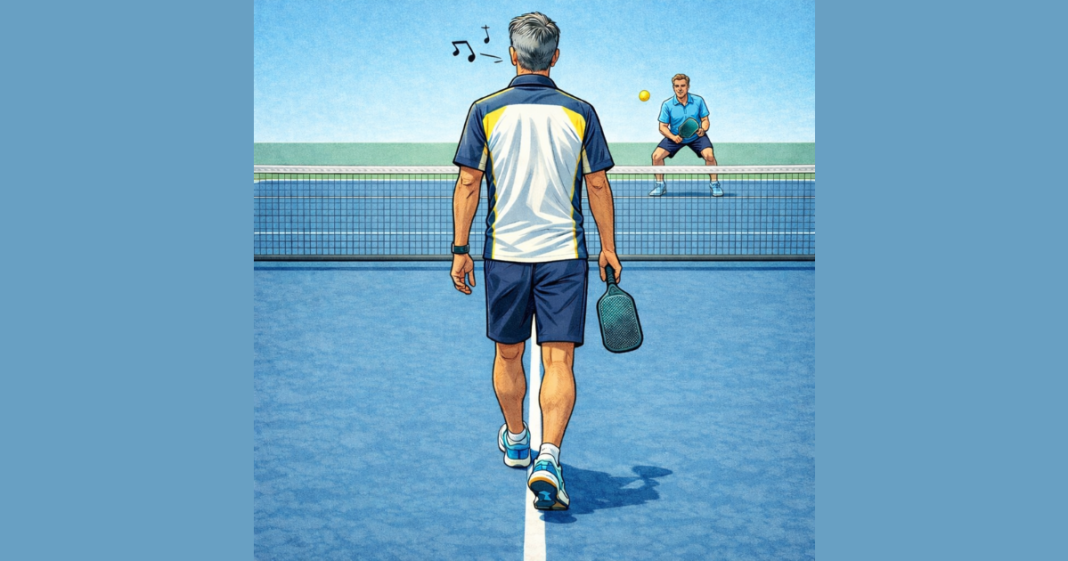
Most players rush to the kitchen on their third shot. They hit a drop, then sprint forward, eyes locked on the net, hoping the ball clears it. If the drop is even a little low, they’re already in no-man’s-land when the opponent speeds it up. The result is a frantic volley, a pop-up, or a retreat that never ends.
The best transition players don’t sprint. They walk.
They hit a third shot that buys them enough time and margin that they can move forward under control, arrive balanced, and be ready for whatever comes back. The shot itself isn’t magic. It’s a specific shape with a specific job: clear the net comfortably, land deep enough to push the opponent back, and give you time to move forward behind it.
This is the third shot that lets you walk to the kitchen.
Why most third shots force a sprint
The problem isn’t effort. It’s the shape of the shot.
When players try to hit a “perfect” drop—just over the net, dying at the opponent’s feet—they often:
- Scoop the ball with their hands instead of creating lift from low to high.
- Contact the ball too far out in front or too far back, losing control of the face.
- Aim so low that net errors become common, or they hit it short and invite a speed-up.
That kind of drop demands a sprint. If you don’t get there fast, you’re exposed.
The walking-third-shot is different. It’s not about killing the ball. It’s about giving yourself margin and time.
What this third shot actually looks like
Think of this shot as a controlled lift, not a finesse trick.
Trajectory:
- Clears the net by at least 6–12 inches, often more when you’re off balance.
- Lands between the opponent’s feet and the baseline, ideally deep enough that they can’t step in and attack easily.
- Has a gentle arc, not a flat line.
Contact:
- Happens out in front of your body, around hip to waist height when possible.
- Uses a low-to-high path so the ball naturally gets height without scooping.
- Keeps the paddle face neutral to slightly open, so the ball lifts cleanly.
Feel:
- Relaxed grip, about 3–4 out of 10. A softer hold lets the ball sit on the paddle a fraction longer.
- Smooth, compact swing. No big wind-up, no sudden jab.
- A sense of “pushing it forward and up” rather than “dropping it dead.”
The goal isn’t to hit an unreturnable shot. It’s to hit a ball that’s hard to attack and easy for you to move behind.
The three keys that make it work
1. Create lift, don’t scoop
Net errors on third shots usually come from trying to be too soft with the hands. Players drop the paddle below the ball and try to lift it with their wrist. That’s unreliable under pressure.
Instead:
- Start with the paddle face slightly below the ball, but not underneath it.
- Move low to high with your whole arm and a little knee bend, not just your wrist.
- Think “lift and forward,” not “up and over.”
This gives you consistent height without sacrificing depth.
2. Aim for comfortable margin, not perfection
A walking-third-shot doesn’t need to die at the opponent’s feet. It needs to:
- Clear the net with room to spare.
- Land deep enough that the opponent can’t easily step in.
- Give you time to move forward without panic.
When you’re off balance, deep is better than short. Height is better than net-level. A ball that lands at the opponent’s shoelaces from deep in the transition zone is often more useful than one that dies at their feet but sits up because you were rushed.
3. Move forward behind the ball
The shot is only half the pattern. The other half is what your feet do.
As soon as you make contact:
- Take a small step forward with your lead foot.
- Keep your eyes on the ball as you move.
- Walk forward in a straight line toward the middle of the kitchen, not diagonally toward a sideline.
You’re not chasing the ball. You’re moving behind it. If you’ve created enough height and depth, you’ll have time to arrive before the opponent can do real damage.
When to use it (and when not to)
This third shot is your default in most transition situations, especially when:
- You’re off balance or deep in the transition zone.
- The return came deep and you don’t have a clean attack angle.
- You’re playing against a team that loves to speed up anything short.
You can choose a more aggressive third shot—drive or speed-up—when:
- The return sits above net height and you’re balanced.
- You’re closer to the kitchen and can hit down or through the ball.
- Your opponents are pinned back or showing a clear gap.
But for most rec and mid-level points, the walking-third-shot is your bread and butter. It keeps you safe, keeps you moving forward, and keeps the point from spiraling.
Simple cues to lock it in
Use one of these short phrases when you’re setting up for your third shot:
- “Low to high.” (Reminds you to create lift with your path.)
- “Out front.” (Keeps contact in front of your body, not late.)
- “Clear and deep.” (Prioritizes margin and depth over a dying drop.)
- “Walk, don’t sprint.” (Reminds you that the shot should buy you time.)
Pick one or two that resonate. They’re not motivational; they’re mechanical redirects.
A drill to train the walking third shot
This partner drill makes the pattern repeatable.
Setup:
- One player at the baseline (third-shot player), one at the kitchen (feeder).
- Feeder starts by hitting deep returns to the baseline player’s forehand or backhand side.
Rules:
- The baseline player must hit every third shot with enough height to clear an imaginary line 12 inches above the net and deep enough to land between the feeder’s feet and the baseline.
- After each third shot, the baseline player walks forward to the kitchen line, no sprinting.
- If the ball hits the net, lands short of the feeder’s feet, or forces the baseline player to retreat, the rally resets.
Progression:
- Feeder starts by resetting every ball softly.
- Then feeder occasionally adds light speed-ups to test the baseline player’s movement and posture.
- Goal: 10 clean third shots in a row where the baseline player walks to the kitchen balanced and ready.
This isn’t about hitting perfect drops. It’s about building a third shot that consistently gives you time and margin.
How this changes your transition
When you adopt this shot:
- Your net errors on third drops drop sharply.
- You stop getting caught in no-man’s-land as often.
- Your volleys at the kitchen get cleaner because you’re arriving balanced, not frantic.
- You start to feel like you have time, even when the return is deep.
The third shot isn’t just a way to start the rally. It’s the bridge that decides whether you arrive at the kitchen as a hunter or as prey.
Hit it with lift, aim for comfortable margin, and move forward behind it. That’s the third shot that lets you walk to the kitchen—and play the rest of the point from a position of control.