

Most players understand that the middle is a valuable target in doubles. But knowing where to hit isn’t the same as knowing why it works, or how to use it deliberately.
The middle isn’t a bailout and it isn’t a default direction. When used well, it controls angles, forces hesitation, and keeps you in command of the rally. When used poorly, it sits up and gives both opponents time to reset and attack.
Learn to target the middle on purpose.
When players talk about “the middle,” they don’t mean a painted line or a fixed spot on the court. The middle is the shared space between your two opponents, the area where responsibility overlaps. It shifts depending on positioning, movement, and court geometry, but its power comes from the same place every time: neither player fully owns the ball.
If a shot makes both opponents hesitate, even briefly, you’ve found the middle.
Playing the middle well isn’t about blasting the ball straight down the seam. It’s about understanding when the middle gives you the highest margin, and how subtle positioning and footwork turn it into pressure.
Why the middle creates pressure
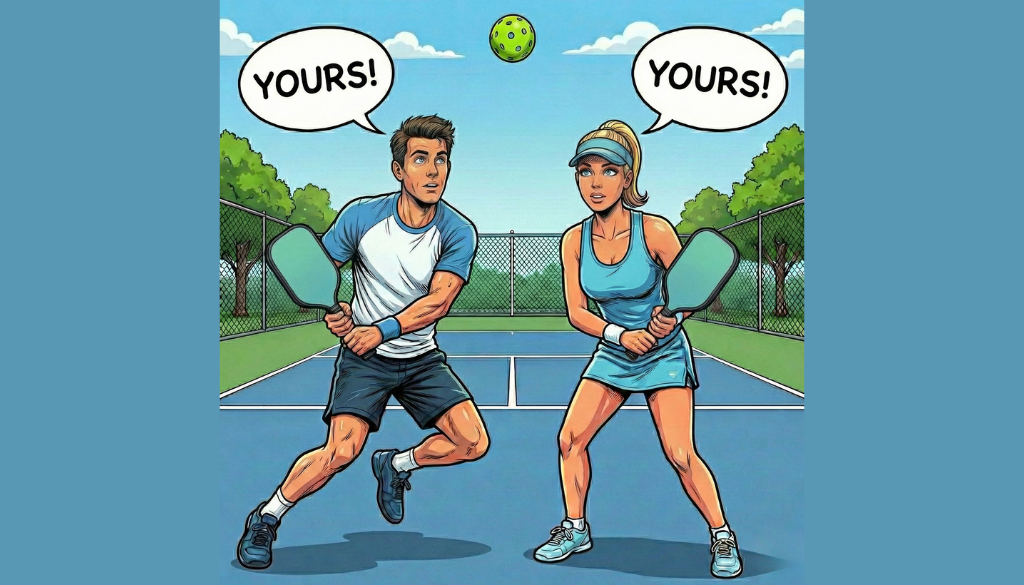
The middle works because it exploits shared responsibility. When a ball travels between two players, each has to decide whether to take it. That decision costs time. Even a half-beat of hesitation can lead to late contact, defensive swings, or balls that float higher than intended.
Middle balls also naturally reduce angles. Shots hit toward the center tend to come back toward the center, which keeps you balanced and makes recovery easier. Instead of defending sharp crosscourt angles, you’re often receiving balls that are more predictable and easier to manage.
There’s also a backhand factor. On many doubles teams, especially righty-righty pairings, a well-placed middle ball often forces someone to hit a backhand under pressure. You’re not aiming for weakness as much as you’re narrowing options.
When the middle is the right choice
The middle shines in neutral and pressured situations.
If you’re stretched, late, or off-balance, the middle is often the highest-percentage target. Guessing at a sideline when you’re under pressure usually creates errors. A firm, well-shaped ball through the middle buys time and keeps the rally under control.
The middle is also effective on drops, resets, and neutral thirds. These shots don’t need to be perfect. They need to stay low, land deep enough, and force both opponents to decide who takes the next ball.
In hands battles, the middle shrinks angles and limits speed-up options. Attacking wide from the kitchen often opens the door to sharp counters. Playing through the middle keeps exchanges compact and easier to manage.
When the middle is not the best option
The middle loses value when you’ve already created clear advantage elsewhere.
If you’ve pulled one opponent wide, forced a step backward, or clearly exposed open court, redirecting to space is usually the better play. At that point, the middle gives your opponents a chance to recover.
Depth also matters. Shallow middle balls sit up and invite attacks. Middle targets should have intent and shape, not just direction. Aim for depth around the kitchen line or deeper, with enough margin to stay low through the strike zone.
How footwork makes the middle work
Middle success starts before the swing.
Good middle shots are paired with disciplined footwork and recovery. Stay low, keep your base wide, and avoid crossing your feet as you move. After contact, recover toward a neutral position instead of admiring the shot.
Because middle balls often come back to the middle, they reward players who re-center quickly and split-step on time. The more balanced you are, the more pressure your next shot can apply.
Playing the middle with a partner
Consistent middle play builds trust.
When both partners understand that the middle is a shared space, communication becomes simpler. Decide ahead of time who takes middle balls based on forehand preference, momentum, or situation, then commit fully. Hesitation happens when roles are unclear.
Using the middle also allows your partner to stay set and aggressive. Instead of scrambling to cover sharp angles, both players can hold stronger positions at the kitchen line.
Common middle mistakes
The most common mistake is hitting the middle too hard. Power without shape turns a smart target into an attackable ball.
Another mistake is hitting middle and stopping. Middle shots work best when paired with movement and readiness. If you hit middle and freeze, you give back the advantage you just created.
Finally, players sometimes confuse “middle” with “safe.” Middle shots still require intention, depth, and positioning. Lazy middle balls are no safer than lazy sideline shots.
Drills to build middle awareness
Middle-only rallies
Play cooperative rallies where all balls must travel through the middle corridor. This builds comfort using the middle as a neutral pattern rather than an occasional choice.
Transition-zone middle resets
Start in the transition zone and practice hitting soft middle resets while moving forward in stages. This mirrors using the middle to fight your way to the kitchen under pressure.
Middle hands battles
From the kitchen line, keep rapid exchanges aimed through the middle. Focus on compact swings, balance, and recovery rather than speed.
The Key Takeaway
The middle isn’t about playing scared or playing safe. It’s about controlling space, time, and decision-making. Used deliberately, it turns the court into a smaller, more manageable place and puts the pressure where it belongs: on the other team.