

Most unforced errors in pickleball have the same root cause: players try to hit too close to the net. They aim for a ball that barely clears the tape, thinking that lower equals safer. In reality, that’s where rallies fall apart.
A ball that skims the net has almost no margin for error. A tiny change in paddle face, a slight misread of spin, or a fraction of late contact sends it into the tape or just over into a perfect attack for your opponent.
The players who make fewer mistakes and control more points aren’t the ones hitting the lowest balls. They’re the ones who consistently give their shots a bit more height over the net than everyone else. That extra margin is their secret weapon.
What “margin” actually means
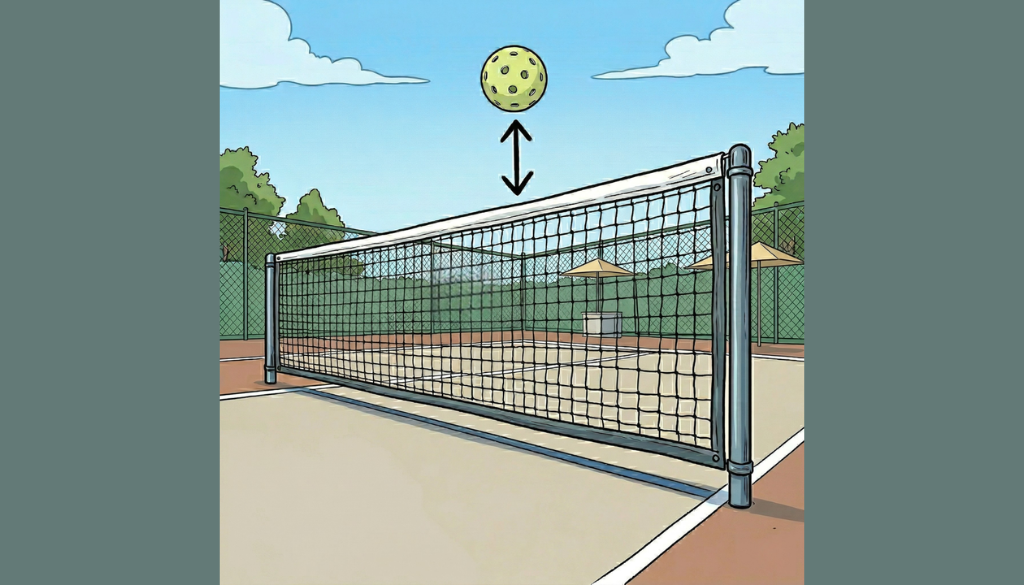
Margin over the net is the difference between where your ball actually crosses the net and where it would hit the tape.
- Low margin: The ball crosses 1–2 inches above the net. One small error and it’s in the tape.
- Healthy margin: The ball crosses 6–12 inches above the net (sometimes more, depending on the shot). You can absorb small mistakes and still land it in.
This isn’t about looping everything high and slow. It’s about choosing a height that keeps the ball safe while still being hard to attack.
How margin changes every shot
Third shots
When players try to hit perfect third‑shot drops that just clear the net, they:
- Net the ball under pressure.
- Hit it short and invite a speed‑up.
- Rush forward and get caught in no‑man’s‑land.
With more margin:
- You clear the net comfortably, even when your contact isn’t perfect.
- The ball lands deeper, pushing the opponent back.
- You have time to walk forward instead of sprinting.
A third shot that clears the net by 6–10 inches and lands deep is far more effective than a “perfect” drop that barely clears the tape and dies short.
Resets
Under pressure, a low‑margin reset is a disaster waiting to happen. If you aim to just clear the net:
- Any heavy spin or pace from your opponent sends you into the tape.
- You tighten your hand and lose feel.
- The ball pops up because you’re trying to be too precise.
With more margin:
- You absorb pace and lift the ball just enough to clear the net safely.
- You aim for depth (their feet or deeper) instead of a dying drop.
- You stay in the point without gifting an easy attack.
A good reset doesn’t need to be beautiful. It needs to clear the net cleanly and land where it’s hard to attack.
Dinks
Even in soft games, margin matters. A dink that barely clears the net:
- Is risky if your contact is slightly off.
- Often sits up if you try to compensate by lifting with your wrist.
- Gives your opponent a flat, fast trajectory to work with.
A dink with a bit more arc:
- Lands softer at their feet.
- Gives you more consistency over a long rally.
- Forces them to lift slightly, which often creates a higher, more attackable reply.
You’re not looping it; you’re giving yourself a safe window that still lands short.
Volleys and speed‑ups
This applies even when you’re being aggressive. A volley or speed‑up that aims just over the net:
- Has a high error rate when you’re moving or off balance.
- Often ends up in the tape when you try to add pace.
With more margin:
- You aim 6–8 inches over the net and let pace carry the ball deep.
- You reduce unforced errors while still hitting an attacking ball.
- You can swing with confidence instead of tightening up.
Aggressive doesn’t mean low. It means controlled and purposeful.
Why players resist margin (and why they shouldn’t)
Most players fear that more height equals more attacks against them. In reality:
- A ball that’s 6–12 inches over the net but deep and descending is hard to attack.
- A ball that’s 1–2 inches over the net but short or sitting up is easy to punish.
- Consistency beats occasional perfection. Ten safe balls in a row create more pressure than one “perfect” shot followed by an error.
The opponent might put away one low, risky ball. But they can’t put away a ball that never hits the net and never sits up short.
How to build margin into your game
1. Change your target image
Instead of picturing the ball skimming the tape, picture it clearing an imaginary line 6–12 inches above the net. For third shots and resets, imagine a window between that line and about 18 inches above the net.
Your new rule:
“If it didn’t clear at least 6 inches, it doesn’t count—even if it landed in.”
2. Use your legs, not just your wrist
When players try to add margin with only their wrist, they lose control. Instead:
- Bend your knees slightly more than feels natural.
- Use a low‑to‑high path driven by your legs and shoulder, not a flick of the hand.
- Keep your paddle face neutral to slightly open, then let your body create the lift.
This gives you repeatable height without sacrificing direction.
3. Prioritize depth when you add height
Margin over the net only works if the ball still lands where it’s hard to attack. Pair height with depth:
- Third shots and resets: aim deep enough that the ball would land within a foot of the baseline if you let it go.
- Dinks: aim for their feet or just beyond, even with a bit more arc.
- Volleys: aim deep at their feet or body, not short angles, unless you’re clearly finishing the point.
Height without depth becomes a floater. Height with depth becomes pressure.
4. Use simple cues
Pick one or two short phrases to remind yourself mid‑rally:
- “Clear and deep.”
- “Six inches over, then down.”
- “Safe height, safe landing.”
- “Margin first, precision second.”
These keep you from chasing perfection when the point speeds up.
A drill to lock in margin
Drill: The Margin Game
- Play live points, but with one rule: any ball that clears less than 6 inches above the net (you can estimate or use a visual reference like the net band plus a paddle length) counts as an error, even if it lands in.
- This applies to third shots, resets, dinks, and volleys.
- Play to 7 or 11, focusing on keeping every shot in the “safe window.”
You’ll quickly feel how much more consistent your shots become when you stop trying to hug the net.
How this changes your results
When you make margin over the net a non‑negotiable habit:
- Your unforced errors drop across every shot type.
- Your opponents get fewer free attacks from your net errors and short balls.
- You feel calmer because you’re not walking a tightrope on every contact.
- You win more points simply by staying in rallies longer and forcing them to hit one more ball.
Margin isn’t a compromise. It’s a weapon. It’s the difference between a game built on risky perfection and one built on repeatable control. Give your shots a bit more room over the net, and you’ll find that your game gets steadier, safer, and far more dangerous.