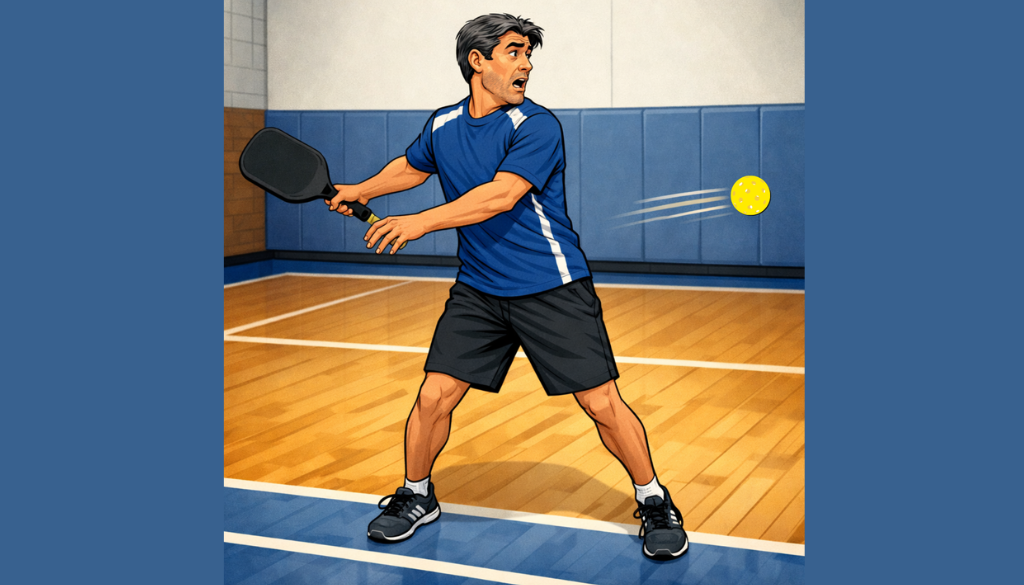



Most players try to “be more patient” by talking to themselves: calm down, stop rushing, wait for a better ball. But in real games, your feet usually decide before your brain does.
When your feet stop early, you reach and poke. When you creep too close to the net, every firm ball feels like an emergency. When you never reset your balance between shots, long rallies feel chaotic and out of control.
If you want more patience, start with your movement. Disciplined footwork buys you time, gives you cleaner contact, and makes long rallies feel manageable instead of frantic.
Why Patience Starts In Your Base
Watch the steadiest player at your park in a long rally. You will usually see the same things:
– Their head is stable, not bobbing.
– Their weight looks centered, not falling forward or back.
– Their steps are small and frequent, not big lunges.
Because their base is quiet and organized, the ball keeps arriving in a familiar spot. That comfort is what lets them choose a soft dink or reset instead of bailing out early with a big swing.
On the other hand, when your feet are late:
– You lean and reach instead of stepping.
– Your paddle drops, your shoulders twist, and your contact point moves all over the place.
– You feel “rushed,” even when the ball was very playable.
You do not need to move more. You need to move just enough, early enough, so each ball feels a little less urgent.
A Rally Stance That Keeps You Ready
Good footwork starts before your opponent even hits.
At the kitchen line, picture this as your default stance:
– Feet a bit wider than shoulder width.
– Knees softly bent, like you are about to sit back into a barstool.
– Weight on the balls of your feet, heels light.
– Paddle in front of your chest, not drifting off to one side.
From that stance you can:
– Slide left or right with one or two short shuffles.
– Take a small step back for a hard drive or lob.
– Step into a dink instead of leaning to reach it.
If you stand tall and flat-footed, every movement takes longer and your brain feels behind from the start of the rally.
Small Adjustment Steps Beat Big Reaches
A simple rule: if you feel your arm reaching, your feet stopped too soon.
Most unforced errors at the kitchen come from trying to “save” a ball at the last second. The fix is one more small adjustment step before contact.
On a typical ball:
– Read the direction as it crosses the net.
– Take one or two quick, short steps to line it up with your body.
– Then make a calm swing with your arm and paddle.
The same is true in the transition zone. Big, choppy strides lead to off-balance swings. Two or three shorter steps might feel slower, but they help you arrive set, which actually gives you more time to choose a soft, patient shot.
Sliding The Line Instead Of Leaning Over It
As rallies extend, many players slowly drift forward until their toes float over the kitchen line and their weight tips toward the net. From there, any firm ball feels like it is in your face.
Train yourself to:
– Keep your toes just behind the line.
– Move parallel to it instead of stepping toward the net.
– Shuffle sideways so your chest keeps facing the ball.
A good shuffle is light and short. Your feet do not cross unless you are chasing a lob. This keeps your shoulders square and your paddle out in front, which makes it much easier to stay patient in long dink exchanges.
Footwork For Resets Instead Of Panic
Nothing tests patience like being pushed off the line. Many players backpedal in big steps, feel off balance, and then try to hit a hero passing shot.
A better pattern when you are forced back:
– Retreat with short, quick steps, chest still facing the net.
– Plant your outside foot before contact instead of swinging while moving backward.
– Use that planted base to play a soft reset into the opponent’s kitchen, usually toward the middle.
– As soon as you finish the shot, start stepping forward again to reclaim the line.
Your feet are doing two important jobs: giving you enough balance to choose a soft reset instead of a wild swing, and getting you back into position quickly so you are not stuck in no man’s land.
How Better Footwork Calms Your Mind
When your movement is under control, your brain does not have to work as hard.
Quiet, disciplined footwork:
– Makes the ball arrive at a predictable distance from your body.
– Keeps your contact point more consistent from shot to shot.
– Buys you an extra beat to decide whether to reset, continue dinking, or attack.
Because you feel balanced, misses feel like ordinary mistakes instead of disasters. That makes it much easier to stay present, let go of the last error, and keep your shot selection steady late in games.
A Simple Footwork Drill: Kitchen Patience Box
You can build “patient feet” in a few minutes before or after play.
Setup
– Stand at your kitchen line.
– Imagine a rectangle on your side of the court: sideline to sideline, about three feet deep.
– A partner stands at their kitchen line with a basket of balls.
Phase 1: Movement Only
– Your partner points with their paddle to one of four spots in your box: front-left, front-right, back-left, back-right.
– Each time they point, you use two or three quick shuffle steps to get there, drop into your athletic stance as if you were about to hit, then shuffle back to center.
– Keep your chest facing the net and your steps small and light.
Do this for 30–45 seconds, then rest.
Phase 2: Add Soft Dinks
– Now your partner softly dinks balls into those same four zones.
– Use the same small shuffle steps to get behind the ball and send a calm dink back to their kitchen.
– Any time you catch yourself reaching with your arm, remind yourself to move your feet earlier on the next ball.
Run a couple of short rounds of this and then go play. You will notice that in real rallies, getting into position feels easier, your contact point feels more predictable, and patience shows up almost automatically—because your feet have already done the hard work.