

Train the patience to let the ball travel wide.
The Around the Post shot is one of the most satisfying winners in pickleball. It also has the highest mistake rate, because most players try to hit it before they have actually earned it. The ATP is a footwork decision before it is a swing decision. You either get to the ball wide enough that an ATP angle exists, or you reach early and pop a weak ball into the middle. This drill builds the patience.
Why this drill matters
Most rec players see a sharp cross-court angle coming and immediately stretch their paddle out. That instinct is the one thing that prevents the ATP from happening. Real ATPs require letting the ball travel so wide that a normal return is awkward, with enough time to step outside the sideline and arrive balanced. Reach early and you eliminate all of that.
Quick rules refresher
- The ball does not have to clear net height. It can travel below the net, around the outside of the post, and still land in for a clean shot.
- The ball must travel around the OUTSIDE of the post. A ball that passes between post and net, or under the net cord, is out.
- You can step beyond your own sideline or behind your baseline. There is no rule against being off court while the ball is in play.
- You cannot touch the net, post, or your opponent’s court while the ball is in play.
- Kitchen rules only apply to volleys. If the ball bounces, you can stand anywhere on your side.
How to set it up
- Use a full court.
- Player A (the feeder) stands at the kitchen on one side.
- Player B (the hunter) stands at the kitchen on the diagonal.
- The cross-court sideline closest to the feeder is the ATP lane for the round.
This drill is built around the bounced ATP. Volley ATPs are real but harder to time, and they are addressed in the ‘When the rules bend’ section.
The right ball: when to go
Quick definition: the ‘post line’ is the imaginary line extending out from the net post along the sideline toward the back fence. ‘Past the post line’ means the ball has crossed that line on its way out.
A green-light ATP ball usually shows three things at once.
- Width. The ball is heading past the post line at the point of contact.
- Trajectory. The ball is usually dropping, or at least flattening out, by the post area.
- Time. You have enough beats to step outside the post and arrive balanced.
Look at where your opponents are too. The best ATP angles aim at open court or at a body leaning the wrong way. If you cannot plant your feet and swing without a full dive, it is not your ATP. Play it as a regular cross-court dink.
Footwork that earns the ATP
- Drop step with the outside foot the moment you read the angle.
- Cross-step or shuffle wide. Keep your eyes on the ball the whole way.
- Step past the sideline if the ball calls for it.
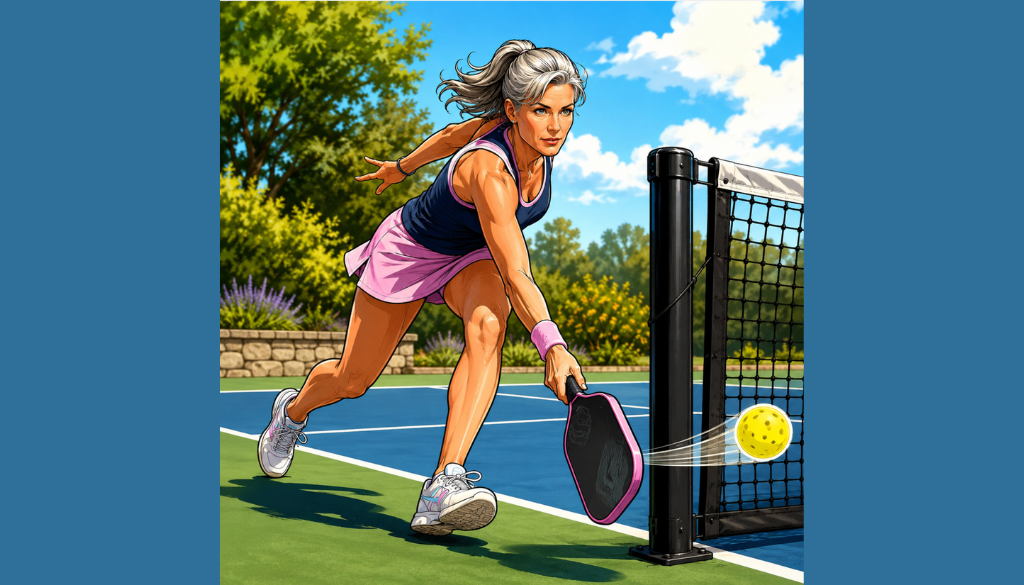
- Plant outside the post line, paddle low and out front.
- Contact the ball in front of your hip, not beside or behind.
Common mistakes
- Reaching early. Robs the angle and turns a winning shot into a losing one.
- Half-committing to the wide path. Stepping wide partway and then trying to hit it like a normal dink is the worst of both worlds.
- Trying to lift a low ball over the net when an ATP was available.
- Going for too much. ATPs do not have to be winners. A clean ATP that lands deep cross-court is usually unreturnable anyway.
- Forgetting recovery. After the ATP, you are way off the court.
Level variations
Beginner: Track and Touch
Feeder sends only ATP-able balls with predictable timing. Hunter focuses solely on footwork and tracking the ball wide. The win condition is reaching the ball outside the post in balance, not making the ATP. After 10 reps of clean tracking, add the swing.
Intermediate: Mix and Decide
Feeder mixes ATP-able and non-ATP-able cross-court angles. Hunter calls ‘ATP’ or ‘dink’ out loud before each contact, then executes. Aim for 80 percent read accuracy across 30 balls before adding speed. If you hit fewer than 5 of 10 attempts, the read is wrong, not the swing.
Advanced: Live Pressure
Feeder may also speed up at the body or hit a deeper push to punish a hunter who leans wide too early. Hunter mixes ATPs with regular cross-court dinks. Play live points after any successful ATP. Recovery rule: if the ATP comes back and you do not get a paddle on it, you lose 2 points.
When the rules bend
- ATP volleys are legal if the ball stays in the air, as long as kitchen rules are respected. Harder to time than off-the-bounce ATPs.
- Defensive ATPs from deep court are also legal. If you are pulled wide from the baseline and the ball passes the post line, you can ATP from there.
- Lefties on the right and righties on the left have a forehand reach for the most common ATPs. If you are on the harder side, expect to commit a little earlier with your feet.
- When you commit to a wide ATP path, your partner should slide toward the middle to cover the open court.
Why this drill belongs in your rotation
The ATP is not a hero shot. It is a patience shot. The players who hit the most ATPs are not the ones with the fastest hands. They are the ones who stop reaching, trust their feet, and let the ball come to them.
Train the patience. The shot will follow.