


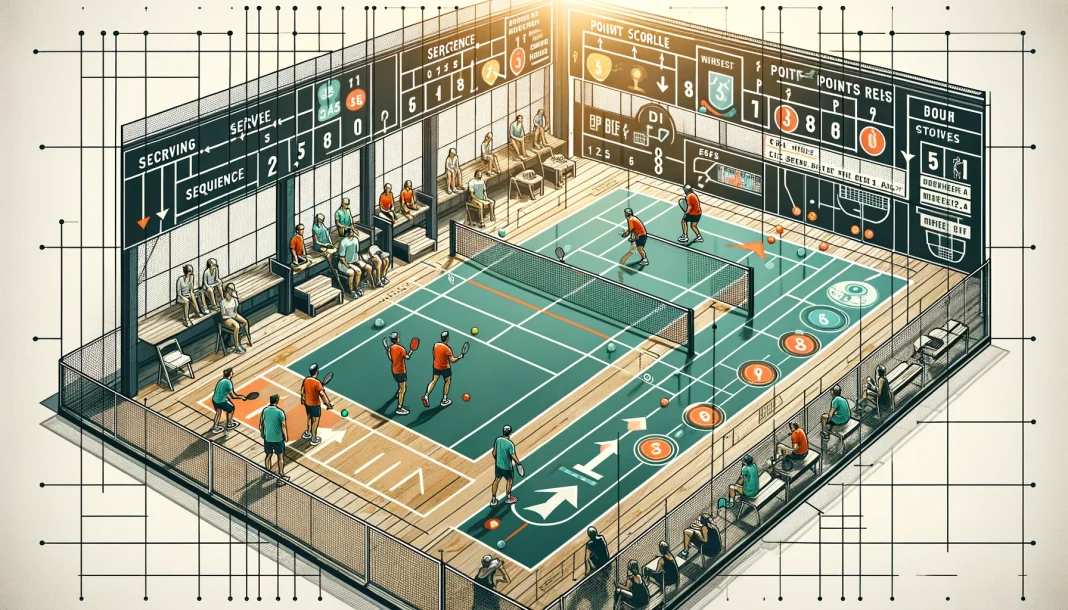
Understanding the scoring rules of Pickleball, is a crucial aspect of mastering the game. The scoring system, unique in its complexity, requires both the serving team and its players to adhere to certain conditions to be able to score. While the basics of scoring, such as the three-number score in doubles and two-number score in singles, are fundamental, advanced strategies like ‘stacking’ bring an added layer of intrigue. This discussion will provide a comprehensive look at Pickleball’s scoring rules, exploring their nuances to enhance one’s appreciation and performance of the game.
Basics of Pickleball Scoring
Understanding the basics of pickleball scoring is crucial for both novice and seasoned players, as a correct comprehension of the scoring rules can significantly influence the strategy and outcome of the game. It is important to note that in pickleball, only the serving team can score points, a rule that sets this sport apart from many others.
In doubles, the score is typically called out as three numbers, representing the serving team’s score, the receiving team’s score, and the server number, respectively. The server number is either one or two, reflecting the order of service within the team. For singles, the score call consists of just two numbers: the server’s score and the receiver’s score.
Player positioning is also a key element in doubles pickleball scoring. The team serving first in a game starts from the right-hand/even side of the court, serving crosscourt to the receiving team’s right-hand/even side. Thereafter, teams switch sides of the court each time they score a point. However, they must return to their designated positions at the end of each rally.
One advanced strategy known as ‘stacking’, allowing partners to stay on the same side of the court throughout the game. This strategy can be used to maintain an advantageous court position and potentially confuse opponents. Despite its complexity, understanding these basics of pickleball scoring is integral for players looking to advance their game and maximize their scoring potential.
Player Positioning in Doubles Pickleball
Building on the basic scoring rules, let’s now explore the importance of player positioning in doubles pickleball, a critical factor that significantly influences both the scoring and the overall strategy of the game. Proper positioning not only determines the server but also the receiving player in every point.
In doubles pickleball, players must adhere to specific positioning rules:
- The initial serve of the game is always made from the right-hand court. The server must direct the ball diagonally to the receiver in the opponent team’s right-hand court.
- Following a successful point, the server switches sides with their partner to serve from the left-hand court.
- If a fault occurs, the serve switches to the partner, if available, or a side-out occurs, passing the serve to the opposing team.
Understanding these positioning rules is vital for maintaining a correct serving sequence and avoiding faults, which can result in loss of serve or points for the opponent team. It also influences player strategy, as certain players may have stronger skills on specific sides of the court.
Player positioning also affects the stacking strategy, a common technique in doubles pickleball where players align themselves in a particular order to gain a positional advantage. Stacking can be an effective way to exploit player strengths, disrupt opponent rhythm, or protect a weaker player. However, it requires excellent communication and coordination between partners to avoid faults and maximize its benefits.
Scoring in Pickleball Doubles
In doubles pickleball, scoring is a crucial component that dictates the flow of the game and significantly influences strategic decisions. A comprehensive understanding of scoring mechanisms not only facilitates a fluent game but also encourages tactical gameplay.
In doubles, the scoring system is slightly complex with three numbers constituting the score; the serving team’s score, the receiving team’s score, and the server number. The game commences with the score of 0-0-2, indicating that server number 2 of the team that is starting the game is serving. Notably, only the serving team can score points, presenting a unique dynamic to the game.
The serving team maintains their serve until they commit a fault. Each team gets two opportunities to serve – one by each player – before the serve switches to the opposing team, a situation known as a side-out. The servers continue to alternate from right to left each time they score a point.
The score is announced before each serve, with the server’s score declared first. The game is played to 11 points, but a team must win by at least two points. Therefore, games often exceed the 11 point threshold.
In doubles pickleball, strategic positioning plays a pivotal role, often determining the scoring. Teams can use ‘stacking’, a strategy where players stand on the same side of the court throughout the game, allowing for a more favorable matchup against opponents. Understanding these nuances provides a competitive edge in doubles pickleball.
Scoring in Pickleball Singles
While the dynamics of scoring in doubles pickleball present their own unique challenges and strategies, it’s crucial to note that singles play introduces a different set of rules and considerations. Unlike doubles play, there is no second server in singles pickleball, reducing the score to two numbers – the server’s score first, then the receiver’s score.
The serving position in singles pickleball is dictated by the server’s score; if it’s even, the serve is made from the right service court; if it’s odd, the serve comes from the left. The player continues to serve until a fault is made, following which the service switches to the opponent.
Scoring in singles pickleball shares the characteristic with doubles that only the server can score. This rule, known as traditional scoring, implies that the receiver is essentially playing defense, trying to force a fault to gain the serve and the opportunity to score.
Here are some more important points about singles pickleball scoring:
- The game starts at 0-0, and the first player to reach 11 points with at least a two-point lead wins.
- The server must call out their score first, followed by their opponent’s score before serving.
- The serve must be made diagonally, landing in the service court on the opposite side.
Understanding these differences in scoring and serving rules can help players transition smoothly between doubles and singles pickleball, and employ effective strategies in each format of the game.
Conclusion
Mastering Pickleball scoring rules is essential to effectively play and enjoy the game. Understanding the basic scoring structure, the significance of player positioning, and scoring in both doubles and singles play is crucial. Additionally, advanced strategies such as ‘stacking’ can complement traditional rules to enhance gameplay. A thorough comprehension of these rules not only improves performance but also enriches the overall experience, making Pickleball an increasingly popular choice for sports enthusiasts.