


Watch a typical dink rally at the club level and you’ll notice something interesting.
Most players only have one speed.
Every dink looks the same.
Same pace. Same shape. Same intent.
The problem is that predictable dinks are easy to handle.
Your opponents get comfortable. They settle into a rhythm. They stop reacting and start anticipating.
Better players understand that a dink rally isn’t just about keeping the ball in play. It’s about creating discomfort, disrupting timing, and gradually building pressure.
One of the easiest ways to do that is by changing speeds.
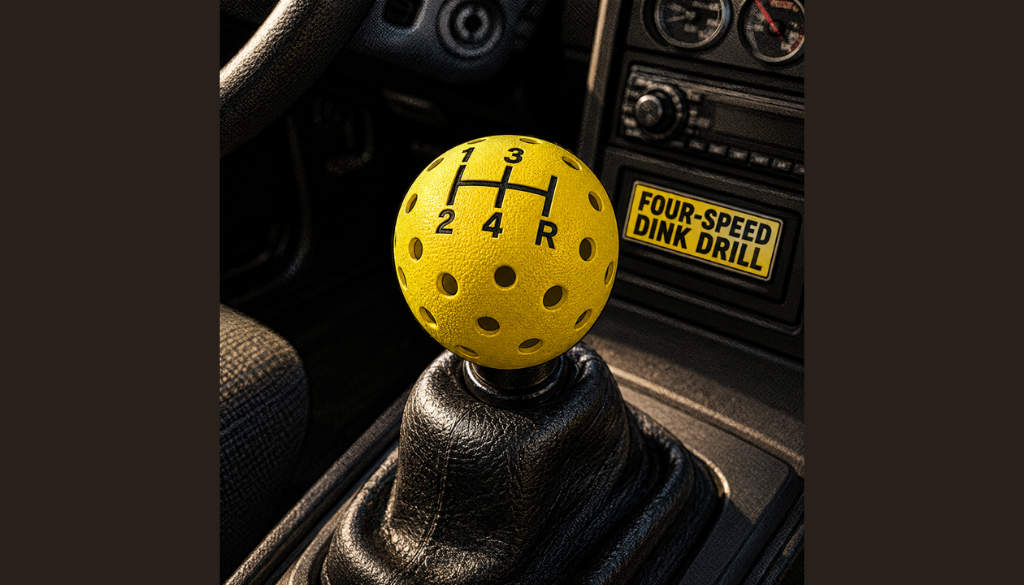
That’s what the Four-Speed Dink Drill is designed to teach.
Instead of hitting the same dink over and over, players learn to intentionally shift between four distinct gears: soft, medium, push, and attack.
The goal isn’t to hit harder.
The goal is to make your opponents uncomfortable.
Why This Drill Matters
Many players think of dinking as a single shot.
In reality, there are several different types of dinks, each with a different purpose.
A soft dink can slow down a rally and force opponents to generate their own pace.
A medium dink can maintain pressure while keeping a large margin for error.
A push dink can move opponents off their preferred contact point.
An attack dink can create a speed-up opportunity without actually speeding up the ball.
The best dinkers don’t use the same tool every time.
They change speeds, trajectories, and targets based on what they see.
The Four-Speed Dink Drill helps players develop that flexibility.
Setting Up the Drill
Two players start at the kitchen line.
Both players follow the same repeating pattern regardless of who hits which ball.
First ball: soft dink.
Second ball: medium dink.
Third ball: push dink.
Fourth ball: attack dink.
Then the sequence repeats.
Soft.
Medium.
Push.
Attack.
Continue cycling through the pattern without trying to win the rally.
The goal is to learn how each speed feels and how it affects your opponent.
Understanding the Four Speeds
Soft Dink
The soft dink is designed to reduce pace.
The ball should arc comfortably over the net and land softly in the kitchen, often closer to the net than your other dinks.
Think of this shot as a way to slow everything down.
Soft dinks often force opponents to generate their own pace, which can create mistakes.
Medium Dink
The medium dink is the neutral gear.
It is neither defensive nor aggressive.
This shot allows you to maintain control while keeping a comfortable margin over the net.
Many successful dink rallies are built on high-quality medium dinks.
Push Dink
The push dink is where pressure begins.
The goal is not power.
The goal is depth and penetration.
A good push dink travels deeper into the kitchen, gets into the opponent’s body, or forces them to contact the ball from an uncomfortable position.
This is often the shot that starts creating problems.
Attack Dink
The attack dink is not a speed-up.
That’s an important distinction.
An attack dink is still a dink.
It simply has a more aggressive purpose.
Instead of trying to end the point, you’re trying to create a more difficult next shot.
You might move the ball wider, push it toward the feet, or target the outside shoulder.
A simple rule is this: if your opponent is still contacting the ball below net height, you’re probably hitting an attack dink. If you’re driving the ball hard enough that they are defending at or above net height, you’ve likely moved into speed-up territory.
The objective is to create a weaker reply, not end the rally.
The Hidden Lesson
Most players believe pressure comes from hitting harder.
Often the opposite is true.
Pressure comes from making opponents uncomfortable.
Imagine facing four identical dinks in a row.
Now imagine facing:
A soft dink.
A medium dink.
A deeper push dink.
A more aggressive attack dink.
The second sequence forces constant adjustment.
Your feet must move differently.
Your contact point changes.
Your timing changes.
Different speeds become even more effective when paired with different targets. A soft dink that lands short and a push dink that gets into the hip may both be dinks, but they create very different problems.
That is what creates pressure.
The Four-Speed Dink Drill teaches players how to disrupt rhythm without taking unnecessary risks.
Common Mistakes
The most common mistake is confusing speed with power.
A push dink is not a mini drive.
An attack dink is not a speed-up.
Both shots should still maintain the characteristics of a dink rally.
The second mistake is changing only pace while ignoring placement.
Different speeds become much more effective when paired with different targets.
A push dink into the body feels different than a push dink toward the sideline.
The third mistake is abandoning patience.
Many players become excited once they reach the attack portion of the sequence and immediately try to end the point.
Remember that the attack dink is designed to create an advantage, not necessarily finish the rally.
The fourth mistake is making the differences too subtle.
If every dink looks the same, the drill loses its value.
The four speeds should feel noticeably different.
Beginner Variation
Start cooperatively.
Players announce the speed before each shot.
Soft.
Medium.
Push.
Attack.
The goal is simply to learn the feel of each gear and complete long sequences without errors.
Intermediate Variation
Remove the verbal calls.
Players must recognize the speed based on the incoming ball and continue the sequence naturally.
This creates greater focus and concentration.
Advanced Variation
After completing one full four-ball cycle, the rally becomes live.
Players can choose any speed they wish while attempting to create an advantage.
This teaches players how to apply the concepts from the drill in realistic dink exchanges.
Drill Session
Spend three minutes warming up with cooperative dinks.
Then complete ten full cycles of the four-speed sequence, for a total of forty balls, without errors.
Next, challenge yourselves to complete twenty consecutive shots while maintaining the proper progression of soft, medium, push, and attack.
Finish with ten minutes of the advanced variation, allowing rallies to become live after each completed cycle.
Final Thought
Most players spend years improving their dinks without ever learning to change gears.
As a result, every rally looks the same.
The Four-Speed Dink Drill teaches something different.
It teaches control.
It teaches variation.
Most importantly, it teaches how to create pressure without relying on power.
The next time you’re caught in a long dink rally, don’t ask yourself how to hit harder.
Ask yourself whether you’re giving your opponents the same ball over and over again.
Often, the player who controls the rhythm controls the rally.