

One of the biggest differences between newer and more experienced pickleball players has very little to do with how they swing the paddle.
It has to do with what they notice.
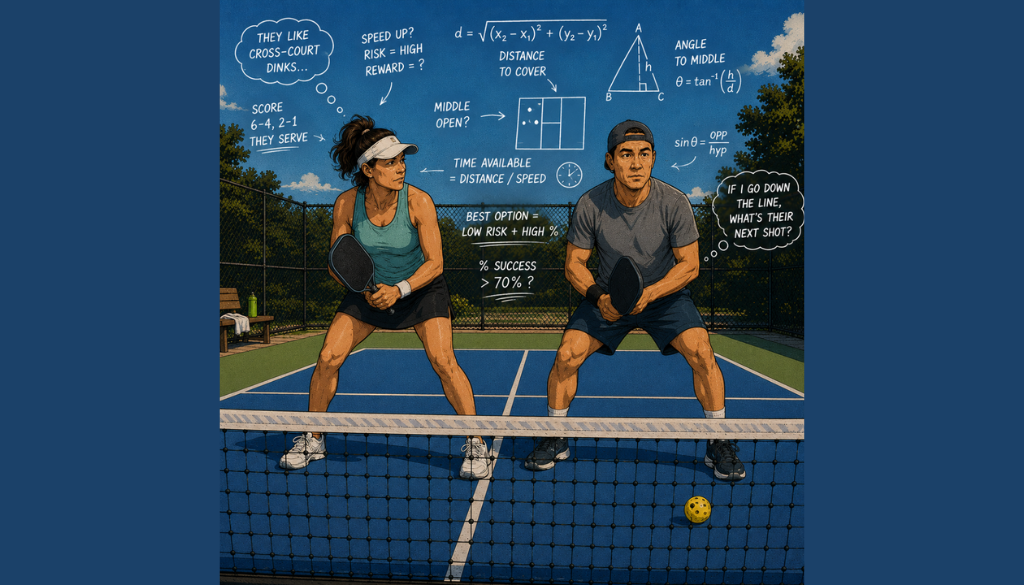
Some players see only the ball. They react to each shot as it comes, trying to hit the next one well. Others seem to know where the openings are before the ball even arrives. They notice a partner drifting too wide, an opponent leaning toward the middle, or someone creeping forward before a speed-up.
It can look like instinct.
Most of the time, it is awareness.
Court awareness is not about watching more things at once. It is about learning where your attention belongs at different moments during a rally. The best players are not constantly looking everywhere. They shift their focus as the rally unfolds, gathering information that helps them make better decisions on the next shot.
The good news is that court awareness is a skill you can practice.
1. Stop Watching Only the Ball
Many players spend an entire rally doing one thing: following the ball.
That sounds reasonable until you realize how much information they are missing.
The ball tells you where the rally is.
Your opponents tell you where the rally is going.
After you strike the ball, you already know roughly where it is headed. That gives you a brief opportunity to look beyond it. Instead of staring at your shot, notice what it is doing to your opponents.
- Did your drop force one player to contact below net height?
- Did your crosscourt dink pull someone several feet off the sideline?
- Did your drive jam a player near the body?
Those reactions often matter more than the exact path of your own shot.
Think of your vision as constantly switching between two jobs. Before contact, your eyes belong on the ball. After contact, they can briefly gather information from the players receiving it.
That rhythm, ball, players, ball again, is how awareness begins to improve.
2. Learn to See All Four Players
Many doubles players think almost entirely about the opponent directly in front of them.
Sometimes that is exactly where the next ball will go.
Sometimes it is not.
Every rally involves four players moving at once. While one opponent is playing the ball, the other is often adjusting their position. Your partner is moving, too.
Suppose your partner hits a wide crosscourt dink that pulls the opposing player off the court. Instead of watching only the ball, notice what the other opponent is doing.
- Are they sliding toward the middle?
- Are they leaving the sideline exposed?
- Have they stepped forward expecting a speed-up?
Those movements often create opportunities before anyone actually hits a winner.
The same awareness applies to your own partner.
If your partner has been forced wide, you may need to shade toward the middle before the next ball arrives. If they are balanced and covering their side well, you can remain in your normal position.
Court awareness is not just reading opponents.
It is constantly updating where everyone is.
3. Notice Patterns, Not Individual Shots
Many rallies follow predictable patterns.
The same opponent attacks almost every shoulder-high ball.
One player always speeds up crosscourt.
A team consistently leaves the middle open after a wide dink.
Those patterns become visible only if you stop treating every shot as a completely new event.
Early in a match, pay attention to habits.
- Does one opponent prefer backhand dinks?
- Who is more likely to poach?
- Which player avoids hitting overheads?
- Who gets impatient during long dink rallies?
Once you recognize those tendencies, your decisions become easier.
Instead of reacting to every ball as a surprise, you begin anticipating what is most likely to happen next.
That does not mean guessing.
It means recognizing probabilities.
Better court awareness often feels like improved anticipation because you are using information gathered over several rallies instead of relying only on your reaction speed.
The Mistake: Looking for Open Space Instead of Creating It
When players hear court awareness, they often think they should spend the rally searching for openings.
But many openings do not exist until someone creates them.
A player gets pulled wide.
A partner slides to help.
A middle lane opens.
A defender backs away from the kitchen after a difficult reset.
Those spaces appear because movement created them.
The best time to notice an opening is usually just after your previous shot has forced someone to move.
That is why awareness and shot selection work together.
Good shots create movement.
Movement creates information.
Information creates better decisions.
Drill: Call It Before It Happens
This drill trains awareness instead of shot execution.
Setup
Four players play a normal doubles game.
The rally is cooperative at first, then becomes live.
Rules
Before hitting each shot, the player must quietly identify one observation.
Examples include:
- Opponent reaching.
- Middle open.
- Partner wide.
- Both opponents back.
- Backhand coming.
The observation does not need to be spoken loudly. The purpose is to force players to notice something besides the ball before making their decision.
After several minutes, remove the verbal cue and continue playing while keeping the same habit internally.
Focus On
- Looking briefly at opponents after your own contact.
- Tracking all four players rather than just the ball.
- Recognizing repeated patterns instead of isolated shots.
- Letting what you see influence your next decision.
At first, this may feel awkward because your attention has always followed the ball.
Within a few sessions, many players notice they begin anticipating movement instead of simply reacting to it.
Final Thoughts
Court awareness is not something certain players are born with.
It is built one rally at a time.
The more information you collect, the slower the game begins to feel.
You start recognizing when your opponents are uncomfortable. You notice when your partner needs help covering the middle. You see openings developing before they fully appear.
The paddle still matters.
Your footwork still matters.
But better decisions usually begin with better awareness.
The next time you play doubles, give yourself one simple goal.
Do not just watch the ball.
Watch what the ball makes everyone else do.