

Watch enough pickleball and you’ll start to notice something surprising.
The hardest hitter on the court doesn’t always win.
In fact, some of the toughest opponents to play against aren’t particularly powerful at all. They don’t overwhelm you with drives. They don’t speed up every ball. They aren’t constantly looking for winners.
What they do is make every shot uncomfortable.
They hit to your feet. They find the middle. They move you just enough to create a problem. They seem to know exactly where the ball should go before the rally even begins.
Meanwhile, many players are doing the opposite.
They’re trying to hit better shots instead of smarter targets.
And that’s why smart targeting often beats power.
Most points at this level are lost because of discomfort, not speed
Think about the last few points you lost.
How many were true winners?
Not balls you touched but couldn’t control. Not balls that forced a pop-up. Not balls that stretched you out of position.
Actual winners.
For most players, the number is surprisingly small.
Most points at this level are lost because the ball creates discomfort, not because it’s the fastest shot on the court.
Maybe it jammed your body.
Maybe it forced a backhand from an awkward position.
Maybe it landed at your feet.
Maybe it pulled you wide and exposed the court.
The shot itself wasn’t overwhelming.
The target was.
That’s an important distinction.
Good target selection creates difficult contact. Difficult contact creates mistakes.
The power is often secondary.
The best target is usually the one that creates the next shot
One of the biggest differences between improving players and stronger players is how they think about targets.
Many players focus only on the shot they’re about to hit.
Stronger players think about what the target will create.
A dink pulled wide often opens the middle.
A deep return can produce a weaker third shot.
A ball hit at an opponent’s feet often creates an easier volley.
A shot through the middle can create hesitation between partners.
The target isn’t valuable because of where the ball lands.
The target is valuable because of what happens next.
That’s why some players seem to control rallies without hitting particularly hard.
They’re constantly creating situations that become easier for them and harder for their opponents.
At most levels, the middle remains one of the most underused targets in pickleball
Players love angles.
The problem is that angles often come with risk.
The middle comes with margin.
When a ball travels through the middle:
• The net is lower risk.
• The court is effectively larger.
• Communication becomes important.
• Both opponents must make a decision.
That last point matters.
Many points are won not because the shot was perfect but because uncertainty appeared for a split second.
Who’s taking it?
Should one player switch?
Is the forehand crossing over?
Those tiny hesitations create weak replies.
The middle won’t always produce a winner.
It produces something more valuable: confusion.
And confusion wins a surprising number of rallies.
Feet are often a better target than corners
Players spend countless hours trying to paint lines.
There’s nothing wrong with that. Painting lines has its place.
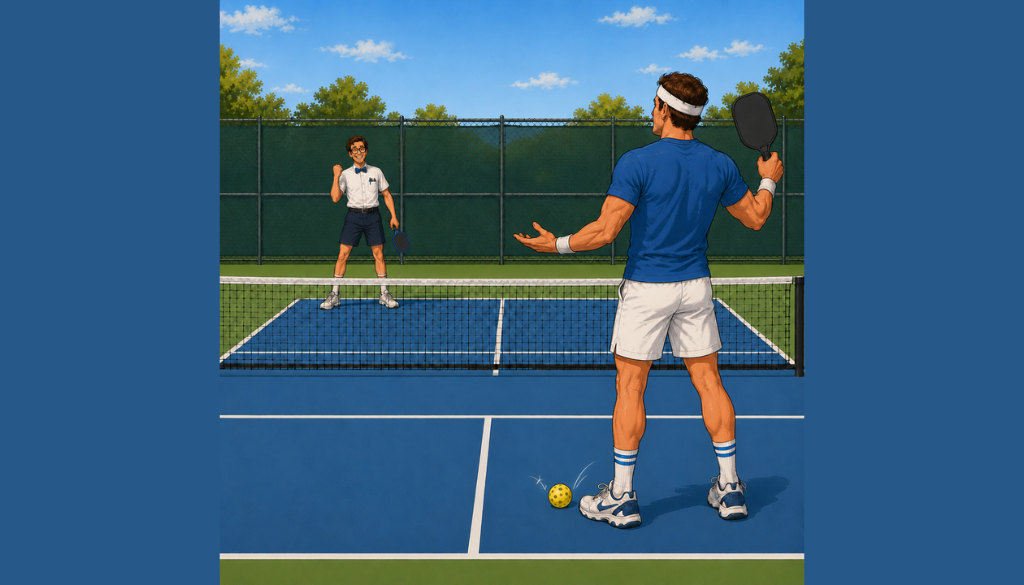
But for most rallies, aiming at feet does more work with less risk.
Why?
Because feet are difficult.
A ball at the feet takes away comfortable contact.
The paddle has to lift.
The player has to bend.
The options become limited.
Most importantly, attacking becomes difficult.
A shot that lands near an opponent’s feet may not look impressive, but it often produces exactly the response you want.
A weaker ball.
And weaker balls are where rallies begin to change.
Smart targets still need smart margins
One mistake players make after learning about targeting is becoming too precise.
They start aiming at shoelaces, sidelines, and tiny openings.
The idea is correct.
The execution becomes risky.
A great target that clips the tape doesn’t help you.
A perfect idea that lands three inches wide still loses the point.
The strongest players combine smart targets with safe margins.
They aim at feet, but they clear the net comfortably.
They play through the middle, but they leave room away from the sidelines.
They create difficult contact without requiring perfect execution.
Good targets create pressure.
Good margins make that pressure repeatable.
Smart targets become even more important under pressure
When players get nervous, they often become more aggressive.
They try sharper angles.
They swing harder.
They aim closer to lines.
Unfortunately, pressure is usually the worst time to make target selection more difficult.
Strong players often do the opposite.
They simplify.
They choose bigger targets.
They play through the middle.
They aim at feet.
They prioritize difficult contact over spectacular placement.
The result is that their game holds up when the score gets tight.
Good targets create margin.
Margin creates consistency.
Consistency wins a lot of close games.
A Drill to Improve Target Selection
This drill helps train intentional targeting instead of random placement.
Setup:
• Two players start at the kitchen line.
• Play a normal dink rally.
Rules:
• One player earns a point only by creating a difficult contact point.
• You score when your shot clearly forces a reach, movement, hesitation, or a difficult contact point near the feet.
• If your opponent resets comfortably without being pressured, no point is awarded.
The goal is not to hit winners.
The goal is to create uncomfortable contact.
Play to 7 points, then switch roles so both players spend time as the problem-creator.
Most players discover something quickly.
The shots that create the most problems are rarely the hardest-hit shots.
They’re usually the smartest targets.
Final Thoughts
Power will always have a place in pickleball.
A good drive can create pressure. A well-timed speed-up can end a rally.
But power is often overrated because it draws attention.
Targets are quieter.
They don’t always look impressive. They don’t always produce immediate winners. They don’t create highlight-reel moments.
What they do is create difficult decisions, awkward contact, and uncomfortable positions.
And that’s where many rallies are actually won.
The next time you’re tempted to hit harder, ask a different question:
Where is the most uncomfortable place my opponent could hit this ball from?
The answer to that question will often win more points than another ten miles per hour ever could.