

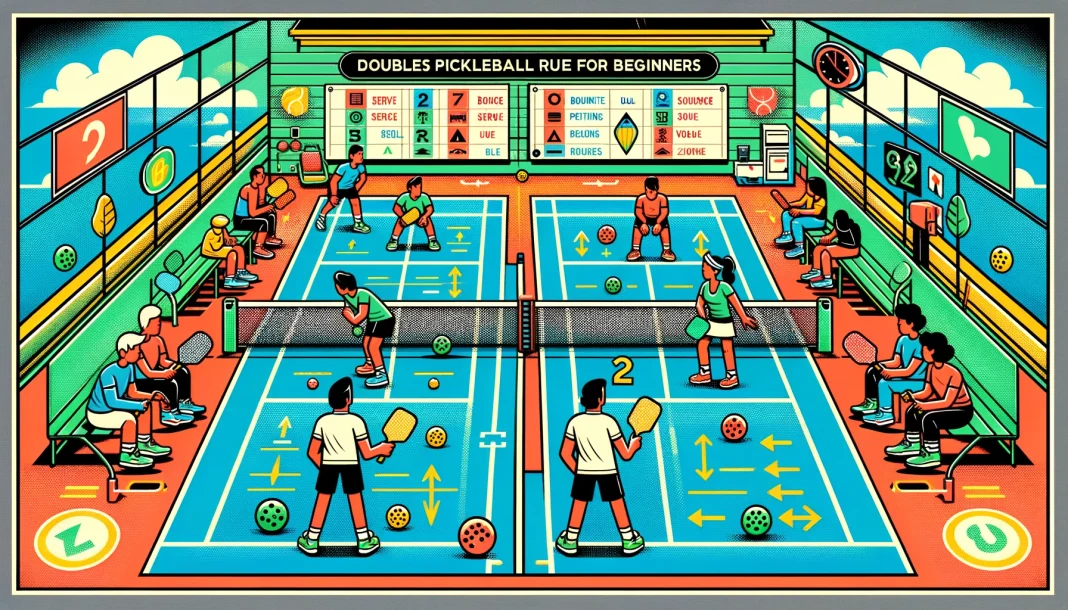
As a rapidly growing sport, doubles pickleball has garnered a substantial following due to its intriguing mix of tennis, table tennis, and badminton elements. For those new to the sport or interested in participating, understanding the specific rules and strategies of doubles pickleball is a crucial first step. This discussion will cover essential guidelines including pickleball serve rules, doubles scoring, volleys, the double bounce rule, line calls, and faults. While these may initially seem overwhelming, a clear comprehension of each rule will enhance the game experience and boost performance levels. This discussion aims to provide beginners with a comprehensive introduction to the game, encouraging further exploration of its nuances.
Pickleball serve rules (and determining the serving team)
In addition to the standard volley serve, pickleball also offers a drop serve. This form of service, while less common, can be a strategic variation under certain circumstances. Let’s take a closer look at the specific rules and techniques of performing a successful drop serve in pickleball.
Serving variation: drop serve
A rising trend in the game of pickleball is the use of the drop serve, a unique variation on the traditional volley serve where the player initiates the serve by dropping the ball on the ground and hitting it upon its bounce. This method is gaining popularity due to its versatility and simplicity, though it comes with its own set of rules to ensure fair play.
- The server can initiate the drop in one of two ways:
- By dropping the ball from one hand.
- By rolling the ball off the paddle face.
- The ball can bounce anywhere, given:
- The server’s feet remain behind the baseline.
- The ball is not forcefully thrown down or tossed into the air before hitting the ground.
Throughout the game, remember to maintain the spirit of good sportsmanship and fair play.
Doubles pickleball scoring
Understanding doubles pickleball scoring involves a unique three-number system, and is crucial for beginners looking to master this fast-paced game. This system, for example 0-2-1 or 6-3-2, comprises the serving team’s score, the receiving team’s score, and the server number.
In pickleball, only the serving team can score points; the receiving team cannot. If the serving team loses the rally, it results in the server’s loss of serve or side out. The server is either the first or second player of the serving team, denoted by the third number in the score.
At the game’s commencement, the player on the right side of the court, also known as the ‘even’ side, serves to the service court diagonally opposite from them, and must announce the score before serving. The game begins with a score of 0-0-2.
Scoring results in the server moving to the left side, the ‘odd’ side, and serving again to the diagonally opposite service court. The serving team members continue to switch places with each successful point until they fault and lose the serve. Conversely, the receiving team members do not change places.
Typically, when the first server of a team loses a rally, their partner gets to serve next. However, the game’s first serve is only done by server #2, hence the starting score of ‘0-0-2’. This rule is designed to minimize the advantage of the team who serves first and thus has the first opportunity to score.
Volleys
Understanding when to enter the non-volley zone in pickleball is crucial to mastering the game. The non-volley zone, or ‘kitchen’, is a space where volleys are not permitted, and certain restrictions apply to player movement. Let’s explore these rules and how they impact the strategy of the game.
When can you enter the non-volley zone?
Contrary to common misconceptions, players are permitted to enter the non-volley zone, often referred to as the ‘kitchen’, at any point during the game, provided they adhere to specific conditions. This rule, while seemingly simple, plays a significant role in the strategic depth of Pickleball.
- Players are disallowed to volley the ball when any part of their body is in the non-volley zone. This includes touching the kitchen line.
- However, a key exception exists: If the ball bounces in your non-volley zone, you are allowed to step in and hit it.
- This often results in a ‘dink’, a strategic shot that passes over the net and lands in your opponent’s non-volley zone.
Understanding these rules is crucial for mastering the game.
What is pickleball’s double bounce rule?
The Double Bounce Rule in pickleball is a fundamental regulation that stipulates the ball must bounce once on each side of the court before either team can commence with a volley. This rule is one of the core aspects of the game that distinguishes pickleball from other racquet sports, and understanding it is crucial for beginners looking to learn and enjoy the game.
When a game commences, the serving team initiates the play by hitting the ball into the opposing team’s court. The receiving team must allow the served ball to bounce once before returning it. This is the first bounce. Subsequently, the serving team must also let the returned ball bounce once on their side of the court before they can hit it back. This is the second bounce, thus completing the Double Bounce Rule.
Following these first two bounces, the players no longer have to wait for a bounce before returning the ball. They can choose to volley it directly out of the air, or let it bounce and then return it. However, it’s essential to remember that the Double Bounce Rule must be satisfied at the start of every point.
Understanding and applying the Double Bounce Rule can seem a bit tricky for beginners. However, with practice and focus, it soon becomes second nature. It is a strategic element of the game that prevents teams from aggressively volleying right from the serve, thus adding a layer of complexity and excitement to the sport of pickleball.
Line calls
While grasping the Double Bounce Rule is a significant aspect of mastering pickleball, another crucial element beginners must familiarize themselves with involves line calls. This is the process of determining whether a ball is ‘in’ or ‘out’. Understanding and abiding by these rules will ensure the smooth progress of the game.
USA Pickleball, the governing body of the sport, has clearly laid out rules for line calls. A shot in pickleball is deemed ‘in’ if it lands anywhere on the court, including the boundary lines. The only exception is the serve, which must completely clear the non-volley zone, often referred to as the ‘kitchen’.
A nested bullet point list of some line call rules include:
- Players should not call a shot ‘out’ unless:
- There is clearly visible space between the ball and a boundary line.
- The ball lands outside the boundary lines.
- In games without a referee or line judges:
- All line calls for their side of the court are made by the players.
- Either teammate in a doubles game can make line calls.
It’s important to note that sportsmanship and trust are integral to the culture of pickleball. Players are encouraged to trust the calls of their opponents. When in doubt, the benefit of the doubt should be given to the player who made the call. This spirit of fair play and respect for each other is what makes pickleball more than just a game and forms the basis of its growing popularity.
Faults
In the complex arena of pickleball, understanding the concept of ‘faults’ is pivotal for any beginner aiming to become proficient at the game. By definition, a fault is any action that stops play because of a rule violation. These infractions can occur on both the serving and receiving team and have differing outcomes.
Among the most common faults in doubles pickleball include instances where the serve does not clear the non-volley zone, otherwise known as the kitchen, including the line. Other frequent faults occur when a shot is hit out of bounds, landing behind the baseline or outside of the sidelines, or when a shot hits into the net. Less common faults include instances where the ball hits a player, the ball bounces twice before being hit, and serving faults including foot faults and violating serving rules.
In doubles pickleball, it is permissible for any player on each team to call faults, including foot and service faults. The rules of USA Pickleball also provide guidance for non-officiated games where disagreements about the non-volley zone and service foot faults on the opponent’s end of the court are present. Players are encouraged to replay the point in such instances. However, if a player believes their opponent has committed any other type of fault, they can mention it to the opposing team but cannot enforce it. Ultimately, the final decision on fault resolution belongs to the player that allegedly committed the fault. Understanding these rules will help newcomers navigate the game with confidence and proficiency.
Conclusion
In conclusion, mastering doubles pickleball involves understanding the game’s rules, such as serving, scoring, volleys, the double bounce rule, line calls, and faults. These basic guidelines ensure fair play and enhance the overall gameplay. A comprehensive grasp of these rules facilitates an enjoyable and competitive experience for all participants. Hence, beginners must invest time in learning and practicing these rules to improve their doubles pickleball skills.