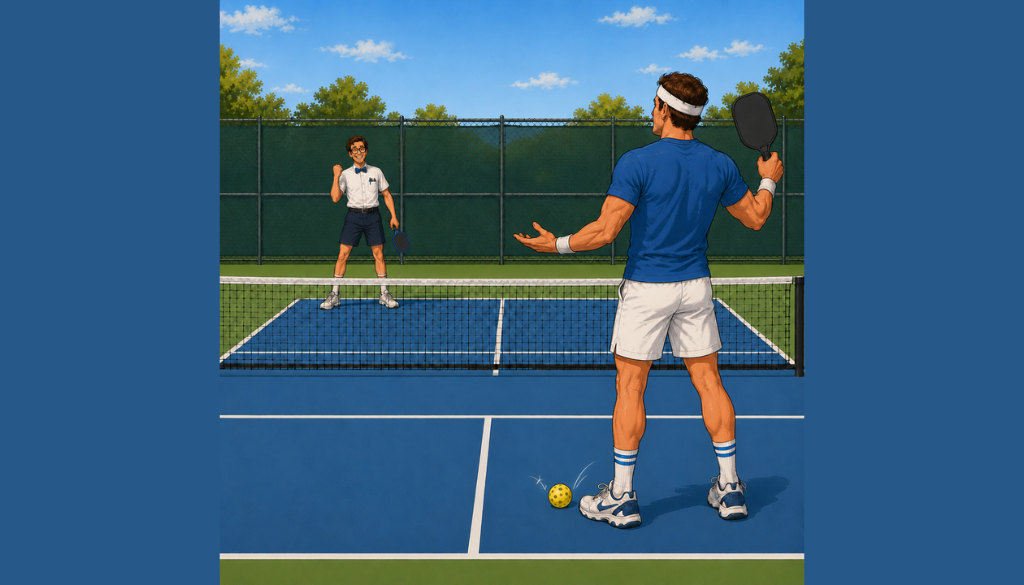


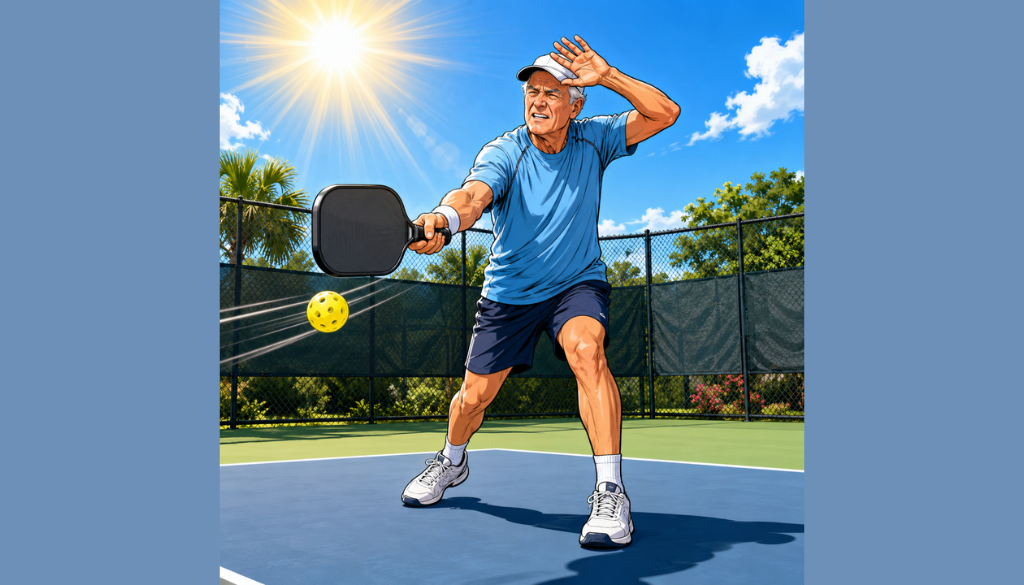
If you’ve ever shanked an easy overhead on a clear June morning and wondered what happened to your hands — it probably wasn’t your hands.
You were squinting.
And if you play outdoors in summer, that matters more than most players realize. The right sunglasses help from the outside.
But your eyes also need support from the inside — which is why The Fit Pickler readers can click here to try Advanced Vision Formula and unlock an exclusive discount automatically at checkout.
What squinting does to your visual field
Most players associate squinting with discomfort, not performance. But squinting is your eyes’ response to overload — too much incoming light, with the macula working too hard to process the scene.
When you squint on a bright outdoor court, your visual field narrows. The peripheral vision you use to track incoming shots — the ball coming low off your opponent’s backhand, your partner moving up to poach — gets cut off. You’re seeing less of the court, even if you don’t feel it.
It compounds across a session. By game two on a clear summer morning, your eyes have been working under that load for 45 to 60 minutes. Visual tracking — picking up the ball early enough to give your paddle time to respond — degrades before your legs do.
Why the outdoor court in June is harder on your eyes than it looks
Outdoor pickleball courts in full summer sun are surrounded by reflective surfaces: the court itself, adjacent concrete, other players’ paddles, the fence. The light load is dramatically higher than what you encounter under indoor fluorescent lighting — and every bright surface around you adds to it.
After 50, the lens of the eye begins to yellow slightly, which reduces its ability to filter UV and high-energy blue light. Your eye works harder to process the same scene. The result isn’t dramatic vision loss — it’s a subtle decline in tracking speed, contrast, and reaction time. The kind of thing that makes you say, “I just wasn’t seeing the ball today.”
Three adjustments that help
1. Switch to polarized lenses. Regular tinted sunglasses reduce brightness but not glare. Polarized lenses filter horizontal light specifically — the kind reflecting off court surfaces and concrete. Players who make the switch often say the ball pops more clearly against the sky and background.
2. Take real shade breaks between games. Five minutes out of direct sun lets your photoreceptors recover. Most players use that time to check their phone in full sun, which has the opposite effect.
3. Give your eyes the internal filters they need. Lutein and zeaxanthin — found in leafy greens and eggs — accumulate in the macula and act as natural filters for blue and UV light. Research on macular health consistently links higher concentrations of these nutrients to better contrast sensitivity and visual acuity under bright conditions.
When food alone doesn’t close the gap
Most people don’t eat enough leafy greens to maintain the lutein levels the research points to. One study found the average American gets about 2mg of lutein per day from food. Studies on macular pigment density have used doses of 10–20mg. That gap is hard to close through diet alone, especially in summer when you’re playing outdoors every week.
Advanced Vision Formula from Advanced Bionutritionals delivers lutein, zeaxanthin, and the additional antioxidants your macula uses to filter UV and high-energy blue light — at doses closer to what the research supports. For players spending long summer mornings on outdoor courts, it’s worth adding alongside the adjustments above.
Special for The Fit Pickler Readers: Click any link in this article and you unlock an exclusive discount for Advanced Vision Formula. Your savings are applied automatically at checkout. And you’re backed by a 90-day money-back guarantee — try it for 3 months, and if it’s not right for you, send it back for a full refund.