

Most players spend a lot of time working on return depth. That’s important, but depth is only half the equation.
If every return lands in the same general place, opponents quickly get comfortable. They know where the ball is going, they know how to move to it, and they can begin their third-shot sequence with confidence.
Better returners understand that the return is more than a safe way to start the point. It’s a chance to create the first problem of the rally.
That’s where the Three-Lane Return Drill comes in.
This drill teaches players to place returns intentionally into different areas of the court while still keeping the ball deep. Over time, it builds a return game that is harder to predict, harder to attack, and much more effective at creating weak third shots.
Why This Drill Matters
Many players have one return.
They hit it deep and somewhere near the center of the court.
There’s nothing wrong with that. In fact, a deep middle return is often a smart play. The problem comes when it is the only return you trust.
The best returners can vary location while still maintaining depth.
Sometimes they send the return toward the server’s backhand. Sometimes they drive it through the middle seam. Sometimes they pull a player wide and force a difficult third shot from near the sideline.
The goal is not to hit fancy returns. The goal is to make the serving team uncomfortable before they ever hit their third shot.
The Three-Lane Return Drill develops that control.
Setting Up the Drill
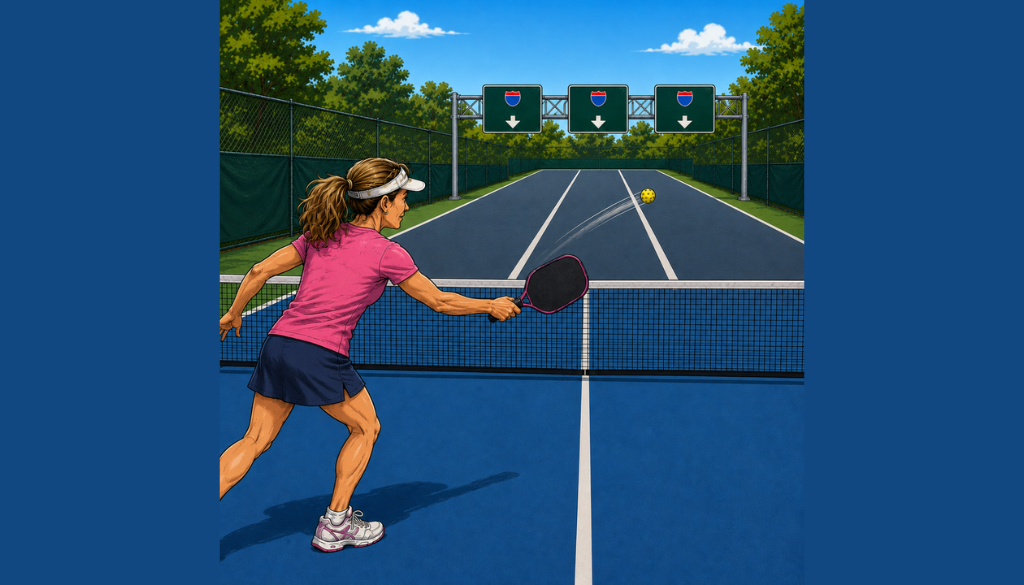
Divide the opponent’s court into three vertical lanes.
The left lane runs from the sideline to roughly one-third of the court.
The middle lane covers the center third.
The right lane covers the opposite third.
You do not need tape or cones. Use the court lines as visual references and think of each lane as a big chunk of court, not a narrow stripe.
One player serves while the other returns.
The returner must successfully place returns into each lane before moving on to the next round.
A successful return must land in the designated lane, land beyond the service line, and stay in play.
Once the player completes all three lanes, start over. Switch roles after a set number of rounds.
What to Focus On
The biggest mistake players make in this drill is aiming too precisely.
You are not trying to hit a six-inch target. You are trying to send the ball into this third of the court while keeping enough depth to prevent an easy third shot.
Think “big lane,” not “perfect spot.”
Depth still comes first. A deep return that misses the intended lane by a few feet is usually better than a short return that lands exactly where you aimed.
If you have to choose, choose depth over direction.
As you become more comfortable, pay attention to how your body position affects placement. Returns sent through the middle often require very little adjustment. Returns aimed closer to the sidelines usually require more careful paddle control, better spacing, and a cleaner contact point.
The purpose of the drill is to build directional control without giving up the most important part of the return: making the serving team hit their third shot from farther back.
The Hidden Lesson
This drill teaches more than placement.
It teaches observation.
As you begin placing returns into different lanes, you’ll notice that each location creates a different problem.
A return through the middle may create hesitation between partners.
A return toward a weaker backhand may produce a softer third shot.
A return near the sideline may pull a player off the court and make their next shot more difficult.
But wide returns should be used with some judgment. Against weaker third-shot players, pulling them wide can create trouble. Against stronger teams, a wide return may also give them more angle to work with.
That is why this drill is not about blindly rotating lanes in a match. It is about learning what each lane does.
As you practice, start noticing which lane bothers which opponent. Does one player struggle when stretched wide? Does one player dislike hitting thirds from the backhand corner? Does a stacked team leave an awkward return target during movement?
The drill gives you the control. The match tells you when to use it.
Common Mistakes
The most common mistake is sacrificing depth in pursuit of direction.
A shallow return placed perfectly in the correct lane is still a poor return.
The second mistake is aiming too close to the sideline. Many players become obsessed with painting lines and end up missing returns they do not need to miss.
Use the full lane. A return does not have to land on the outside edge to be effective.
The third mistake is hitting every return with the same pace and height. Some returns work best with more arc and margin. Others can be driven a little flatter. The lane may be the same, but the shape of the return can change depending on the serve and your balance.
The fourth mistake is forgetting to move forward after the return. Placement matters, but the returner still needs to use that shot to get to the kitchen.
Beginner Variation
Allow the returner to complete the lanes in any order.
The objective is simply to learn directional control.
Complete three successful returns in each lane before switching roles. Do not worry about sequence yet. Focus on sending the ball into a large target area while keeping it deep.
Intermediate Variation
The returner must hit the lanes in sequence.
Go left, middle, right.
If the return misses the designated lane or lands short, the sequence starts over.
This adds pressure without turning the drill into a full game. It also forces players to adjust from one target to the next instead of falling into the habit of hitting the same return repeatedly.
Advanced Variation
Add a live third shot.
The server serves. The returner hits to the designated lane. The server then plays the third shot, and the rally stops after that shot.
This lets both players see how return location affects the quality of the third shot.
After several rounds, patterns will become clear. Some lanes will create easy thirds. Others will create rushed drops, weaker drives, or hesitation between partners.
That is the point of the drill.
You are not just practicing where to return. You are learning what your return causes.
Drill Session
Start with five minutes of relaxed returns into each lane.
Then complete three successful returns to the left lane, three to the middle lane, and three to the right lane.
Next, move into the sequence round: left, middle, right. Complete the sequence five times.
Then add the live third-shot version for ten minutes. The returner chooses the lane, hits the return, moves forward, and watches what kind of third shot comes back.
Finish with a short practice game where the returner quietly chooses a lane before each point and tries to execute it with depth.
Final Thought
Most players think about return depth. Fewer think about return location.
The Three-Lane Return Drill teaches both.
The goal is not to hit perfect sideline returns or trick your opponents with dramatic changes. The goal is to become less predictable while still making the serving team play from a difficult position.
A deep return gives you time.
A well-placed deep return gives your opponents a problem.
That is the return you want to build.