

It doesn’t happen all at once.
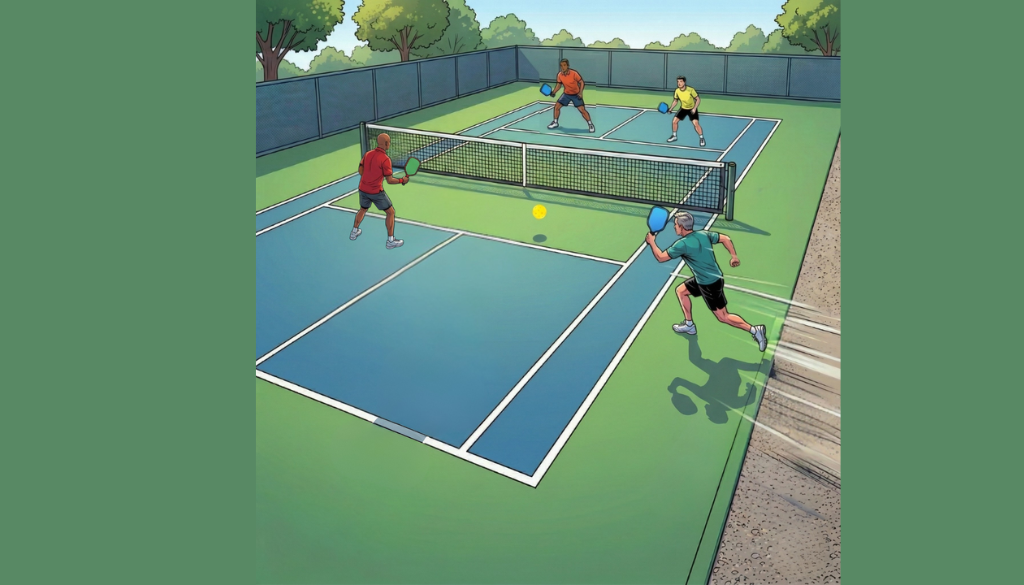
You’re in a crosscourt dink exchange, feeling in control, seeing the ball cleanly… and then suddenly you’re outside the sideline, reaching and off-balance, with no good option left.
Most players think they lost the point on that last shot.
They didn’t.
They lost it a few balls earlier—when they gave away their positioning.
What’s actually going wrong
Getting pulled too wide isn’t about foot speed.
It’s about how you manage space in doubles.
In a crosscourt dink rally, the angle is working against you. Each ball can pull you a little farther off the court if you follow it without recovering. And in doubles, “center” doesn’t mean the literal middle of the court—it means staying aligned with your half and the gap you’re responsible for, alongside your partner.
If you keep drifting outward and never reclaim that space, you’re slowly stepping out of the point.
Once you’re outside the sideline:
- Your angles disappear
- Your balance goes
- The middle opens up behind you
That’s when the rally flips.
The habit that causes it
Most players drift instead of recover.
They hit, watch, and stay where they landed.
Then they react to the next ball… which pulls them even wider.
It becomes reactive instead of controlled.
Stronger players treat every dink as a sequence:
hit → recover → be ready again.
Not hit → hope.
The shift: dink, then reclaim your lane
After every crosscourt dink, there should be a small recovery step back toward your proper position in the doubles formation.
Not all the way to the middle of the court.
Just enough to stay aligned with your partner and protect your share of space.
Think of it like this:
- Your shot goes crosscourt
- Your body shifts slightly back inward to your lane
- You’re ready for both the next dink and a speed-up
If you stay where you hit, you’re giving up ground.
If you recover, you’re holding it.
What your partner should be doing
This is not a solo job.
When you get pulled wide, your partner should pinch toward the middle—not drift with you.
That closes the biggest gap and protects against speed-ups or counters through the center.
Your job when stretched is to stabilize the rally.
Your partner’s job is to protect the space you just left.
When both happen, the court stays balanced.
The footwork that makes this work
Recovery doesn’t happen by thinking about it—it happens through how you move.
When you’re pulled wide:
- Load on your outside leg
- Contact the ball from that base
- Use that same leg to push yourself back toward your lane
It’s subtle, but it’s the difference between staying out wide… and returning to neutral.
Also, be aware of your boundaries. Stay just inside the sideline and under control at the kitchen line. Once your momentum carries you outside the court, your options shrink fast.
Paddle position matters more than you think
When players get stretched, the paddle usually drops with them.
Now they’re reaching, scooping, and hoping.
Instead:
- Keep your paddle in front of your body, around chest height
- Use a compact motion, not a reach
- Keep a slightly open face—but controlled, not floppy
“Slightly open” doesn’t mean lifting the ball.
It means guiding it with enough shape to clear the net while still keeping it low.
Your paddle should feel stable, not reactive.
Stop trying to win from a bad position
When you’re pulled wide and off-balance, that’s not the moment to force something.
That doesn’t mean you can never attack from the sideline.
It means you don’t attack when you’re stretched, leaning, or late.
From that position, your job is to neutralize:
- A soft crosscourt dink
- A controlled ball toward the middle
- Anything that resets the rally and buys you time
Trying to go sharper or faster from a weak position usually ends the point in your opponent’s favor.
Use the middle—but use it correctly
The middle is your best escape when the rally starts tilting against you.
It:
- Reduces angles
- Gives you more margin
- Lets you recover your positioning
But there’s a guardrail.
That ball has to stay low.
A soft, controlled ball that dips below net height is a reset.
A floating ball through the middle is an invitation to get attacked.
Use the middle early when you feel yourself getting stretched—not just when you’re already in trouble.
The feel you’re looking for
In a good crosscourt dink rally, you’re not getting dragged outside the court.
You’re operating inside a lane.
You move, but you recover.
You reach, but you stay balanced.
And after every shot, you’re still in position for the next one.
That’s the difference between defending space…
…and slowly giving it away.