

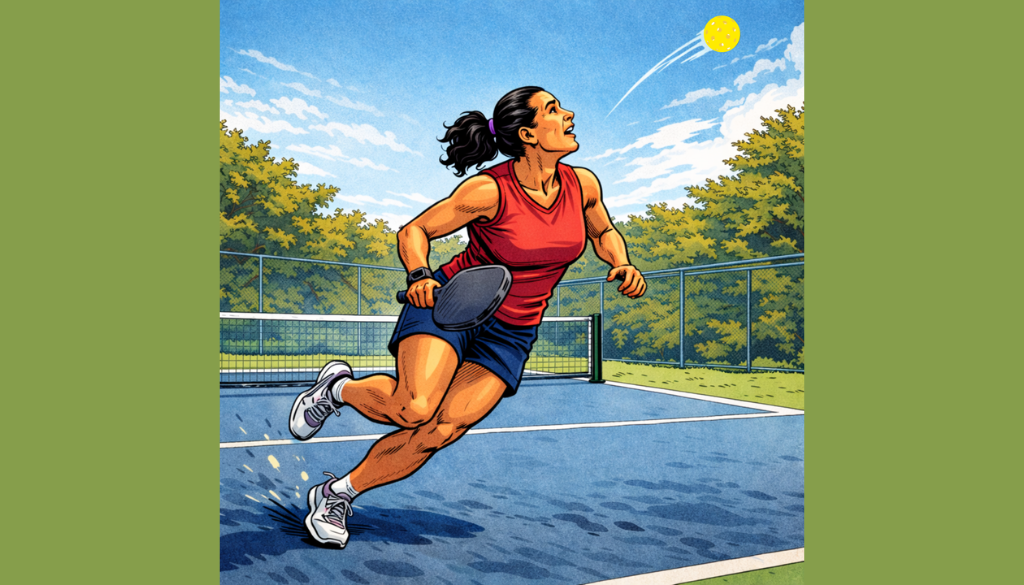
This is about defending lobs.
Not blocking smash shots at the kitchen. Not hand battles off a pop-up. This drill is specifically for the moment when you are at or near the kitchen line, the ball goes up over your head, and you have to turn, run, and survive the scramble.
That’s a different skill.
Most points after a lob are not lost because the smash was unstoppable. They’re lost because of what happened before the smash — the backpedal, the panic swing, the no-call between partners, or the weak return that never resets the rally.
This drill trains that sequence on purpose.
Why lob defense matters
Overheads don’t have to lose points. Poor movement does.
At the recreational level, players:
• Backpedal instead of turning
• Swing while drifting backward
• Try to counter-smash from a bad position
• Forget to communicate
• Never fully recover to neutral
Lob defense is a system:
Turn.
Create space.
Return with height.
Recover together.
This drill builds that system for doubles.
The setup (clear roles and pattern)
This is a doubles drill.
Offensive side
One player stands at the kitchen line on the same half as the primary defender. This player is the feeder. Their job is to initiate the lob and apply realistic pressure.
Defensive side
Two players start opposite. One begins at or just behind the kitchen line (this is the player who will be lobbed). Their partner starts mid-court or near the baseline.
The pattern
• Feeder dinks or soft-feeds to the defender at the kitchen.
• Feeder then throws a controlled lob over that defender into the deep court.
• Defender must turn and chase.
• Defender returns the ball with either a high, deep defensive lob or a soft reset.
• Optional: after the return, play live for 1–3 balls.
The feeder should send realistic, reachable lobs — not moonballs you can’t touch and not impossible lasers. As skill improves, the feeder may close forward after the lob to simulate real pressure.
Phase 1: The non-negotiable footwork
No backpedaling.
As soon as you recognize the lob:
• Turn your shoulders sideways immediately.
• Drop step with the outside foot.
• Run to create space behind the ball.
• Do not contact the ball while drifting backward.
If you cannot turn and run safely, let the ball bounce and play it after the bounce. That is not failure. That is controlled defense.
Success here looks like this:
• You are fully turned before sprinting.
• You arrive balanced behind the ball.
• You are not reaching or falling at contact.
This is performance and safety.
Phase 2: The right defensive choice
Your return depends on balance.
Balanced and set
Send a high, deep defensive lob cross-court. The ball should clear your opponent by at least a paddle length and land within 3–5 feet of the baseline.
Late or off-balance
Send a soft cross-court reset that clears the net with margin and bounces in the kitchen — ideally closer to the NVZ line than the net.
If you let the ball bounce first, the rule is the same. From a stable base behind the bounce, your job is still height and margin. Letting it bounce is a smart defensive choice.
What you do not do:
• Try to counter-smash from a poor base
• Aim low to “keep it down”
• Force pace when height will buy time
Height is not passive. Height resets the rally.
Phase 3: Communication and recovery
Lob defense is a team skill.
As soon as the lob goes up:
• Clear early call: “Mine” or “You.”
• If the stronger overhead player is switching sides, call “Switch” immediately.
After the defensive return:
• If one player is still deep, the other may hold mid-court temporarily.
• As soon as possible, both players work back to side-by-side at the kitchen.
The scramble should end in organization, not chaos.
Common mistakes this drill exposes
• Backpedaling instead of turning
• Swinging while drifting backward
• Counter-attacking from defense
• Defensive lobs that land short
• Resets that float high near the net
• Camping at the kitchen and ignoring the lob threat
Progressions
Beginner
Feeder sends predictable lobs to the same corner.
Defender focuses only on turning, running, and sending back a high, deep ball.
No live play after the return.
Success goal: 5 quality deep defensive lobs in a row without backpedaling.
Intermediate
Feeder varies depth and direction slightly.
If the return is short, offensive player may hit a second overhead.
Count consecutive quality returns.
Success goal: 5 straight defensive balls where each either lands within 5 feet of the baseline or bounces safely in the kitchen with margin. Any short sitter resets the count.
Advanced
After the defender’s return, play the point live for up to 5 balls.
Offensive player may close and attack any weak ball.
Work both deuce and ad sides, forehand and backhand chases.
Run 3-minute rounds and rotate roles.
Why this drill belongs in your rotation
Lobs are not going away.
If you fear being lobbed, you rush the kitchen or drift too far back. Both hurt your positioning. When you trust your ability to turn, chase, and reset safely, you play freer at the line.
This drill is not about defending a smash at the kitchen. That’s a separate skill.
This is about defending the lob, surviving the chase, and calmly rebuilding the point from neutral.
And that changes how confidently you play every rally.