


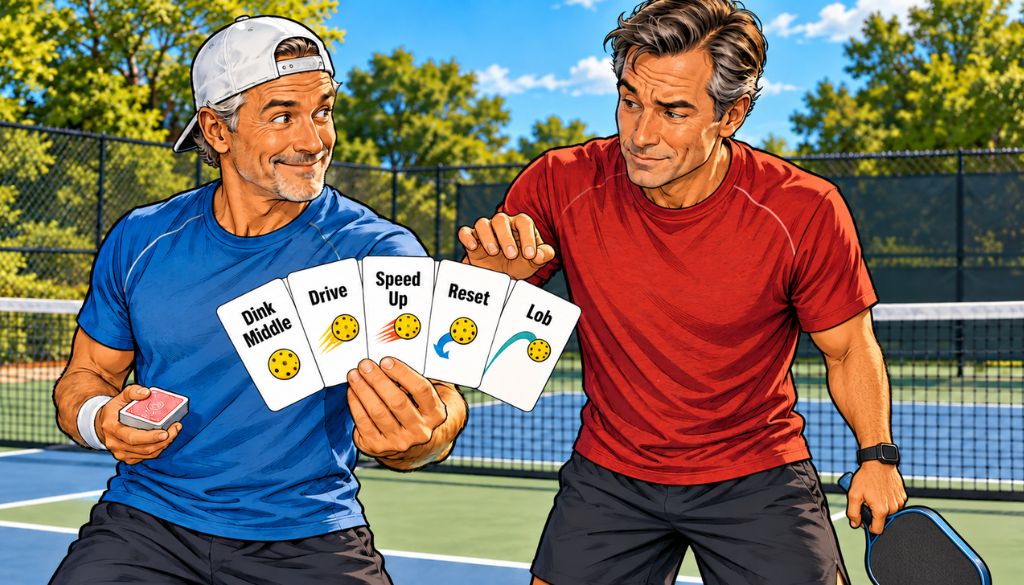
Better pickleball players usually know which shots are available to them. They can drop, drive, reset, dink, roll, speed up, lob, and counter. Having all those options is an advantage, but it can also create a different problem: choosing the right shot at the wrong time.
Shot selection mistakes become less obvious as players improve. The problem is rarely attempting a shot they cannot hit. More often, it is choosing a perfectly reasonable shot that does not fit the ball, the court position, or what is happening in the rally.
That distinction matters. Improving shot selection is not about becoming more conservative. It is about recognizing which option gives you the best chance to improve your position or create a better next ball.
Attacking a Ball Because You Can
As players develop better hands and more confidence, they discover they can attack balls they once would have dinked. That does not mean all of those balls should be attacked.
A ball slightly below net height may still be rollable. A dink sitting a little farther from the body may still be reachable for a speedup. The question is not whether the shot can be executed. The better question is what is likely to happen afterward.
If the attack leaves the ball rising into an opponent’s comfortable counter zone, the player may have turned a neutral rally into an advantage for the other team. Against opponents with good hands, a marginal speedup can be much more dangerous than simply continuing the dink rally.
Good shot selection takes the likely response into account. The first attack matters, but so does the ball that comes back.
Choosing the Harder Shot When the Simple One Works
Players with more shots sometimes overlook the easiest solution.
A difficult crosscourt angle may be available, but a ball through the middle would create almost the same pressure with much more margin. A sharp passing shot may look tempting from the transition zone, while a controlled reset would give the team a better chance to reach the kitchen. A big drive may be possible from the baseline even though a routine drop would solve the problem more cleanly.
The more options a player develops, the more important it becomes to distinguish between a shot being available and a shot being necessary.
Simple does not mean passive. A high-percentage ball to the feet or middle can create more trouble than a technically impressive shot aimed near a sideline. If two shots can accomplish the same job, the one with more margin is often the better choice.
Using the Right Shot From the Wrong Court Position
A shot that works beautifully from one part of the court can become a poor choice from another.
Consider a speedup. From the kitchen line, a player who receives a high dink may be able to attack while balanced and immediately prepare for the counter. From several feet behind the kitchen, that same attack gives the opponents more time to react and leaves the hitter with more court to defend.
The same applies to resets, drives, and aggressive angles. Court position changes the amount of time available, the height of the net relative to the contact point, and how quickly a player can recover after the shot.
Before choosing the shot, notice where you are. A player stretched wide, moving backward, or caught in the transition zone may need a different answer than a player who is balanced at the kitchen.
Good shot selection starts with the position you actually have, not the position you wish you had.
Forgetting About the Partner
In doubles, the best shot for one player is not always the best shot for the team.
A sudden speedup may feel like a great opportunity, but the partner may still be recovering from the previous ball. A sharp angle can pull an opponent off the court, but it can also create an equally sharp angle coming back. A poach may put pressure on the opponents while leaving a large opening if the ball is returned.
Before changing the pace or direction of the rally, players should have some awareness of what their partner is prepared to handle next.
This becomes particularly important when one partner is still moving forward. Starting a fast exchange while a partner is several feet behind the kitchen can expose the gap between the two players. One more reset or neutral ball may give the team time to establish a much stronger position before attacking.
The shot may be good individually and still be wrong for the team at that moment.
Becoming Predictable With Your Best Shot
A reliable favorite shot is valuable. It also becomes less effective when opponents know it is coming.
A player with an excellent third-shot drive may begin driving every return, including balls that make the shot difficult. Someone with a strong crosscourt dink may keep returning to it even after opponents have adjusted their positioning. A good speedup target can lose much of its effectiveness when it is used repeatedly.
The solution is not constant variation. Changing shots simply to be unpredictable can create its own mistakes. The better approach is to notice when opponents have begun anticipating the pattern.
If they are leaning toward the favorite target, another part of the court has probably become available. If they are sitting on the drive, a drop may become easier. If they are protecting against a speedup, the dink rally may become more comfortable.
A strong shot becomes even more useful when opponents cannot assume they will see it every time.
The Mistake: Judging the Decision by the Result
One of the hardest parts of improving shot selection is separating a good decision from a good outcome.
A poor speedup can clip the net and fall for a winner. A low-percentage sideline shot can land perfectly. A smart reset can be followed by an excellent attack from the opponent.
The result does not necessarily tell you whether the decision was good.
Instead, evaluate the situation before the shot. Were you balanced? Was the ball attackable? Did you have reasonable margin? Was your partner ready? Did the shot fit what the opponents were giving you?
Good decisions sometimes lose points. Poor decisions sometimes win them. Over enough rallies, better choices produce better results.
Drill: Two Choices Before Contact
Play normal doubles points, but after each rally, choose one or two shots that changed the direction of the point. The player who hit the shot identifies another reasonable option that was available.
For example, a player who drove the third shot might identify a drop as the alternative. Someone who sped up a dink might identify the safer target they could have used instead. A player who attempted a difficult angle might compare it with a ball through the middle.
The goal is not to decide that the alternative was always better. Compare the two choices based on court position, ball height, balance, opponent positioning, and what the partner was doing.
As the drill continues, players begin noticing those choices before contact rather than after the rally has ended. That is the skill being trained.
Final Thoughts
Smart players still make shot selection mistakes because having more skill creates more choices.
The next step is learning when those choices actually improve the rally. A shot should fit the ball, the player’s position, the partner’s position, and the response it is likely to create.
Sometimes that will mean attacking. Sometimes it will mean taking the difficult angle or changing direction. Other times, the smartest shot on the court will be the simplest one available.
Knowing how to hit more shots expands your game. Knowing which one belongs in the rally is what makes those shots useful.
