


Most players don’t lose points because they can’t attack.
They lose because they attack the wrong ball.
Speeding up isn’t the problem. Timing is. And more specifically, whether the ball actually earns an attack.
This game teaches that difference.
Why this matters
In a lot of rallies, the first player to speed up loses.
Not because attacking is wrong, but because the ball wasn’t right. It was too low, too wide, or taken while off balance. Instead of creating pressure, the attack hands control to the other team.
The advantage belongs to the player who initiates from a strong position.
This drill makes that visible quickly.
The setup
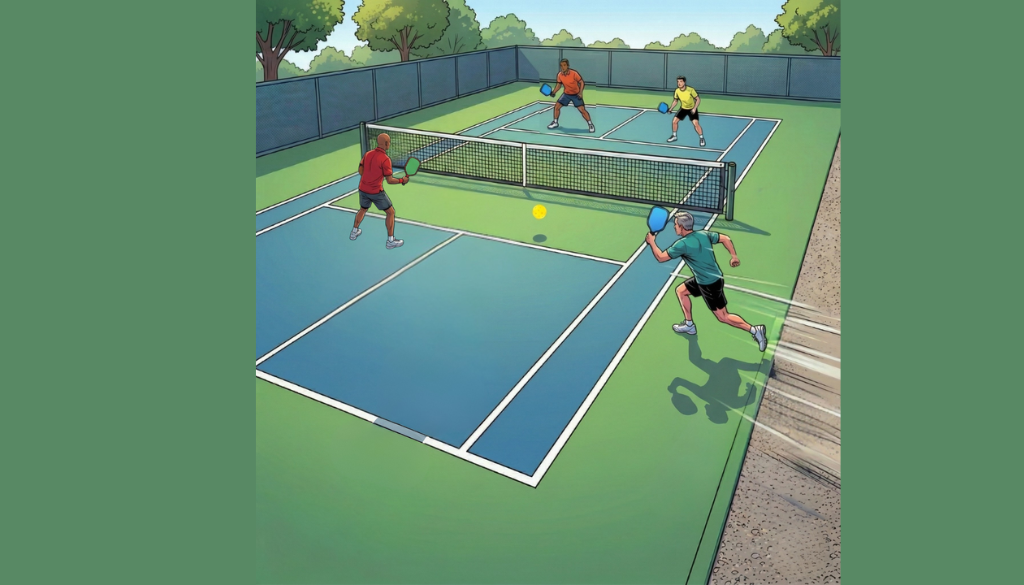
Use a standard doubles court.
All four players start at the kitchen line. Begin each rally with a cooperative dink exchange, preferably cross-court to establish rhythm.
Before the point starts, assign one team as the initiator.
Only that team is allowed to start the first true speed-up.
Once that first attack happens, the point is fully live.
The rule that drives the drill
Only the initiator team may start the first speed-up.
The non-initiator team must stay in control — dinking, resetting, and keeping the ball unattackable — until the initiator goes first.
Once the initiator speeds up, the restriction is gone. The other team is free to counter, re-attack, or finish the point.
One important guardrail:
If the non-initiator receives an obvious, high put-away ball, they should finish it. Do not train yourself to pass on easy winners. Those situations are rare in this structure, but when they happen, take them.
What counts as a “speed-up”
Not every firmer ball qualifies.
A speed-up in this drill is a ball you intend to start a hands exchange with — clearly more aggressive than your normal dink, with the intent to pressure or finish.
If it wouldn’t force a reaction at the kitchen, it’s not a true speed-up.
What counts as an attackable ball
This is where the drill lives.
A ball is attackable when:
• It is above net height
• It is in your strike zone (roughly net height to chest/shoulder)
• You can contact it in front of your body
• You are balanced when you hit
If one of those is missing, the attack is usually forced.
What the initiator team is learning
Being the initiator does not mean attacking early.
It means waiting for the right ball and then committing.
Focus on:
• Selecting the correct ball
• Attacking with control, not just pace
• Targeting high-percentage locations (often straight ahead or into the body)
• Being ready for the next shot
Avoid:
• Speeding up low balls
• Attacking while reaching or off balance
• Telegraphing the attack with obvious preparation
Your preparation should look similar to your dink until the moment you go.
Success here is not just starting the attack — it’s starting it from a position where you can stay in control.
What the non-initiator team is learning
The job is simple and difficult at the same time:
Do not give them a ball to attack.
That means:
• Keep dinks low and controlled
• Avoid balls that sit up
• Stay patient even when tempted
• Be ready for the attack you know is coming
Once the attack comes:
• Stay compact
• Absorb and redirect
• Look to counter with control, not panic
Success is not avoiding the attack forever. It’s handling it well when it happens.
How to run it
Start the dink rally and let it develop naturally.
The initiator team waits for a true attackable ball and speeds up.
From there, play the point out.
If the non-initiator speeds up first (without a clear put-away), stop the rally and award the point to the initiator.
Rotate roles every few points or play full games before switching.
Scoring options
Standard play
Play to 7 or 11 and switch initiator roles each game.
Initiator scoring
The initiator only scores if they win points they started with a clean attack — meaning the ball met the attackable criteria (above net, in front, balanced).
Non-initiator scoring
The non-initiator scores by forcing errors or winning after the counter.
You can also track how many initiations actually lead to winning the point. That number is usually lower than players expect.
What this drill exposes
• Attacking balls below net height
• Rushing the moment instead of recognizing it
• Telegraphing speed-ups
• Over-swinging
• Being unprepared for the counter
It also highlights who can stay patient long enough to get the right ball.
When to use it
• After dink work
• Before competitive play
• Any time points feel rushed or forced
This drill works best for players who already understand basic dinking patterns and are ready to improve decision-making.
Keep the pace controlled. The goal is recognition and timing, not hitting harder.
Why this belongs in your rotation
Attacking isn’t just a skill. It’s a decision.
When you recognize the right ball, you attack less often — and win more when you do.
That’s the shift.
This drill teaches that the point doesn’t belong to the player who swings first.
It belongs to the player who chooses the right moment.