


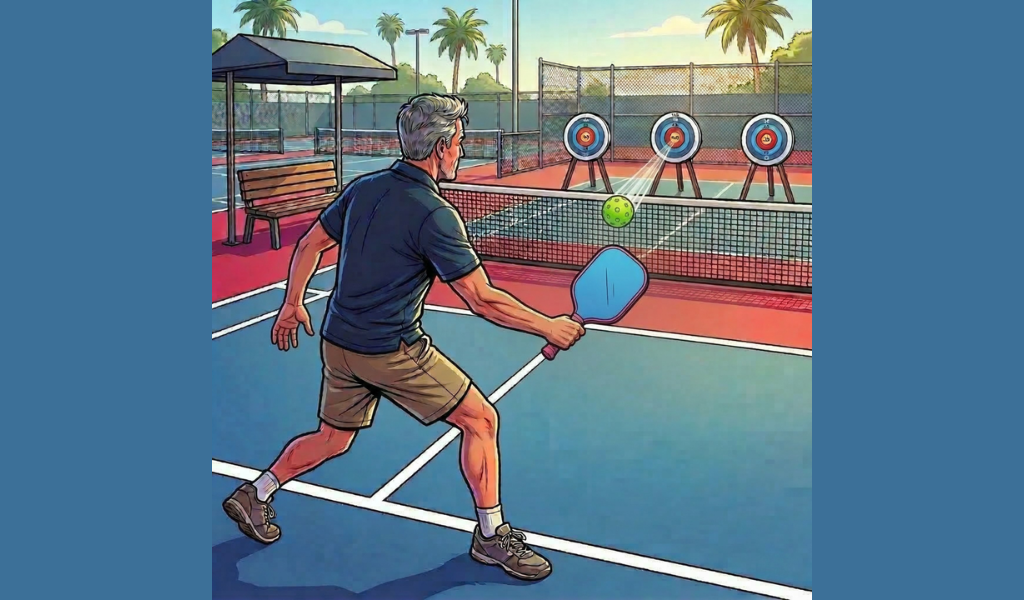
Most missed drives aren’t mechanical.
They’re directional.
Players swing harder, aim lower, and hope the ball stays in. When it doesn’t, they assume they need more power or better timing. In reality, they don’t have a repeatable target.
A good drive isn’t just fast. It goes somewhere on purpose.
This drill trains that.
Why this drill matters
A drive should create a problem for your opponent.
Not just speed — placement.
A well-placed drive can:
• Jam the body
• Force a backhand block
• Create a predictable pop-up
A poorly placed drive gives your opponent a clean contact and control of the rally.
This drill builds a drive you can aim — and trust.
What you’re training
This is not a power drill.
It’s about:
• Paddle face control through contact
• Direction without changing your swing
• Margin over the net
• A repeatable contact point
• Using your legs and balance, not your arm
If you can’t hit the same zone repeatedly, the drive isn’t ready to use in a game.
Best used once your basic drive contact feels comfortable. If you’re still mishitting, clean that up first.
Partner version (controlled placement with safety and intent)
The setup
One player at the baseline.
One player at the kitchen line as a live reference.
This is not a body-shot drill. You are not trying to hit your partner. Pace should be controlled, and both players should be comfortable with the setup. Protective eyewear is strongly recommended.
The kitchen player is there to show you what a bad target looks like — a clean, comfortable ball.
The pattern
• Baseline player drives with controlled pace
• Kitchen player blocks any ball they could reasonably reach without lunging
• Let obvious out balls go
• Reset after each ball or play one controlled block back
Where you aim
• Just inside the body line (jam zone), not center mass
• Low to the backhand side
• Through the middle seam if simulating doubles
Ball context matters
This drill assumes you are driving balls that are at least neutral to slightly attackable (not low, skidding half-volleys). If the ball is below net height, your margin shrinks and this becomes a different decision.
What to focus on
• Same swing, different direction
• Contact out in front
• Get set with your feet before you swing
• Transfer weight forward — don’t reach across your body
• Keep enough net clearance to stay safe
On paddle face
A slightly closed paddle face can help control a higher ball, but if balls are going into the net, it’s likely too closed. Adjust until you can keep the ball above the net with margin.
What to avoid
• Clean, waist-high balls directly to your partner
• Aiming at lines
• Swinging harder to fix misses
• Changing your swing path to change direction
Success looks like this
Your partner is uncomfortable — not because of speed, but because they don’t get a clean contact.
Solo version (wall or court targets)
Wall setup
Stand about 10–15 feet from the wall — far enough that the rebound gives you realistic preparation time.
Pick a target zone:
• Net height to shoulder height
• Slightly offset left or right
The pattern
• Drive into the target
• Control the rebound
• Repeat into the same zone
The goal is rhythm and repeatability.
Court target setup
Place cones or markers:
• One in the middle seam
• One a few feet inside the sideline
• Optional: one slightly toward the jam zone
Drive from the baseline toward those targets.
What to focus on
• Same swing every time
• Direction comes from setup and alignment, not last-second wrist changes
• Consistent net clearance
• Balanced base before contact
What to avoid
• Chasing perfect shots
• Changing tempo after a miss
• Swinging harder when you lose control
Success looks like this
You can hit the same zone multiple times in a row with similar height, shape, and pace.
Progressions
Beginner
• Larger target zones
• Controlled pace
• Focus on clean contact and direction
Intermediate
• Alternate targets (middle, then sideline)
• Add light movement before contact
• Partner blocks one ball back
Advanced
• Add live play after the drive
• Reduce target size
• Sequence targets (middle → sideline → middle)
Common mistakes this drill exposes
• Swinging harder instead of aiming better
• Aiming too low over the net
• Giving opponents clean contact points
• Reaching instead of getting set
• Changing mechanics to change direction
• Letting misses speed you up
When to use it
Before games to groove your drive
After working on third-shot drives
Any time your drives feel inconsistent
Keep volume reasonable. Quality matters more than reps, especially if your arm or elbow starts to fatigue.
Why this belongs in your rotation
Power shows up quickly.
Control doesn’t.
When you can place your drive, you stop giving away easy balls and start creating predictable replies. That’s how points are built — not by hitting harder, but by hitting smarter.
Hit a spot you can repeat.
Then build from there.