

What Are The Main Differences Between Indoor and Outdoor Pickleball Balls?
In the realm of pickleball, a sport rising in popularity, the subtle, yet significant differences between indoor and outdoor balls play a critical role in the gameplay’s dynamics. The nuanced disparities, ranging from the number and diameter of holes to weight, hardness, and durability, all contribute to the behavior of the ball in different environments. As we explore these variations, you might find it intriguing how these factors can profoundly influence your performance, strategy, and overall enjoyment of the sport. With a deeper understanding of the subject matter, you may find yourself better equipped during your next pickleball match, whether it takes place indoors or outdoors.
Number of Holes
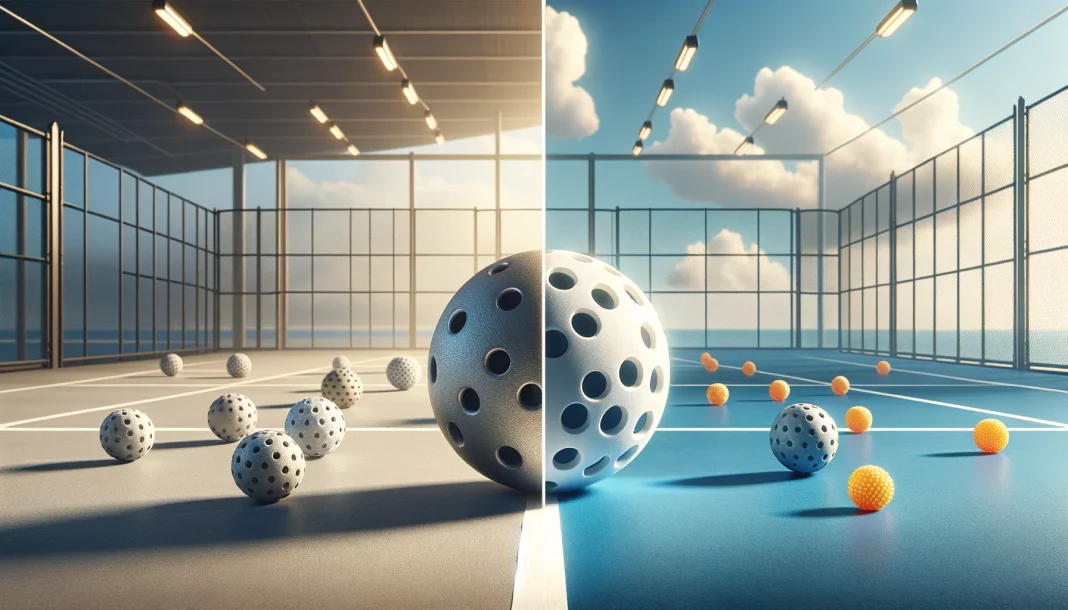
In the intricate design of pickleballs, the number of holes plays a pivotal role, with outdoor balls typically featuring 40 closely-packed holes, while their indoor counterparts usually boast 26 wider ones. There is no rule on the number and there are some variations, such as the P7 ball which has 32 holes. This difference in the number of holes is not arbitrary but is a calculated consideration to neutralize factors such as wind and the playing surface’s texture, which can influence the ball’s flight trajectory and consistency of bounce.
The most common outdoor balls, with their 40 closely-packed holes, offer increased robustness for windy conditions. The smaller holes reduce the wind’s ability to alter the ball’s flight path, leading to a more accurate and reliable shot. The closely-packed arrangement of the holes also adds to the ball’s overall strength, making it more suitable for outdoor play.
The most common indoor balls, on the other hand, feature 26 wider holes. This design choice is a nod to the controlled environment of indoor courts. The wider holes allow for a truer bounce, which is crucial in fast-paced indoor games where precision is key.
The design of both varieties ensures each hole is uniformly sized and placed across the ball. Some outdoor pickleballs even feature two different sizes of holes on the same ball to optimize performance in varied outdoor conditions.
However, it is critical to note that official guidelines do not mandate the number of holes for indoor or outdoor games. This flexibility in design has led to diversity in pickleballs, with variants such as the 32-hole ball available for outdoor play. The number of holes is thus a testament to the thoughtful design of pickleballs, tailored to optimize player performance in diverse conditions.
Hole Diameter
Moving from the number of holes in a pickleball, the diameter of these holes also significantly impacts the game’s dynamics, particularly in distinguishing indoor balls from outdoor ones. The variation in hole diameter is not merely a random factor but a calculated difference that has been designed to cater to specific playing environments.
Indoor pickleballs have wider holes, averaging .43-inches in diameter. This larger diameter allows the ball to travel slower, providing a softer and more controlled play which is ideal for indoor environments. On the other hand, outdoor pickleball hole diameters measure roughly .282-inches, which is about 40% smaller than indoor pickleball holes. This smaller diameter is designed to withstand outdoor factors such as wind, allowing the ball to travel faster and providing a more challenging game.
These measurements were derived from examining 10 of the more common indoor and outdoor pickleballs on the market. Although there are exceptions and outliers, this data provides a directional understanding of the general difference in hole size between indoor and outdoor pickleballs.
Interestingly, despite the significant impact hole diameter has on the dynamics of the game, USA Pickleball, the governing body of the sport, does not have any specific regulations on the hole diameters of indoor vs. outdoor pickleballs. This lack of regulation provides manufacturers with the flexibility to design pickleballs that best suit the varying conditions of indoor and outdoor play, further enriching the game’s strategic and technical aspects.
Weight
The weight of a pickleball is a critical aspect that distinguishes indoor balls from their outdoor counterparts, and significantly influences game dynamics and player strategy. Despite the common perception, the weight difference is minimal, less than 1%, with outdoor balls being slightly heavier.
The weight of a pickleball can be influenced by two main factors:
- Hole Contribution: Indoor pickleballs have fewer holes compared to outdoor ones, 26 vs 40 respectively. However, because the holes in indoor balls are larger, covering more surface area, they create more negative space, resulting in a lighter ball.
- Indoor balls: 26 holes, larger in size
- Outdoor balls: 40 holes, smaller in size
- Environmental Conditions: Outdoor games are subject to weather conditions like wind, hence a slightly heavier ball helps maintain its intended trajectory.
- Indoor games: Lighter balls, unaffected by weather
- Outdoor games: Heavier balls, more resistant to wind
The average weight of indoor pickleballs is .917 ounces and outdoor balls average .925 ounces. USA Pickleball regulations stipulate the weight of the ball should be between 0.78 and 0.935 ounces, with no separate specifications for indoor and outdoor balls.
Ultimately, the weight difference is minimal and does not dramatically affect gameplay. The aerodynamics, determined by hole patterns and sizes, may have a more significant impact on how the ball moves and behaves during play. The weight factor, therefore, is more relevant in the context of player preference and environmental adaptability.
Hardness
Delving into the hardness of pickleballs, it is essential to understand that it is a crucial factor influencing the performance of the ball, with different levels of hardness being suited for indoor and outdoor play respectively. The hardness of pickleballs is gauged using the durometer hardness test, which assigns Shore D values. The range of hardness for common plastics used in pickleballs spans from LDPE (Low-Density Polyethylene) with a Shore D value of 40-50, to PET (Polyethylene Terephthalate) with a value of 85-95.
Hardness, compression, and bounce are the key metrics influencing pickleball performance. Typically, outdoor pickleballs exhibit greater hardness than indoor ones, due primarily to the material and thickness of construction, as well as the weight. A harder ball, desirable for outdoor play, results in a faster game, compared to a softer ball used indoors that slows the pace.
Indoor pickleballs are crafted from a softer, lighter plastic, thus more prone to drag, while outdoor pickleballs are made from thicker, harder, and heavier plastic to enhance durability. It is worth noting that USA Pickleball previously required pickleballs to have a Shore D of 40-50, which falls within the low-medium range of plastic hardness, but this rule no longer applies. However, no specific rules govern the hardness, bounce, or compression for indoor or outdoor balls, but standards exist for compression and bounce for all pickleballs, indirectly indicating the hardness of a ball.
Durability
In the realm of pickleball, durability plays a pivotal role in the lifespan of both indoor and outdoor balls, with each type exhibiting distinct wear and tear patterns due to the variances in material hardness and construction. Contrary to popular belief, pickleballs are not invincible, they can lose their shape and eventually crack due to consistent play and unfavorable environmental conditions.
The durability of a pickleball is significantly determined by its material and construction. Generally, the harder the material, the shorter its lifespan. For example, a material such as Thermoplastic Elastomer (TPE) exhibits high elasticity, making it difficult to crack or distort its shape, rendering it more durable. In contrast, harder plastics are prone to cracking and shape distortion.
- Indoor vs Outdoor Pickleball Durability:
- Indoor Pickleballs: These balls are usually more durable as they are made from softer plastics. The most common issue with indoor balls is the development of soft spots over time.
- Outdoor Pickleballs: These balls are made from harder plastics, which make them susceptible to cracking, splitting, and losing shape.
It’s worth noting that no pickleball, whether indoor or outdoor, will last forever. However, on average, an indoor ball will outlast an outdoor one. The USA Pickleball Association has set a regulation (2.D.1.) stipulating that pickleballs shall be made of a durable material. Although this regulation lacks specificity, it underscores the importance of durability in the sport. Players’ satisfaction is heavily reliant on the lifespan of a pickleball, and undeniably, a long-lasting ball is a player’s delight.
Conclusion
In conclusion, the variations in hole number, diameter, weight, hardness, and durability distinctly differentiate indoor and outdoor pickleball balls. These differences are vital to optimize the sport’s performance in diverse environments. Understanding these factors is crucial for players to select the appropriate ball for their games, thereby enhancing their performance and the overall enjoyment of the sport. Therefore, the specific attributes of pickleball balls significantly influence the dynamics and outcome of the game.