

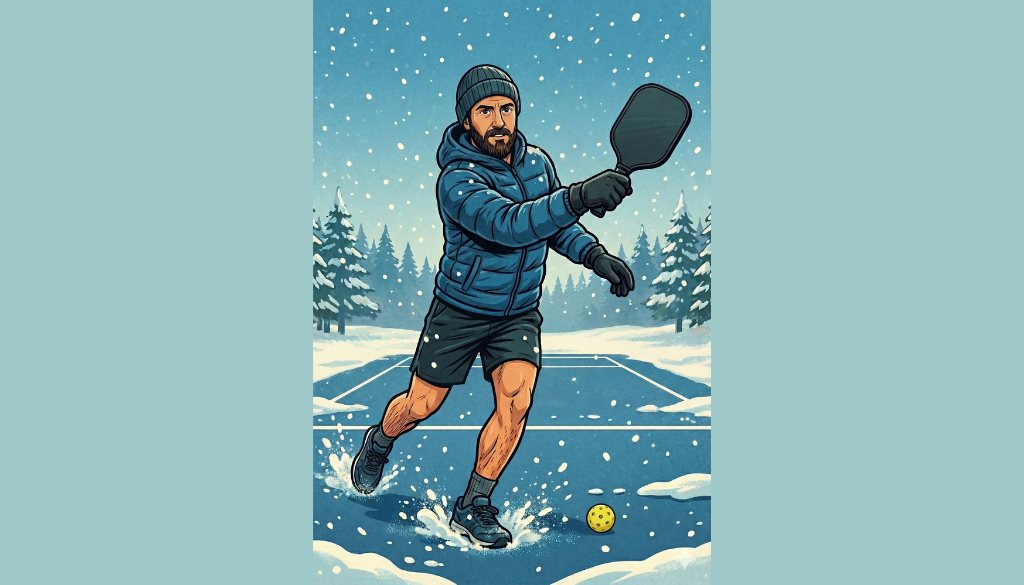
You see the ball coming.
Your brain says, “Move!”
But your paddle arrives late. Your feet feel stuck. And that volley you’d normally crush sails past you before you can react.
You shake it off. Must be rust.
But then it happens again. And again.
Here’s the thing: it’s not rust. And you’re not losing your edge.
Cold weather literally slows your nervous system. Your muscles. Your reflexes. Even your brain.
But once you know why it happens, you can fix it in about 90 seconds – and get back to playing fast, sharp, and confident, even when it’s freezing out.
Why Cold Makes You Slow
Your nerves send signals slower
Your nerves are like electrical wires. When they’re warm, signals fly. When they’re cold, they crawl.
Studies show nerve conduction speed drops when your skin and muscle temperatures fall – even by just a few degrees. For players over 50, that tiny slowdown is the difference between a clean volley and a paddle that gets there late.
Your muscles contract slower
Cold muscles take longer to fire. That means slower footwork, slower paddle prep, slower reaction to anything fast at the net.
It’s not weakness. It’s physics.
Your blood abandons your hands and feet
When you’re cold, your body prioritizes keeping your core warm. So it tightens blood vessels in your hands, fingers, and feet – the exact body parts you need fast.
Less blood flow = stiff, slow, foggy extremities.
Age amplifies everything
Players over 50 feel this more because nerve fibers respond slower to temperature changes, circulation takes longer to ramp up, and muscles need more time to fully warm.
Nothing’s wrong. This is just how bodies work in the cold.
And now that you know it, you can bypass it.
How to Wake Your Reflexes Back Up (In 90 Seconds)
Warm your hands first
Your hands contain thousands of nerve endings. The colder they are, the slower your brain gets information from your paddle.
Before you play:
- Rub your hands together briskly for 30 seconds
- Wear thin gloves during warm-up
- Tap your paddle rapidly in all directions
- Keep a small hand-warmer packet in your pocket
Warm hands = sharper volleys.
Do a 60-second reaction primer
This wakes up your nervous system so you’re fast from point one.
Try this sequence:
- 10 light split-step bounces
- 10 quick paddle taps (forehand/backhand)
- 10 fast shadow volleys
- 5 quick side-shuffles each direction
Takes 90 seconds. Feels like flipping a switch.
Start slow, then build
Don’t jump into fast exchanges while your nerves are still waking up.
Start with soft dinks. Add medium-pace volleys. Then move into speed.
Your nervous system needs those first three minutes to reach full responsiveness.
For Players Who Want to Stay Sharp During Long Court Sessions
Even with a smart warm-up, some players notice they lose sharpness after an hour – especially on cold days when they’re not feeling thirsty.
That’s where Advanced Hydration Formula helps. It keeps your cells hydrated longer, so you stay sharp and responsive even during back-to-back games. Many players over 50 rely on it to maintain quick reactions throughout those long tournament mornings when the temperature’s dropping.
Try Advanced Hydration Formula with our exclusive discount (90-day money-back guarantee)
Bottom Line: You’re Not Losing It – You’re Just Cold
Cold weather slows your nerves, tightens your muscles, and reduces blood flow. But with a few smart moves, you’ll be back to playing fast, reacting fast, and feeling confident – even on freezing mornings.
See you out there. Stay sharp. Keep playing.