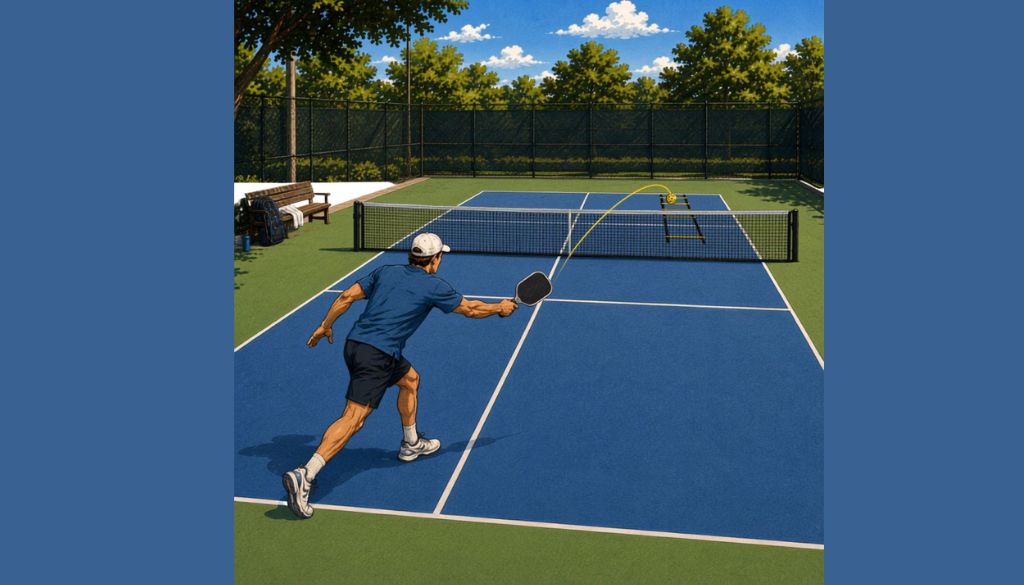


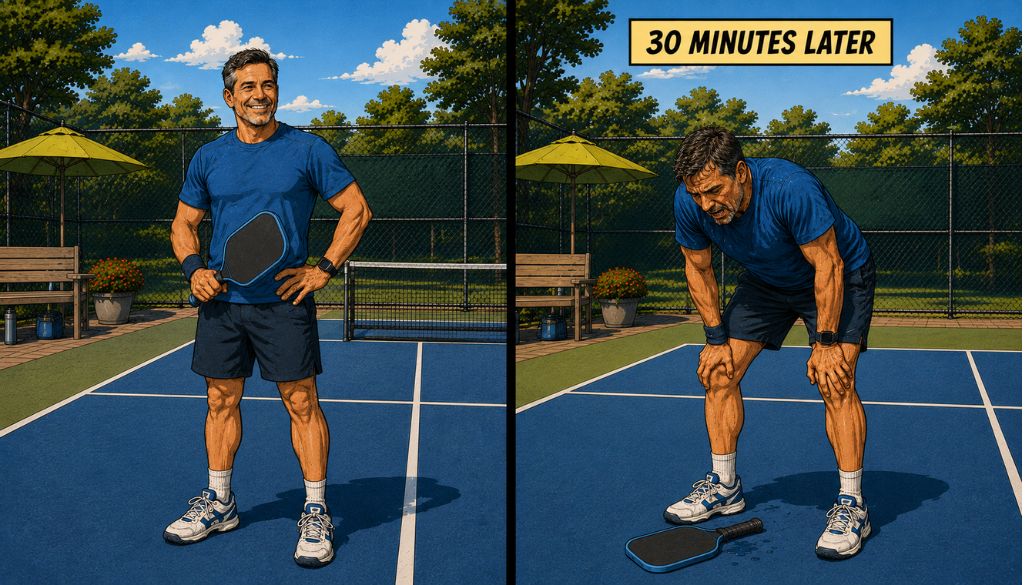
One of the nice things about pickleball is that it does not always feel like a workout. A good morning on the court can mean two or three hours of playing, talking, sitting out a game, then jumping back in for another. You may go home tired, eat lunch, sleep well, and wake up the next morning feeling perfectly capable of doing it again.
And often you are.
The problem comes when feeling good becomes the only measure of whether the body has recovered. Muscles, tendons, joints, and the rest of the body do not necessarily recover at the same rate. You can wake up without soreness and still be carrying some of the workload from the previous day. When that happens repeatedly, three or four ordinary playing days can add up to more stress than any one of them seemed to create.
Rest days give the body time to catch up.
Recovery Is More Than Waiting for Soreness to Go Away
Muscle soreness is one of the easiest signs of incomplete recovery to recognize. If the legs are sore when walking downstairs, most people understand that another hard session may not be a great idea.
No soreness is harder to interpret. It is tempting to assume that feeling normal means everything is back to normal.
Exercise places stress on muscles and connective tissues, and recovery begins afterward. How long that takes varies with the intensity and duration of the activity, a person’s conditioning, sleep, nutrition, age, previous workload, and many other factors. A familiar two-hour session may require very little recovery for someone accustomed to playing four days a week, while the same session can represent a major increase for someone who normally plays once or twice.
This is why recovery is better considered across several days rather than judged only by how the body feels the following morning.
Tendons May Not Give You the Same Feedback as Muscles
Tendons deserve particular attention because they respond differently to repeated loading than muscles do.
Pickleball repeatedly loads the Achilles tendon, patellar tendon around the knee, and tendons of the shoulder, elbow, and wrist. Every push toward a wide ball, sudden stop, overhead, drive, and quick exchange adds another small dose of load.
That load is not inherently harmful. Tendons need appropriate loading to remain strong and adapt. Problems are more likely when activity increases faster than the tissue is prepared to tolerate.
Unlike a hard leg workout that leaves the thighs obviously sore, tendon overload may initially be much less dramatic. A player may notice a little stiffness when first getting out of bed, discomfort during the first few minutes of play, or an area that feels increasingly irritated as the week continues.
Those early signs can be easy to dismiss because the player still feels capable of playing. A day without pickleball can reduce the repeated sport-specific load while still allowing normal daily movement and other appropriate activity.
Joints Also Experience the Accumulated Work
Pickleball asks the knees, hips, ankles, shoulders, and other joints to repeat similar movements hundreds of times during a session. The body is built to move, and regular physical activity is important for joint health. Still, workload matters.
Playing Monday may feel fine. Tuesday may feel fine too. By Wednesday, the legs may be a little heavier and the knees slightly stiffer. Nothing necessarily happened on Wednesday to cause that feeling. It may simply reflect the total amount of work performed over all three days.
Court surface, session length, intensity, previous injuries, strength, footwear, and individual physical differences can all affect how much load a player comfortably handles.
This is one reason there is no universal rule that everyone needs a rest day after a particular number of games. The useful question is whether the weekly workload is appropriate for the body doing it.
Rest Does Not Have to Mean Doing Nothing
A rest day does not require spending the day on the couch.
For many players, an easier day can include walking, comfortable mobility work, or normal daily activity. Someone who strength trains may also be able to work different areas of the body, depending on the training schedule.
What matters is reducing the specific load that needs recovery.
If the legs have spent several days repeatedly starting, stopping, lunging, and changing direction on the pickleball court, another two hours of pickleball is not recovery simply because the games are supposed to be casual. An easy walk places very different demands on the body.
There is also a difference between a rest day and an inactive lifestyle. Regular movement remains important. The purpose of recovery is to make room between demanding sessions, not to avoid activity.
Watch the Week, Not Just the Day
The biggest clue that more recovery may be useful often appears in patterns.
Maybe the first two playing days of the week feel great, but movement becomes noticeably slower on the third. Perhaps the shoulder feels fine when play begins but starts aching earlier in each successive session. The legs may feel heavy, or the first few games may take increasingly longer before movement feels comfortable.
Performance can provide clues too. When fatigue accumulates, players may be slower getting to balls, less stable when stopping, or more likely to reach rather than move their feet. That does not automatically mean the body needs a day off, but repeated changes are worth noticing.
It is also useful to pay attention when playing volume suddenly changes. Adding a league, clinic, tournament, or extra open-play day can turn a normal week into a substantial workload increase without any individual session seeming particularly demanding.
Building toward more playing time gradually gives the body an opportunity to adapt.
A Rest Day Can Protect the Quality of Your Playing Days
There is another reason to recover that has nothing to do with avoiding injury.
Fresh legs move better.
When players are adequately recovered, it is easier to get low, push laterally, stop under control, and recover after a wide ball. As fatigue accumulates, those movements require more effort. Footwork can become less precise, and court position can begin to deteriorate.
That can turn an extra day of pickleball into a day of practicing movement and shot patterns while tired.
More playing time is not automatically more productive playing time. A day away from the court can sometimes make the next session considerably better.
When “Feeling Fine” Is Not the Whole Story
There is no need to become overly cautious about every minor sensation. Bodies are not expected to feel identical every morning, and occasional stiffness after activity is common.
The more useful approach is to notice changes that persist or build. Morning stiffness that repeatedly appears in the same tendon, joint pain that becomes more noticeable as the week progresses, swelling, a loss of normal movement, or pain that begins affecting everyday activity deserves more attention than ordinary post-play fatigue.
Those situations are also different from simply needing another rest day. Persistent or worsening symptoms are a reason to consider evaluation by an appropriate healthcare professional rather than repeatedly resting until the discomfort settles and then returning to the same workload.
Final Thoughts
Rest days matter because the body does not operate on a simple sore-or-not-sore schedule.
Muscles, tendons, joints, and the systems that support repeated movement all respond to workload in different ways. A player can feel good enough to play again before every part of the body has completely recovered from what came before.
That does not mean every player needs the same schedule or that playing on consecutive days is automatically a problem. The body adapts to what it does regularly, and people who build up to frequent play may tolerate it very well.
The important part is leaving enough recovery somewhere in the week. Sometimes the decision to skip a day when you feel perfectly capable of playing is exactly what helps you continue feeling that way.