


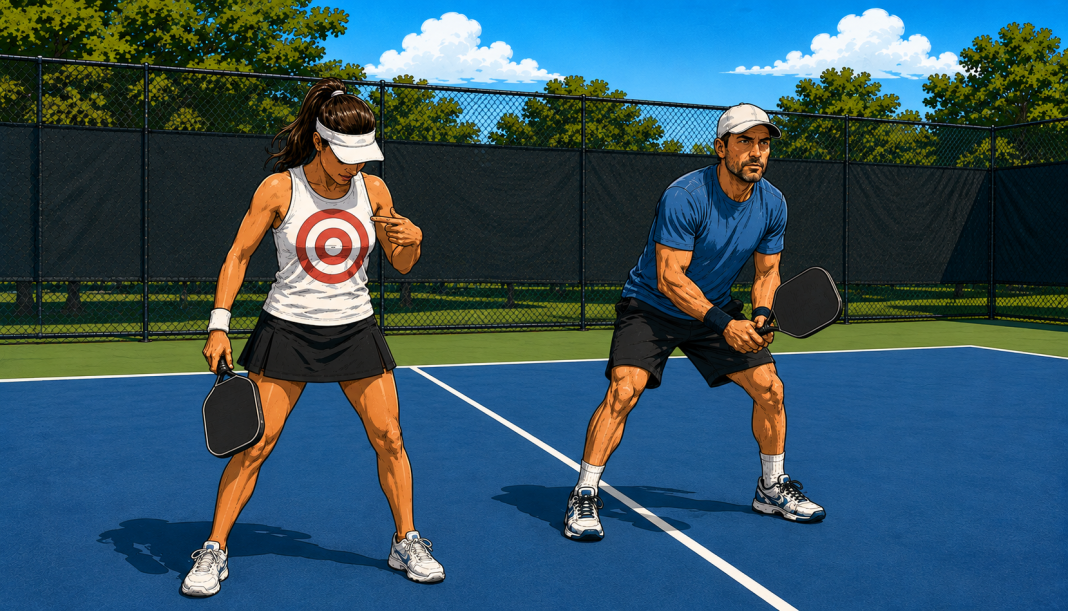
There is a moment in doubles when a player realizes something has changed. The opponents are no longer simply playing the point. They have decided who they want hitting the ball.
Every return seems to come back to the same side. Dinks keep finding the same paddle. Drives are directed at the same player. Even balls that could reasonably go either way seem to have one destination.
Being targeted can become frustrating quickly, particularly when it starts to feel personal. But targeting is simply a strategy. Opponents believe repeatedly involving one player gives them the best chance to win the rally. The best response is to recognize what they are doing and make that strategy less comfortable.
First, Make Sure You’re Actually Being Targeted
A few balls in a row do not necessarily mean opponents have made a tactical decision. Court position, shot selection, and normal rally patterns can naturally send several consecutive balls toward one player.
True targeting becomes easier to recognize over multiple points. Returns repeatedly go to the same player. Crosscourt dink exchanges are deliberately maintained to keep the partner out. Opponents avoid obvious opportunities to play toward the other side of the court.
Once the pattern is clear, there is no reason to become annoyed by it. There is useful information in knowing where the next ball is likely to go.
A player who knows the opponents want to keep feeding the same side can begin preparing earlier and making better decisions.
Stop Trying to Prove Them Wrong
One of the worst reactions to being targeted is deciding that every ball needs an impressive response.
Players start speeding up dinks that should remain soft. They try to create winners from poor positions. Drives get harder, margins get smaller, and suddenly the opponents’ strategy is working even better than they expected.
The first goal should be reliability.
Keep returns deep. Make the third shot manageable. During dink rallies, choose targets that can be hit consistently. When defending pace, block and reset rather than trying to win a hands battle from a bad position.
There is no need to punish opponents for targeting someone. Making them play one more good ball over and over again can be punishment enough.
Change the Pattern Instead of Just Surviving It
Once the targeted player is handling the extra balls comfortably, the next step is to make the pattern harder to maintain.
During a crosscourt dink exchange, changing direction safely can bring the other opponent into the rally. A well-placed dink through the middle can create uncertainty and make it more difficult for the opponents to continue isolating one player. A deeper return or drop can also change the geometry of the next shot.
The partner can help, too. Small positioning adjustments can reduce the amount of court the targeted player has to defend and make certain balls easier to poach. If one player is receiving nearly every return, the partner may be able to become more active on the third shot. If opponents are repeatedly dinking crosscourt to one side, the partner can look for balls that drift toward the middle rather than standing still and watching the pattern continue.
That does not mean taking balls that clearly belong to the targeted player. Overreaching can open large areas of court and create exactly the easy attack the opponents want. The adjustment should make the team harder to isolate without creating a new weakness.
Use Predictability to Your Advantage
Targeting gives away something valuable: intention.
If opponents have hit six straight returns to the same player, there is a reasonable chance the seventh is headed there too. If every neutral dink has been sent crosscourt toward one side, the targeted player can begin anticipating that pattern.
Anticipation should not turn into guessing. Players still need to stay balanced and react to the ball that is actually hit. But knowing the opponents’ preferred pattern can make preparation easier. The paddle can be ready sooner, the feet can begin in a better position, and the player can think about the likely next shot before the ball arrives.
A strategy designed to make one player uncomfortable can become surprisingly comfortable once it becomes predictable.
Your Partner Has a Job, Too
Being targeted is a doubles problem, not simply a problem for the player receiving most of the balls.
Partners should communicate between points. Sometimes a small shift in positioning is enough. Sometimes the stronger move is allowing the targeted player to continue handling the ball while the partner becomes more aggressive about protecting the middle. In other situations, changing who takes certain returns or middle balls can interrupt the opponents’ preferred pattern.
What rarely helps is a partner suddenly trying to cover the entire court. That creates confusion, takes away balls the targeted player is prepared to hit, and often leaves the sidelines exposed.
The goal is to work together so the opponents cannot isolate one player without giving something up somewhere else.
The Mistake: Changing Your Game Because You’re Being Targeted
Being targeted often makes players feel as though they need to become a different player immediately. Someone who normally wins through consistency starts trying to manufacture offense. A patient dinker suddenly speeds up questionable balls. A player who normally uses plenty of margin starts aiming for sidelines.
Those changes usually make the opponents’ decision look smarter.
Stay with the shots that already work. The adjustment should be tactical: better anticipation, safer changes of direction, smarter positioning, and more involvement from the partner. There is no reason to rebuild an entire game in the middle of a match.
Drill: The Targeted Player
Set up a normal doubles game, but designate one player on one team as the target. The opposing team should direct as many playable balls as reasonably possible toward that player without hitting reckless shots just to maintain the rule.
The targeted player has one job for the first several rallies: keep the ball neutral and avoid forcing offense. The partner concentrates on positioning, protecting the middle, and recognizing appropriate opportunities to become involved.
Once that becomes comfortable, allow the targeted team to begin breaking the pattern. They can change dink direction, use the middle, adjust court position, or have the partner take appropriate balls that enter shared space.
After several points, rotate the targeted player.
The drill should feel uncomfortable at first. That is useful. It gives players a chance to experience the extra workload and decision-making pressure of being targeted without feeling they have to immediately do something spectacular to stop it.
Final Thoughts
Being targeted is rarely enjoyable, but it does provide one advantage: the opponents have told you something about how they intend to play.
The answer is not necessarily to hit harder, take more risks, or prove that they chose the wrong player. Start by making the strategy difficult to profit from. Stay consistent, recognize the pattern, and work with your partner to change the court when opportunities appear.
If opponents insist on sending most of the balls to one player, eventually that player may become the most comfortable person on the court.