

Stop defaulting on the third shot and start choosing it.
Most rec players have one third shot. They drive everything because they do not trust their drop, or they drop everything because they fear getting attacked at the kitchen. Both habits give away points. The third shot is supposed to be a choice, not a reflex. This drill builds the choice.
Why this drill matters
The third shot is the most consequential ball in any rally. It either gets the serving team to the kitchen with a chance to win, or pins them back and lets the returners take control. The right third shot is dictated by the return. A short, sitting-up return usually wants a drive. A deep, low return usually wants a drop. When you train both shots in alternation, your body learns to feel the difference. When you add reading the return, you stop guessing and start choosing.
How to set it up
- Full court. Doubles formation if you have four players. Half court works fine for two.
- One player serves, one returns. Hit the third shot, then stop and reset.
- The point is to isolate the first three shots, not to win full rallies.
The base pattern
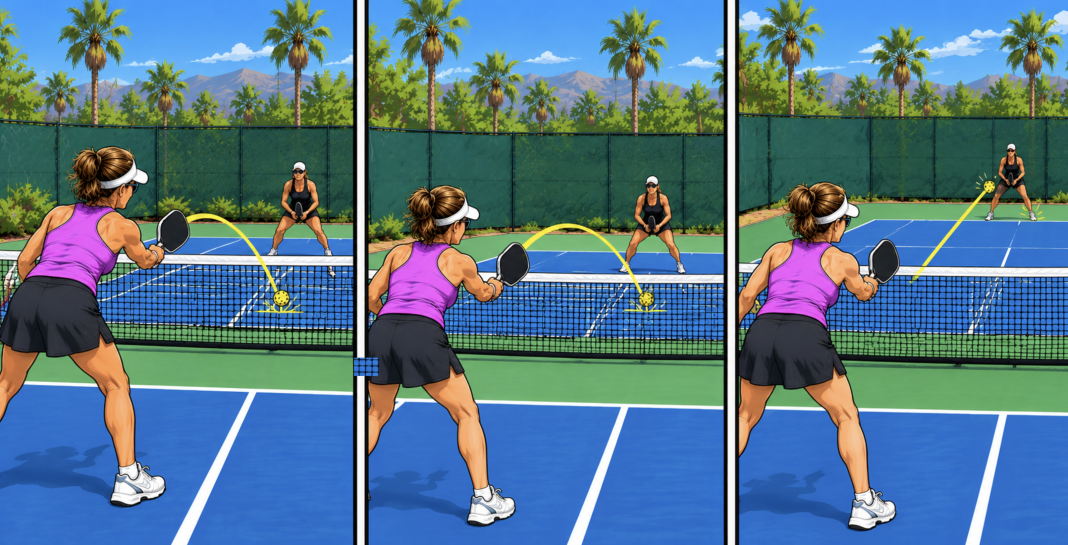
The server hits a fixed sequence: drop, drop, drive. Repeat. Yes, the pattern will sometimes be wrong for the return you got. That is the point of the early levels. You are learning the feel of both shots from the same position before you start choosing between them.
What a good drop looks like
- Arc that peaks above the net by 2 to 3 feet, lands in or near the kitchen.
- Soft enough that the receiver has to move forward to handle it.
- Hit with a relaxed, low-to-high motion, not a flat push.
What a good drive looks like
- Low, with topspin shape, not a flat poke.
- Aimed at a body, hip, or seam, not at a sideline.
- Hit with the legs and core, not just the arm.
Reading the return
Once you start making the choice, this is the cue system.
- Drive when the return is short, high, and you are balanced and stepping forward.
- Drop when the return is deep, low, or you are off-balance.
If two of the three cues say drive, drive. If two say drop, drop. These are guidelines for advancing rec players, not universal laws. Look at the receivers too: if they crash the kitchen aggressively, a drive at their feet is hard to defend. If they hang back to drive the fifth shot, a well-paced drop gives you free distance to come up.
Common mistakes
- Driving a low, deep ball. Without serious topspin, that drive ends up in the net or sailing long.
- Dropping a sitting ball. A high, short return is a free chance to apply pressure.
- Changing the pattern too early. In Levels 1 and 2 below, hold the pattern even when it feels wrong.
- Driving with the arm only. Power should come from the legs and rotation.
Level variations
Beginner: Learn the Feel
Hold the pattern strictly. Two drops, one drive, repeat. Returner feeds a consistent, medium-deep return every time. Goal: 6 of 8 drops in the kitchen, and 6 of 8 drives stay low and in. Focus only on clean contact. No live play after the third shot.
Intermediate: Start the Read
Keep the pattern as the default, but swap when the return clearly demands the other shot. A return inside the service line lets you drive even when the pattern says drop. A return that pins you behind the baseline lets you drop even when the pattern says drive. Returner mixes depth, pace, and slice. Goal: 75 percent or better on the right call across 20 third shots.
Advanced: Live Decision Game
The pattern is gone. Every third shot is a free choice. Returner plays a real return with depth, slice, and occasional short angle. Play the rally out for up to five balls. Plus 1 for winning with the right shot for the return. Minus 1 for losing on a forced wrong shot. Play games to 11. The scoring rewards reading, not just winning.
When the rules bend
- A deep, low ball can be driven if you have a reliable heavy topspin roll. This is a 4.5-plus tool. Build the basic drive first.
- A third-shot lob is situational and opponent-dependent. Used as a default, it gets smashed. Used once or twice a game against the right opponent, it can swing the match.
- Your skill profile matters. If your drive is much more reliable than your drop, lean into your strength in matches while you build the weaker shot in practice.
Why this drill belongs in your rotation
Players who can only drop are predictable. Players who can only drive are unstable. Players who can do both, and read which one the return is calling for, win the third-shot battle.
Train both shots. Train the read. Then the choice gets obvious.