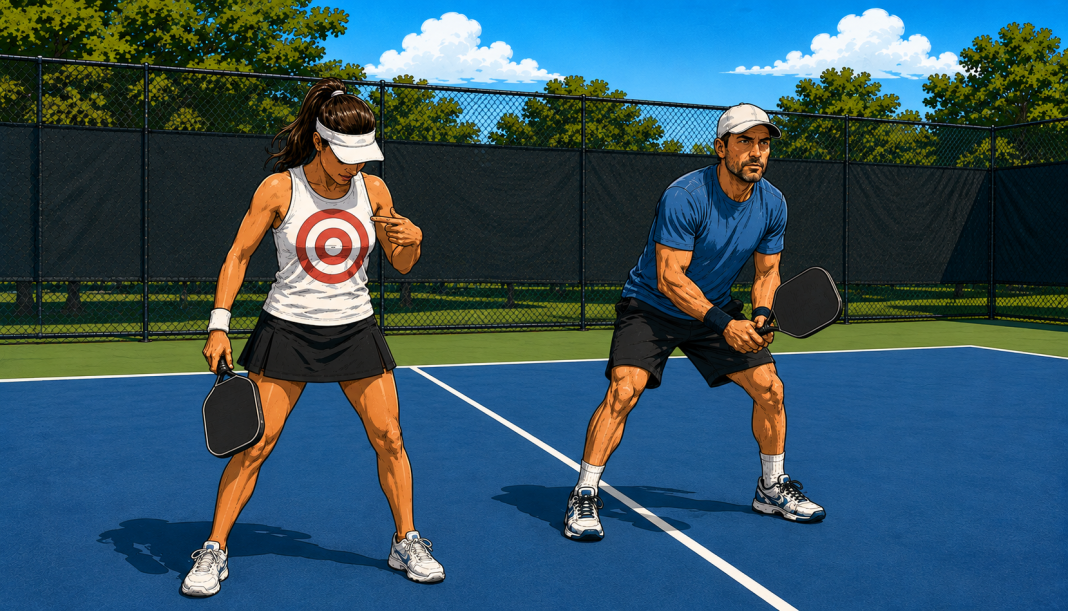


The transition zone gets blamed for a lot of pickleball problems. Players are told not to get stuck there, not to linger there, and sometimes not to be there at all.
But if you’re moving from the baseline to the kitchen (non-volley zone), you have to travel through it. The problem isn’t being in the transition zone. The problem is not knowing what to do when the ball arrives while you’re there.
That’s where the reset becomes so important. A good reset takes an opponent’s faster ball and sends it softly back into the kitchen, giving you time to regain balance and, when the opportunity is there, move forward. It can turn a difficult defensive position into a neutral one without requiring a spectacular shot.
The Transition Reset Circuit trains that skill from several different spots between the baseline and kitchen. Instead of practicing resets from one comfortable location, you work progressively closer to the net, where the ball arrives sooner and your reaction time changes. The goal is to learn how your reset has to adjust as your position changes.
Why This Drill Matters
Reset practice often happens from one spot. A player stands somewhere in the transition zone while a partner feeds balls, and after enough repetitions the shot begins to feel pretty good.
Then the player gets into a game and discovers that the transition zone never feels that predictable.
Sometimes your third-shot drop gets you several steps forward before the next ball arrives. Sometimes you’re barely inside the baseline. Sometimes you stop in the middle. The closer you get to the kitchen, the less time you have to react, and the ball may reach you at your feet, knees, hips, or body.
That means “hit a reset” is not one identical skill from every location.
The Transition Reset Circuit makes those differences part of the drill. By moving through several stations, you learn how much time you have, how compact your motion needs to become, and how to soften the ball from different distances.
More importantly, you learn that advancing to the kitchen is not a race. Sometimes the best way forward is to stop.
Setting Up the Circuit
You need one partner and several cones or markers. The feeder stands at the kitchen line on the opposite side of the net. The player begins near the baseline and works through three transition-zone stations toward the kitchen.
A simple setup is to place the first station a few feet inside the baseline, the second around the middle of the transition zone, and the third a few feet behind the kitchen line. The exact distances aren’t important. What matters is that each station gives you a noticeably different amount of reaction time.
At each station, the feeder sends controlled balls toward the player’s lower body. The player tries to absorb the pace and reset the ball softly into the kitchen.
Hit five balls from the first station. Once you make three quality resets, advance to the second station. Do the same there, then move to the third.
If you cannot make three of five from a station, stay there for another round rather than automatically advancing.
This makes the circuit progressive. You earn your way forward through control.
What Counts as a Good Reset?
Simply landing the ball in the kitchen isn’t enough.
A useful reset should arrive low enough that the opponent cannot comfortably attack the next ball. Ideally, it forces the opponent to contact the ball below net height and hit up.
That doesn’t mean you should try to drop every reset inches behind the net. Giving yourself reasonable margin is important, particularly from farther back in the transition zone.
Think about what the reset is supposed to accomplish. You’re trying to take pace away from the rally, make your opponent hit another ball, and give yourself time to recover.
If your reset lands in the kitchen but sits up for an easy attack, you haven’t really escaped the problem.
Station One: Build the Shape
At the first station, farther from the kitchen, you have more time to see the incoming ball. You also have more distance to cover with the reset.
This is where you can establish the basic feel of the shot. Keep the paddle in front, use a compact motion, and let the incoming pace do some of the work. You’re not trying to hit a miniature drive. You’re trying to absorb the ball and send it back with enough arc to clear the net and drop into the kitchen.
Players often make the mistake of thinking “soft” means barely touching the ball. From this distance, that can leave resets in the net. You still need enough lift to cover the distance.
Use the first station to find that balance between softness and necessary trajectory.
Station Two: Take Away the Swing
Move closer and the drill changes.
The ball gets to you sooner, so the larger motion you could get away with at the first station becomes a problem. Your preparation needs to become smaller, and your paddle needs to be ready earlier.
This station exposes players who are trying to manufacture the reset with their arm.
If you find yourself late or jammed repeatedly, don’t automatically assume your hands are too slow. Look at where your paddle is before the feeder contacts the ball. If it is hanging at your side, you’re spending valuable time simply getting it into position.
At this station, compact usually wins.
Station Three: Handle the Pressure
The final station puts you just behind the kitchen line.
Now reaction time is short, and the incoming ball can feel much faster even if your partner hasn’t changed the feed.
This is where the reset begins to resemble the balls you encounter while trying to finish your trip to the kitchen. You may be dealing with balls at your feet, your body, or somewhere awkwardly between the two.
The temptation is to fight pace with pace.
Don’t.
Your job is still to take energy out of the ball and put your opponent back into a position where they have to hit up.
At this distance, the reset may look more like a soft block than a traditional drop. That’s fine. The purpose matters more than making every reset look identical.
The Hidden Lesson: Your Feet Are Part of the Reset
It’s easy to think of resetting as a paddle skill.
This circuit quickly shows you how much your feet matter.
If you’re moving forward through contact, even a good paddle motion can send the ball too high. If you’re reaching because you didn’t adjust to the feed, control becomes much harder. If you’re leaning backward after being jammed, the reset may float.
In an actual rally, you don’t have to keep advancing simply because you started moving toward the kitchen.
When your opponent is about to hit, get balanced. If necessary, stop your forward movement, handle the ball, and then decide whether you’ve earned another step forward.
That rhythm matters: move, get balanced, reset, then move again when the ball allows it.
The reset isn’t merely the shot that gets you through the transition zone. It’s what gives you permission to continue moving.
Common Mistakes
One of the biggest mistakes is trying to advance while hitting. Players become so focused on reaching the kitchen that their feet continue moving through contact. Practice getting stable before the ball arrives, even if that means staying at the same station for another shot.
Another problem is overusing the wrist. Players sometimes try to create softness by flipping or scooping the paddle under the ball. That makes paddle-face control much harder. A stable paddle and controlled lift are usually more reliable.
Watch the feeder, too. This isn’t supposed to be a blasting contest. The feeder should provide enough pace to make the player absorb the ball, but the feeds should be repeatable enough that the reset is actually being trained.
Finally, don’t judge the drill only by whether the ball lands in the kitchen. Watch what happens after the bounce. A reset that sits up high enough to be attacked hasn’t accomplished what you wanted.
Beginner Variation
Use all three stations, but have the feeder toss or gently hit predictable balls toward the player’s forehand and backhand sides. Give yourself five to ten attempts at each station before moving forward.
The emphasis is on discovering how the shot changes as you get closer to the kitchen, not on completing the circuit quickly.
Once the player can consistently produce soft, controlled resets from all three locations, increase the pace of the feed.
Intermediate Variation
Use the three-of-five advancement rule. The feeder can vary the ball between the forehand, backhand, and body while keeping the pace controlled.
A reset counts only if it lands in the kitchen and would force a low contact rather than creating an obvious attack.
If you fail to make three of five, repeat the station.
This creates enough pressure to make the repetitions meaningful without turning the drill into a game.
Advanced Variation
Remove the fixed progression.
Start at the first station and reset the feed. After each successful reset, take one or two controlled steps forward. The feeder sends the next ball from wherever you stop.
If the reset is poor, stay where you are. If the ball forces you backward, recover and play from the position you actually reach rather than trying to preserve the pattern.
Now the drill begins to resemble a real transition. You are no longer moving forward because a cone tells you to. You’re advancing because the quality of your previous reset earned you space.
The repetition ends when you reach the kitchen under control.
A Simple 15-Minute Session
Spend the first three minutes warming up from the first station and establishing a comfortable reset trajectory. Then work for three minutes at each of the three stations, paying attention to what changes as you get closer to the net.
Use the final three minutes for the advanced moving version. Start farther back and see how many controlled resets it takes to reach the kitchen. Don’t turn it into a race. A four-reset trip completed under control is more valuable than charging forward in two shots and popping up the second one.
Also notice where the circuit consistently breaks down. If the first station is difficult, you may need better control of trajectory and distance. If the middle station causes trouble, your preparation may be too large or too late. If the closest station is the problem, you may need more work absorbing pace with compact hands.
The circuit isn’t only training your reset. It’s showing you which transition position gives you the most trouble.
Final Thought
Getting from the baseline to the kitchen isn’t one movement. It’s a series of decisions.
Sometimes a good third shot lets you move almost all the way forward. Other times, you’ll need a fourth, fifth, or sixth shot before you finally arrive.
The Transition Reset Circuit teaches you to be comfortable with that.
You don’t need to rush through the transition zone. You need to know how to play from it.
When you can stop, soften a difficult ball, regain your balance, and earn the next few feet of court, the space between the baseline and kitchen stops feeling like somewhere you’re desperate to escape.
It becomes somewhere you know how to play.