

A speed-up comes at you at the kitchen line. You get your paddle on it, send the ball back, and survive.
Good enough?
Sometimes. But if every hard ball puts you into pure survival mode, you’re giving your opponent repeated chances to keep attacking. Better defense doesn’t always mean hitting a spectacular counterattack on the first ball. Often, it means handling the first attack well enough that the next ball gets easier—and then recognizing when the advantage has shifted.
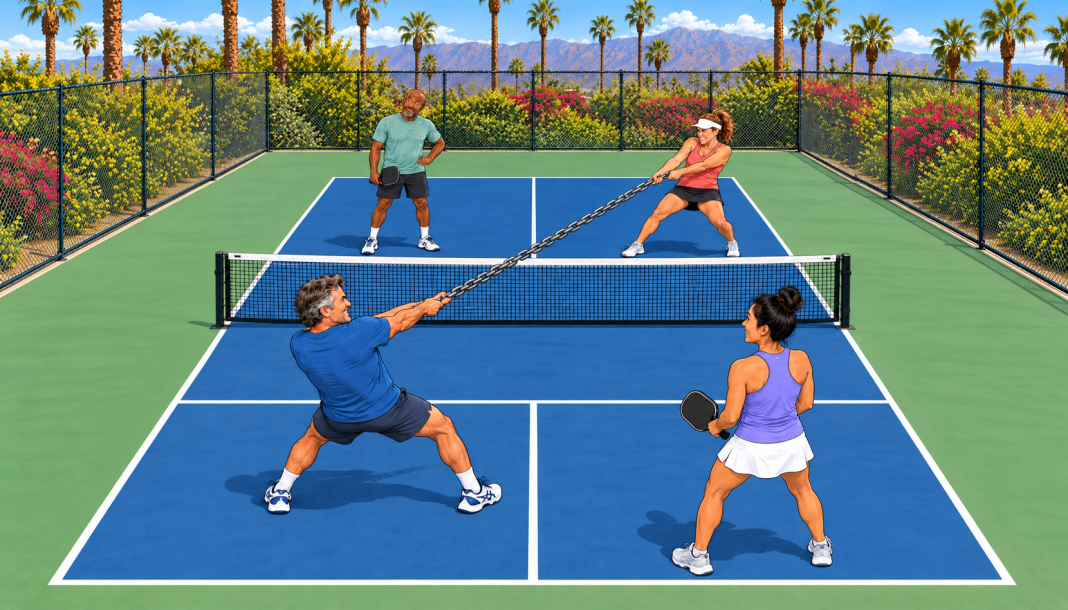
That’s the idea behind the Counterattack Chain Drill.
One player initiates an attack while the defender works through a sequence: handle the first ball, improve the next contact, and counterattack when the right opportunity appears. Instead of treating every fast exchange as a frantic hands battle, the drill teaches you to see a chain of balls in which each response can make the next one better.
Sometimes you’ll counter immediately. Sometimes you’ll need two or three defensive contacts before the opportunity appears.
The important part is recognizing the difference.
Why This Drill Matters
Players often practice counters by having a partner speed balls up while they try to fire them back.
That can improve hand speed, but it can also create a bad habit: every incoming attack starts to look like a ball that should be attacked right back.
In a game, that isn’t always possible.
Your opponent may catch you slightly out of position. The attack may be directed into your body. You may have to reach or contact the ball below the height where you can comfortably counter. Trying to turn that ball immediately into offense can produce a pop-up, a miss or an even easier next attack for your opponent.
A controlled block may be the better first response.
If that block makes the attacker’s next ball less threatening, you may be able to do more with the second one. Perhaps the next attack arrives higher. Maybe it’s farther from your body. Maybe your opponent is now slightly off balance after having to generate another attack.
The Counterattack Chain Drill teaches you to stay in that sequence long enough for the opportunity to change.
Setting Up the Drill
Two players begin across from each other at the kitchen line. One is the attacker and one is the defender.
The attacker begins each repetition with a controlled speed-up toward the defender. Start at moderate pace. The purpose is to create realistic pressure, not overwhelm the defender before the drill has even begun.
The defender’s first job is simple: deal with the ball appropriately.
If the attack arrives in a position where a controlled counter is available, the defender can counterattack immediately. If the ball jams the body, arrives low, or catches the defender in a poor position, the better response may be a block.
The attacker continues applying pressure when possible.
The defender keeps working through the chain until one of three things happens: the defender earns a good counterattack, the attacker loses the ability to continue attacking, or the rally ends.
Then reset.
After several repetitions, switch roles.
Ball One: Don’t Panic
The first attack is where the drill usually reveals the most.
Many players see pace and immediately add more pace. The paddle gets bigger, the swing gets longer, and a ball that could have been handled comfortably becomes difficult.
Your first task is to read what you’ve been given.
If the ball is coming directly into a strong counter position and you’re balanced, use it. A compact counter may be available immediately.
But if the ball is low, tight to the body, or forcing you into an awkward contact, you don’t have to win the exchange with that shot.
Block it.
A good block takes pace away and keeps the ball low enough that the attacker has to solve another problem. You haven’t surrendered the rally by blocking. You may simply be buying yourself a better ball.
That is the first link in the chain.
Ball Two: Look for the Change
After your first response, don’t automatically repeat it.
Look at what changed.
Maybe your block forced the attacker to contact the next ball lower. Perhaps the next speed-up arrives farther from your body. Maybe the attacker had to reach and couldn’t generate the same pace.
That second ball may offer something the first one didn’t.
This is where players who think only in terms of “defense” and “offense” can miss opportunities. They decide they’re defending, so they continue blocking even after the rally has given them a ball they can counter.
The Counterattack Chain Drill teaches you to reassess after every contact.
The first ball required defense.
That doesn’t mean the second one does.
What Makes a Good Counterattack Ball?
A useful counter opportunity usually gives you a combination of time, balance and a manageable contact point.
You don’t need all day. At kitchen-line distances, you’re never going to have much time. But you should be able to meet the ball in front with a compact paddle action rather than desperately reaching or trying to create offense from behind your body.
Height matters, but don’t reduce the decision to height alone.
A ball may arrive above net level but still jam your hitting shoulder. Another may be slightly lower but sit perfectly in front of a prepared backhand counter. Your position and paddle readiness matter along with the ball itself.
The goal of the drill is to start recognizing that picture quickly.
When the picture is good, counter.
When it isn’t, keep the chain alive.
Keep the Counter Compact
Once players finally get the ball they’re waiting for, they often do too much with it.
The backswing gets bigger. The paddle accelerates wildly. The player tries to turn a good counter opportunity into a spectacular winner.
At the kitchen line, you often don’t need much extra swing.
Your opponent has already supplied pace. A compact counter can redirect that energy and send the ball back quickly without sacrificing control.
Think about meeting the ball rather than winding up for it.
This also helps with recovery. A short, controlled counter gets your paddle back into position faster if the ball returns.
Remember, even your counterattack may not end the rally.
There can be another link in the chain.
The Hidden Lesson: Defense and Offense Can Change in One Ball
Pickleball rallies don’t always have a clean moment when one team stops defending and starts attacking.
The change can happen almost instantly.
You block a difficult speed-up.
Your opponent attacks again, but the ball comes back slightly higher.
You counter.
Now your opponent is the one trying to survive.
That shift may happen in two shots.
This drill trains you to recognize the moment instead of deciding in advance which role you’re playing.
You don’t want to counter everything.
You also don’t want to remain defensive after the opportunity has changed.
The player who recognizes that transition first often takes control of the exchange.
Placement Still Matters
Once you earn the counter, don’t simply send it back toward the attacker as hard as possible.
Look for a useful target.
A body counter can jam the attacker and reduce their ability to continue swinging freely. A ball toward the backhand may test a less comfortable side. If the attacker has shifted or leaned during the exchange, an open space may appear.
You don’t need to paint the sideline.
At these distances, making the attacker contact the ball from an awkward position can be enough to reverse the pressure.
As you improve at the drill, begin evaluating your counter by the next response it creates rather than whether it immediately wins the rally.
Common Mistakes
The most common mistake is trying to counter the first attack no matter what. That turns the drill into a reflex contest. If the first ball puts you in a poor position, use the defensive response that gives you the best chance to improve the next ball.
The opposite mistake is blocking everything. Once players become comfortable absorbing pace, they sometimes stay in that mode too long. If the next ball gives you a strong counter opportunity, recognize it and use it.
Another problem is swinging too much. Fast exchanges reward compact preparation. A large backswing costs time and can make it difficult to recover for the next ball.
Players also tend to retreat unnecessarily when attacked. Unless the ball actually forces you backward, try to maintain your position at the kitchen rather than giving away space automatically.
Finally, the attacker shouldn’t turn the drill into a firing squad. Start with controlled attacks and increase pace only when the defender can make meaningful decisions. If every repetition ends with the first ball flying past the defender, nobody is practicing the chain.
Beginner Variation
Start with a predictable three-ball sequence.
The attacker sends a moderate speed-up. The defender blocks the first ball regardless of whether a counter might be available. The attacker sends another controlled attack, and the defender counters the second.
After the counter, stop and reset.
This isn’t how you’ll eventually make the decision in a game, but it lets you feel the difference between absorbing pace and redirecting it aggressively.
Once both responses feel comfortable, remove the predetermined sequence.
Intermediate Variation
The attacker initiates the speed-up and continues attacking when the ball allows.
The defender decides on every contact whether to block or counter. There is no required number of defensive shots before the counterattack.
Give the defender one point for a counter chosen from a strong position. Give another point if that counter produces a weak response or wins the rally.
A forced counter from a poor position earns nothing, even if the ball happens to go in.
Play to seven points, then switch roles.
Now the drill rewards the decision rather than simply the outcome.
Advanced Variation
Make the entire exchange live after the first attack.
The attacker can vary targets between the body, forehand and backhand rather than repeatedly attacking the same location. The defender can block, reset or counter based on each ball.
Once the defender counters, continue the rally.
Now watch whether the roles reverse. Can the original attacker handle the counter? Can the defender maintain the advantage after earning it? Does the first counter create another attackable ball?
This turns the drill into a true chain rather than a single transition from defense to offense.
A Simple 15-Minute Session
Spend the first three minutes alternating predetermined blocks and counters. Keep the pace moderate and concentrate on making both responses compact.
For the next four minutes, let the attacker vary the first ball. The defender decides whether the first contact should be blocked or countered. Stop after the defender makes a successful counterattack.
Spend another four minutes allowing the attacker to continue applying pressure. The defender may need one, two, three or more defensive contacts before earning the counter.
Use the final four minutes with live play after the initial speed-up.
Pay attention to where the chain breaks. If you’re missing the first ball, your paddle preparation or reaction may need work. If you can defend repeatedly but never counter, you may be failing to recognize when the opportunity changes. If your counters consistently come back harder, look at your placement and whether you’re trying to attack balls from poor positions.
The number of shots before you counter isn’t the score.
The quality of the decision is.
Final Thought
Good counterattacking isn’t about proving that you have faster hands than the player across the net.
Sometimes the best counterattack begins with a block.
You handle the difficult first ball. You stay balanced. You make your opponent hit another shot. Then you look again.
Maybe the next ball is still defensive.
Maybe it isn’t.
The Counterattack Chain Drill teaches you to recognize that change and respond to the ball you actually have instead of the shot you hoped you’d get.
You don’t have to turn defense into offense in one swing.
Sometimes you do it one ball at a time.