

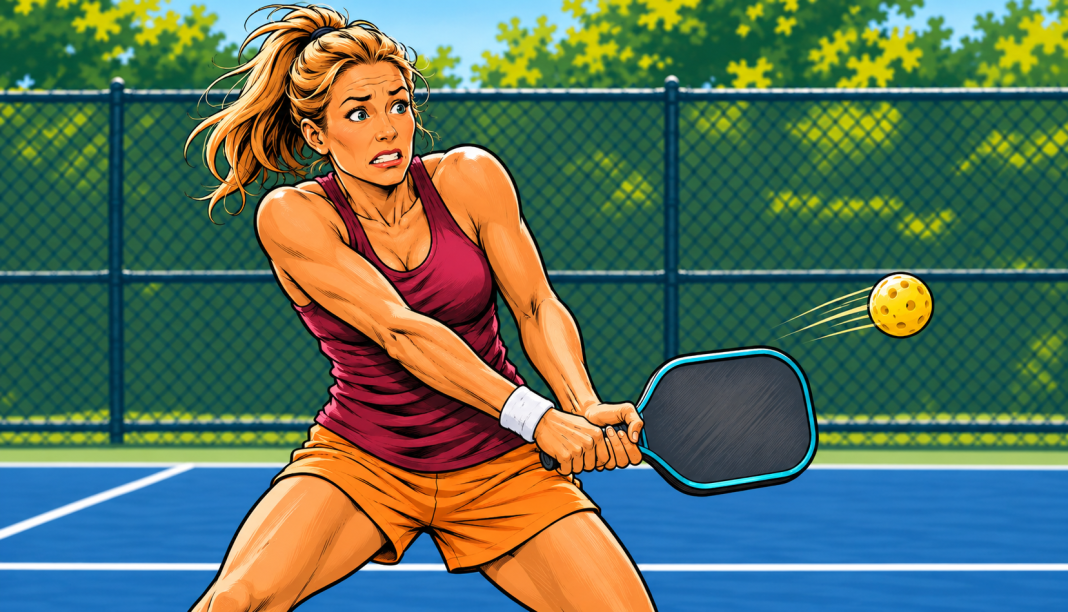
There’s a particular kind of frustration that comes from watching a serve head toward your backhand and knowing, before it even arrives, that your return probably won’t be very good.
You can handle the same serve comfortably on your forehand. You have a reliable swing, you can send the ball deep, and you have time to move toward the kitchen afterward. But shift that serve to the other side, and suddenly the return gets shorter, the contact feels cramped, and your opponent gets an easier third shot.
The problem isn’t always that your backhand is terrible. Often, it’s that you haven’t developed the same confidence, spacing, and depth control that you already have on your forehand.
The Backhand Return Drill gives that weaker side its own practice time. Instead of hitting a few backhands whenever a server happens to send one your way, you’ll work through progressively more demanding backhand returns until you can handle pace, placement, and movement without sacrificing depth.
The objective isn’t to turn your backhand return into a spectacular shot.
It’s to make it dependable enough that opponents stop looking at it as an easy target.
Why This Drill Matters
The return of serve has a straightforward strategic job in doubles. You want to get the ball back consistently, preferably deep enough to keep the serving team near the baseline while you move toward the kitchen (non-volley zone).
A weak backhand return can undermine both parts of that plan.
If the return lands short, the server may be able to step forward and hit a more comfortable third shot. If you rush your backhand contact and lose balance, you may also be late getting to the kitchen.
That creates a double problem: the serving team gets a better third shot while the returner may still be moving forward.
Many players respond by running around their backhand whenever possible. Sometimes that works, especially against slower serves. But against a well-placed serve, trying to manufacture a forehand can leave you reaching, late, or too far out of position.
A reliable backhand gives you another option.
Setting Up the Drill
You need one partner serving from the opposite baseline.
The returner begins in a normal receiving position, generally behind the baseline with enough room to handle a deep serve.
Establish a broad return target in the back portion of the server’s court. Start with the back half of the appropriate service box rather than trying to paint the baseline.
For the first round, the server sends ten manageable serves toward the returner’s backhand side. The returner must use a backhand return rather than running around the ball to hit a forehand.
A successful return lands legally in the designated deep target area and allows the returner to begin moving forward under control.
After ten serves, review the pattern.
Are the returns consistently deep? Are they landing short? Is the returner making clean contact but missing direction? Or is the real problem getting into position before swinging?
The drill becomes more useful when you identify which part is breaking down.
Start With Contact, Not Power
When players feel uncomfortable on their backhand, they often compensate by swinging harder.
That rarely solves the problem.
A backhand return needs enough pace and trajectory to reach the back portion of the court, but it doesn’t need to be a winner. In fact, a higher, deeper return can be especially useful because it gives the returner more time to advance.
Begin by concentrating on clean contact in front of your body.
Turn early enough to prepare the backhand and adjust your feet so the ball isn’t crowding you. Whether you use one hand or two, the important thing is that the contact feels controlled rather than rushed.
If your return repeatedly lands short, don’t immediately assume you need a bigger swing. Look at your contact point, the trajectory you’re producing, and whether you’re actually moving through the ball comfortably.
Sometimes a small adjustment in spacing makes a bigger difference than swinging harder.
The First Challenge: Depth
For the first stage, forget about trying to hit sharp angles.
Your job is to return deep.
Have your partner serve ten balls toward the backhand and count how many land in the back half of the server’s service box.
If you make eight of ten, move the front boundary of the target several feet closer to the baseline.
Now repeat.
The deeper target should be more challenging, but it should still leave room for error. You’re trying to develop a return you can trust, not one that occasionally lands an inch inside the baseline.
Notice what changes when you aim deeper.
Do you begin flattening the ball? Does your swing get bigger? Are you suddenly missing long because you’re trying to force extra distance?
The goal is to find a comfortable trajectory that produces useful depth without sacrificing consistency.
The Second Challenge: A Serve That Moves You
Once the backhand return works against predictable serves, have your partner vary the placement.
Some serves should be closer to your body. Others should pull you wider toward the sideline. A few should be deeper and require you to adjust your starting position.
Now you’re practicing the part that often makes backhand returns difficult: getting into position.
A serve that crowds your body may require a quick spacing adjustment so you have room to swing. A wide serve may require you to move laterally and recover before heading toward the kitchen.
Don’t rush the return simply because you want to move forward.
First, get into position and hit a quality ball.
Then advance.
The Hidden Lesson: Your Weaker Side May Be a Footwork Problem
This drill often reveals something players don’t expect.
Their backhand stroke may be reasonably good when the ball arrives in the right place. The trouble begins when the serve forces them to move.
Perhaps they stand too close to the baseline and get crowded by deep serves. Maybe they don’t turn early enough. Maybe they move toward the kitchen before finishing the return.
Those problems can make a perfectly serviceable backhand feel unreliable.
That’s why you should pay attention to the misses rather than treating every unsuccessful return as evidence that your backhand needs more work.
If you can return ten predictable serves deeply but struggle when the server varies placement, the issue may be preparation and spacing more than the stroke itself.
Common Mistakes
The first mistake is running around every backhand. There are times when using your forehand makes sense, but this drill deliberately removes that escape. You need repetitions on the side you’re trying to improve.
Another is aiming too close to the baseline. Depth matters, but a return that consistently lands long doesn’t help. Use a broad deep target with realistic margin.
Players also sometimes shorten their follow-through or poke at the ball because they don’t trust the backhand. That can leave returns short and easy to attack. Use a controlled, complete stroke rather than a hurried jab.
Watch your recovery, too. If you hit a decent backhand but remain planted at the baseline admiring it, you’ve completed only half the returner’s job. Begin moving forward after contact, while getting balanced before the opponent strikes.
Finally, don’t let the server make every feed difficult from the beginning. Build consistency against manageable serves first, then add pace and placement.
Beginner Variation
Use ten predictable serves to the backhand side at moderate pace.
The returner aims for a large deep target and focuses on early preparation, clean contact, and balance.
Once eight of ten returns land in the target, move to a slightly deeper zone.
Intermediate Variation
The server alternates between serves toward the body and wider backhand serves, without using a predictable sequence.
The returner must hit a backhand and land at least seven of ten returns in the back portion of the court.
After contact, the returner moves toward the kitchen and gets balanced before the server would hit the third shot.
Advanced Variation
Allow the server to vary pace, depth, and location, but keep most serves on the backhand side.
After the return, play the point out. The server may drive or drop the third shot, so the returner must evaluate whether they have reached the kitchen or need to handle another ball while advancing.
Now you’re testing whether the backhand return supports the next part of the rally.
A deep return that leaves you balanced and moving forward is worth much more than an impressive return that leaves you stranded.
A Simple 15-Minute Session
Spend the first three minutes hitting predictable backhand returns to a large deep target. Concentrate on contact and comfortable trajectory.
For the next four minutes, move the target deeper and measure your consistency. If the ball repeatedly lands short, adjust your contact and trajectory rather than immediately swinging harder.
Spend another four minutes with the server varying placement between the body and wider backhand locations.
Use the final four minutes to play the point after each backhand return, paying attention to whether your return depth allows you to establish position at the kitchen.
By the end, you should know whether your biggest weakness is depth, spacing, movement, or confidence under a more demanding serve.
Final Thought
You don’t need to love your backhand return.
You need to trust it.
When you can handle a serve to either side without automatically giving the server an easy third shot, your entire return game becomes more dependable.
The Backhand Return Drill gives you the repetitions to build that confidence, one deep return at a time.
And once opponents realize your backhand isn’t an easy way into the point, they have one less weakness to exploit.