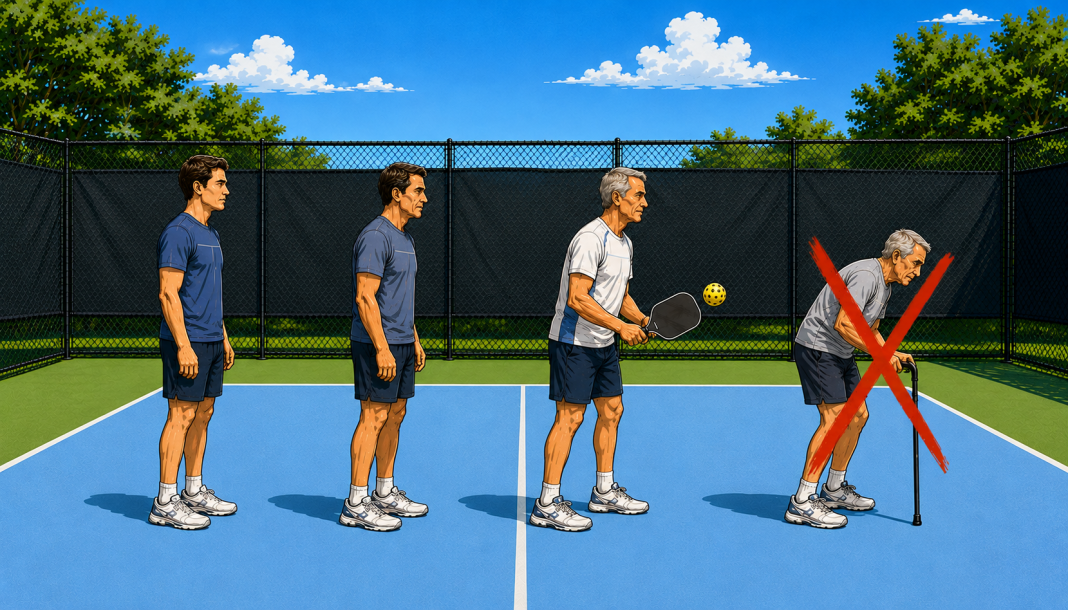


Pickleball players usually notice a loss of strength on the court before they notice it anywhere else. Getting to a wide ball takes an extra step. Staying low during a long dink rally becomes uncomfortable. After two hours of play, recovering back into position takes noticeably more effort than it did during the first game.
Those changes are easy to blame on footwork or conditioning, and sometimes they are part of the problem. Strength also plays an important role. The legs need enough strength to lower the body and bring it back up, push quickly in different directions, slow the body down, and repeat those movements throughout a session.
Strength training for pickleball does not need to imitate pickleball. A few basic movements away from the court can make the movements required on the court easier to control.
Getting Low and Getting Back Up
Players spend a surprising amount of time in partially lowered positions. They bend to handle dinks, drops, low volleys, and balls at their feet, then have to push back up and recover for the next shot.
Squats and similar movements train the hips and legs to handle that job. A chair squat is a simple place to start. Sit back toward a sturdy chair under control, lightly touch the seat, then stand again. As strength improves, the chair can be removed or resistance can be added with a dumbbell or backpack.
The goal is not an exceptionally deep squat. Players need strength through a range they can control. On the court, that can make getting down to a low ball feel less demanding and leave more strength available to recover afterward.
Split squats can take that a step further because pickleball rarely puts both feet in exactly the same position. With one foot forward and the other behind, lower the body through a comfortable range and push back up. Holding onto a stable surface is perfectly reasonable while learning the movement.
Pushing Side to Side
A large amount of pickleball movement happens laterally. Players shuffle along the kitchen line, push toward wide dinks, cover the middle, and then have to reverse direction when the next ball goes somewhere else.
Side steps with a resistance band can strengthen the hips for this type of movement. Place a loop band above the knees or around the ankles, maintain a slight bend in the knees, and take controlled steps in each direction. The torso should stay relatively quiet while the legs do the work.
Lateral lunges are another useful option. Step to one side, allow that hip and knee to bend, then push through the foot to return to the starting position. Begin with a small range and increase it only when the movement feels controlled.
These exercises do not teach court footwork. They give the muscles involved in that footwork more capacity to do their job.
Strength Helps You Stop, Too
Moving quickly is only half of court movement. Players also have to stop.
Every time a player runs forward after a third-shot drop, moves wide for a dink, or chases down a lob, the body has to slow itself before changing direction or hitting the next ball. Poor control during that deceleration can leave a player reaching, falling through the shot, or needing several extra steps to regain balance.
Slow step-downs are useful for training this type of control. Stand on a low step, slowly lower one heel toward the floor, then return to the starting position. A nearby wall or railing can provide support. The lowering portion should be deliberate rather than a quick drop.
Reverse lunges can train a similar quality. Step backward, lower under control, then use the front leg to return to standing. The emphasis should be on controlling the movement in both directions rather than completing repetitions quickly.
This type of strength often shows up on court as better braking. Players can arrive at the ball without carrying as much uncontrolled momentum into the shot.
Recovering After a Wide Ball
Reaching a difficult ball is useful only if a player can recover afterward. Wide dinks and angled shots frequently put most of the body weight over one leg. That leg then has to produce enough force to push the player back toward a better court position.
Split squats, lateral lunges, and step-ups all help develop single-leg strength for that recovery. Calf raises are useful as well because the ankle and calf contribute to the small pushes that start movement around the court.
Single-leg work does not have to mean balancing on one foot while performing complicated exercises. Keeping both feet on the ground in a staggered stance can provide plenty of challenge while allowing players to concentrate on strength and control.
Strength Matters Late in the Session
The first hour of pickleball can hide weaknesses that become obvious during the second or third. As muscles fatigue, players often begin standing taller, taking extra steps, reaching instead of moving their feet, and recovering more slowly after difficult balls.
General conditioning affects this, but strength provides a larger reserve. When a normal court movement requires only a modest portion of the strength available, repeating it is easier than when that same movement is already close to a player’s maximum effort.
That is one reason strength training can help players maintain movement quality later in a session. The benefit may not show up as suddenly moving faster. It may show up as the legs still being able to get low, stop, push, and recover after several games.
A Simple Strength Session
There is no need to turn this into a complicated training program. Two short sessions each week can cover the major movement demands discussed here.
A simple session might include:
- Chair squats for getting low and standing back up
- Split squats for staggered and single-leg strength
- Band side steps or lateral lunges for side-to-side movement
- Slow step-downs or reverse lunges for stopping and control
- Calf raises for pushing through the feet and ankles
Start with a resistance and range of motion that allow every repetition to remain controlled. One or two sets of each movement may be plenty for someone new to strength training. As the exercises become easier, add repetitions, resistance, or a slightly greater range rather than changing everything at once.
Strength work also needs recovery. Placing a challenging leg session immediately before several hours of pickleball may leave the legs tired rather than better prepared. The schedule should allow enough time to recover before demanding court sessions.
Persistent joint pain, significant balance problems, recent surgery, or medical conditions that affect exercise tolerance are good reasons to get individualized guidance before starting or substantially changing a strength program.
Final Thoughts
Better court movement depends on more than knowing where the feet should go. The body also needs enough strength to carry out those movements repeatedly.
Getting low requires strength. Pushing laterally requires strength. Stopping under control and recovering after a wide ball require it too. As a session gets longer, those demands continue even as the legs begin to tire.
Strength training cannot replace good footwork or better positioning. It can make both easier to use by giving the body more capacity to handle the movements pickleball requires.