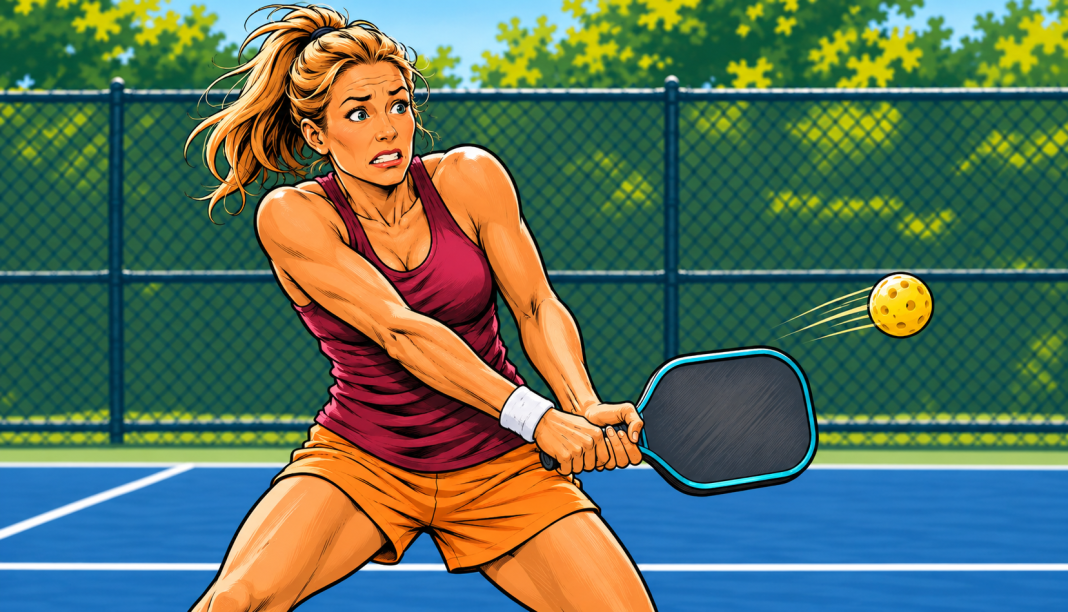


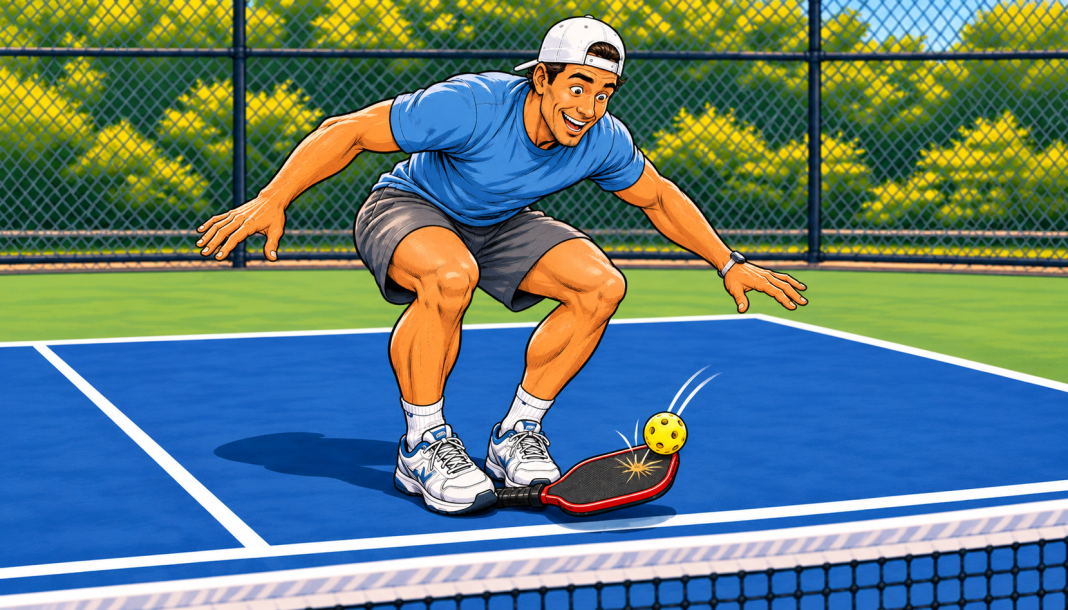
A good dink does not have to be particularly fast or sharply angled to create trouble. Sometimes the most awkward ball is the one that lands almost directly in front of a player’s shoes.
The ball drops low, there is very little room to swing, and the player suddenly has to decide whether to step back, reach forward, or attempt a delicate lift over the net.
A dink at the feet can be especially frustrating because it looks like an easy ball until the moment of contact.
The problem is usually one of spacing. The ball has entered an area where the player cannot comfortably position the paddle, and a small adjustment becomes necessary before making the shot.
Understanding how to create that space is the first step toward handling these balls consistently.
Why Balls at the Feet Are So Difficult
Players are generally more comfortable contacting a dink slightly in front of the body, with enough room for the paddle to move through the ball.
When a dink lands close to the feet, that space disappears.
The player may have to bend more deeply, move the paddle around the knees, or contact the ball unusually close to the body. The natural tendency is to lift with the wrist or scoop upward to get the ball over the net.
That often creates a pop-up.
The problem becomes worse when a player waits too long to recognize the ball’s landing spot. By the time it reaches the shoes, there may be little opportunity to reposition.
A good response begins with reading the ball early enough to make a small adjustment.
Make Room With Your Feet First
When a dink is going to land very close to the body, a small backward adjustment can create enough room for a comfortable contact.
The movement does not need to be dramatic. One short step back, or a slight adjustment of the feet, may be sufficient.
The important consideration is maintaining balance.
A player who jumps backward or retreats too far may turn a manageable dink into a difficult recovery. The objective is simply to create a little working space between the body and the ball.
Sometimes a small sideways adjustment is more useful, particularly when the ball is approaching one foot. Moving slightly to the side may allow the paddle to contact the ball in front of the body rather than directly between the shoes.
The correct adjustment depends on the ball’s location and the player’s position.
There is also an important restriction at the kitchen line. A player should not step into the kitchen to volley the ball, but once the dink bounces, entering the kitchen to play it is perfectly legal.
Players who hesitate because they are worried about stepping across the line may end up reaching awkwardly for a ball they could have handled comfortably.
Get Low Without Collapsing Forward
A low dink requires the player to lower the paddle toward the ball.
The mistake is often bending entirely from the waist and reaching down with the upper body. That can move the player’s weight too far forward and make the next recovery difficult.
Instead, the knees and hips should contribute to lowering the body while the player maintains a stable position.
The amount of bend will vary with mobility, strength, and the height of the bounce. There is no need to force an exaggerated squat for every dink.
The player should be able to control the paddle and recover afterward.
Keeping the head and upper body reasonably stable can also make the ball easier to track. When the entire body suddenly drops forward, the player’s visual perspective changes at the same moment the paddle needs to make precise contact.
A comfortable, balanced lowering movement usually provides better control than a last-second reach.
Use a Small, Controlled Lift
A ball near the feet rarely requires a large swing.
Because the contact is low, the player generally needs to lift the ball enough to clear the net. The challenge is producing that lift without sending the ball too high.
A compact paddle movement is usually the best approach.
The paddle face may need to be slightly open, depending on the ball’s spin and contact point. The stroke should provide a controlled upward component while maintaining a stable paddle angle.
A sudden wrist flick can make the ball jump off the paddle unpredictably. It may also produce more height than intended.
Players should think about guiding the ball over the net with enough clearance to be reliable, rather than trying to create an especially aggressive dink from an awkward position.
The return does not have to be perfect. A neutral dink that keeps the rally going is often a successful response.
Don’t Force an Attack From Below Net Height
A dink at the feet is usually a poor opportunity to speed up.
The ball is low, the player may be slightly off balance, and the paddle often has to move upward simply to clear the net.
Trying to attack from that position can send the ball into the net or produce a high ball that the opponents can counterattack.
There are exceptions. Skilled players can roll certain low balls with topspin, especially when they have room to work and a favorable contact point.
But for most players, a dink that lands directly at the shoes is a ball to manage rather than attack.
A controlled reply gives the player time to recover and wait for a better opportunity.
Recover After the Shot
Handling the difficult dink is only half the job.
A player who steps backward to create space may finish the shot slightly farther from the kitchen line. If the opponent’s next ball is soft, returning toward a comfortable kitchen position can help prevent the team from giving away court space.
But recovery should not be automatic.
If the player has just lifted a ball too high, moving forward aggressively may place them directly in the path of an attack. The better response may be to establish a balanced defensive position and prepare for the opponent’s next contact.
The height and quality of the return should guide the recovery.
Players who concentrate entirely on getting the difficult dink over the net sometimes forget that another shot is coming almost immediately.
The Mistake: Trying to Save the Ball With the Wrist
When a dink lands at the feet, many players react by reaching down and flipping the paddle upward.
It feels like a quick solution, but the wrist movement can send the ball much higher than intended.
The better response begins before the swing.
Recognize the short landing spot, make a small adjustment with the feet, lower the body comfortably, and use a controlled paddle movement.
The wrist does not have to be rigid, but it should not be responsible for rescuing a ball that the feet could have made easier.
Drill: The Shoe-Top Dink
Set up two players across from each other at the kitchen line.
One player feeds soft dinks that land close to the receiver’s feet. Begin with predictable feeds so the receiver can practice making a small backward or sideways adjustment.
The receiver returns each ball with a controlled dink, concentrating on creating space and keeping the paddle movement compact.
After several successful repetitions, the feeder varies the placement between the left foot, right foot, and a more comfortable position in front of the body.
The receiver must decide whether to adjust backward, sideways, or remain in place.
For the final round, play cooperative dink rallies in which either player may deliberately target the opponent’s feet. The objective is to maintain control rather than attack.
This progression helps players recognize the difference between a ball that requires footwork and one that can be played comfortably from the current position.
Final Thoughts
A dink at the feet creates difficulty because it takes away the space needed for an easy paddle movement.
The solution usually begins with the feet. A small adjustment can turn an awkward contact into a manageable one.
From there, lowering the body comfortably, using a compact lift, and resisting the temptation to attack can help keep the ball low and the rally under control.
These shots will never be the easiest dinks on the court. But players who learn to create space instead of reaching desperately for the ball can turn an uncomfortable situation into a routine defensive play.