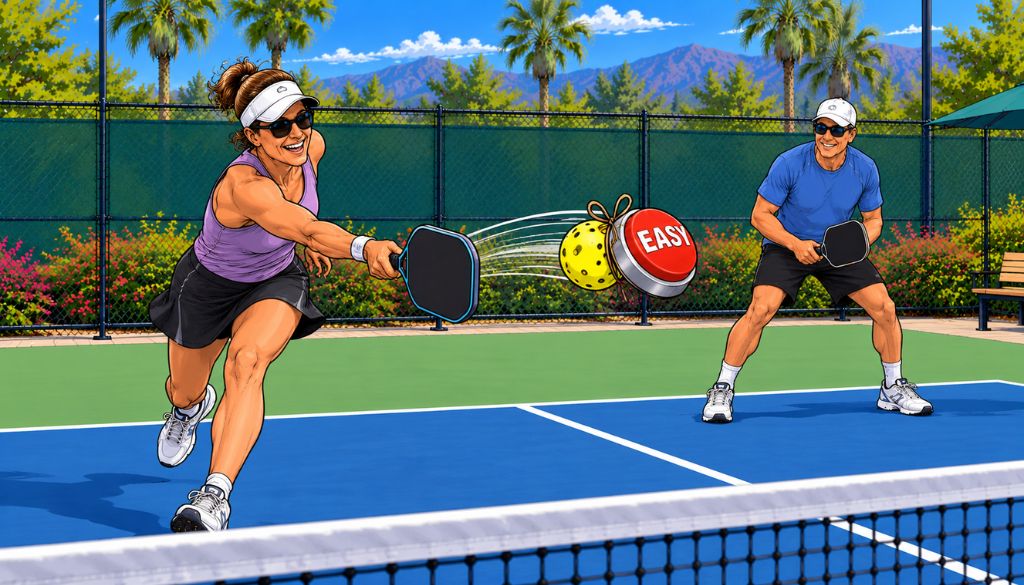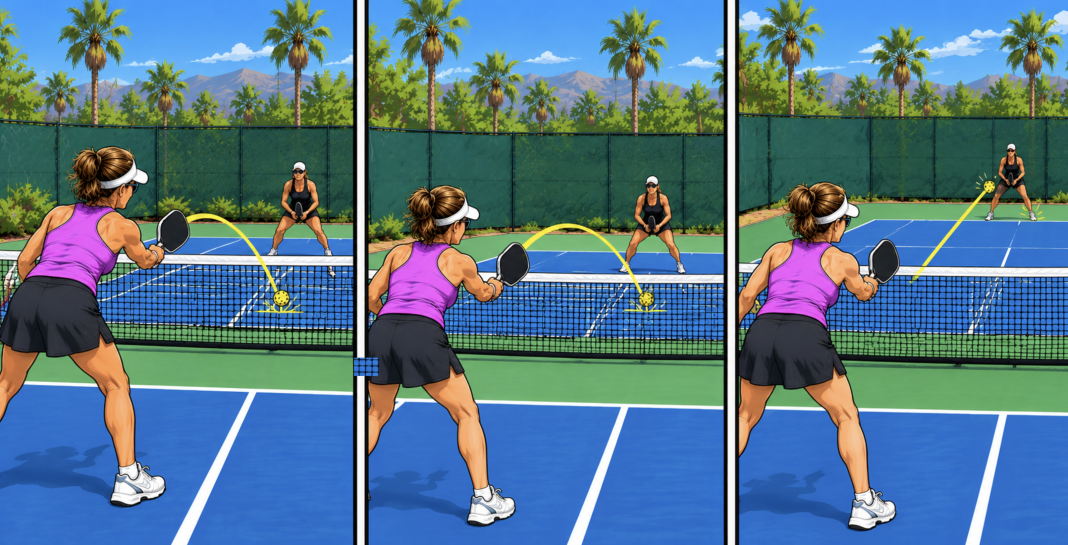



Build the formation that keeps your forehands in the middle, without losing the score or your partner.
Stacking gets a bad reputation. Most rec players try it once, lose two points to a wrong-side serve fault, give up, and decide it is too complicated. It is not. It is a footwork pattern with one strict rule about where the server and receiver start. Learn the start, then learn the steps.
Why this drill matters
Lefty and righty teams give up a real structural advantage when they do not stack. Most rally action runs through the middle of the court, so a team that can keep both forehands aimed at the middle has more attack options and tighter coverage. Same-handed teams stack to put a stronger player on a preferred side or to exploit specific opponent matchups. In every case, the goal is the same: get your formation working FOR you instead of handing the other team the easier matchup.
Quick rules refresher
- The server must serve from the correct service court based on the serving team’s score. Even score, serve from the right (deuce side). Odd score, serve from the left (ad side). Example: at 4 to 2, the score is even, so the server stands on the right.
- The legal receiver is the player diagonal from the server. That player must hit the return.
- After the serve, every player can move freely.
- A wrong-side serve, or a return hit by the wrong player, is a fault.
How to set it up
- Use a full court. One team of two players. Run as 2v0 for footwork only, or 2v2 for live execution.
- Decide each player’s home side. For a lefty and righty team, the lefty’s home is left and the righty’s home is right, so both forehands face the middle. Same-handed teams choose by strength.
- Track the score out loud before every serve.
The pattern
Walk through the movement before adding the ball.
- Player A serves. Score is even. Both partners line up on the right. Player A in the right service court. Player B behind or off the court to the right.
- Player A serves diagonally. As soon as the serve is hit, Player B crosses BEHIND Player A to the left.
- Both players settle: A on the right, B on the left. Forehands in the middle.
- Mirror the pattern when Player B serves or when the score puts the start on the other side.
The cross-behind is the key. Crossing in front blocks vision and risks a collision.
The return-side stack
On the return, the same cross-behind happens AFTER the return is hit. The receiver hits, takes one or two recovery steps, then crosses while their partner slides into the box just vacated. Start the cross when you see your return clear the net, not while you are still contacting the ball.
Communication
- Call the score out loud before every point.
- Confirm the formation. A simple ‘stack’ or ‘stay’ before the serve removes most surprises.
- For mixed-call situations, hand signals work. The partner standing behind the server signals against their back: open hand for switch, closed fist for stay. Both partners must agree on the meaning before the match.
- An audible call always overrides a signal. If the receive goes badly and the receiver yells ‘stay,’ the partner stays.
- If you are confused, default to ‘stay’ and play the point straight up.
Common mistakes
- Wrong-side serve. The single most common stacking error. Always say the score out loud.
- Crossing in front of the partner. Blocks vision, risks collision.
- Crossing mid-swing on the return. Wait until the ball clears the net.
- Not settling at the kitchen. The cross is a means, not an end.
- Stacking under stress. If the mental load is too high, drop the stack and rebuild it later.
Level variations
Beginner: Shadow the Switch
Run 2v0 with no ball. Walk through 10 points of stack-and-switch from both sides, calling the score before every imagined serve. The geometry must be automatic before you add a ball.
Intermediate: Live Stack on Serve
Run 2v2. Stack only on serve, not on the return yet. Play games to 11. Goal: zero wrong-side service faults across two games. One fault means the score call was too quiet.
Advanced: Full Stack with Signals
Run 2v2 live. Stack on serve and return. Add hand signals: each point, the partner standing behind signals stack or stay before the serve. Mix the calls so opponents cannot read the formation. Wrong-side faults cost your team 2 points instead of 1.
When the rules bend
- Half-stacks are common and often smart. Many teams stack only on the side where the geometry actually changes their forehand placement, trading purity for less mental load.
- The mid-rally switch is a different skill. It happens when one partner is pulled wide and the other slides over to cover. Verbal call required, usually ‘switch’ or ‘I got it.’
- Stacking has a cost. More tracking, more communication, more chances for a fault. If your team is fading, simplifying often beats stacking.
Why this drill belongs in your rotation
Stacking is one of those skills that looks complicated until it is automatic. Teams that stack cleanly do not waste mental energy on the formation. They free that energy for shot quality and rally decisions.
Build the system. The advantages will follow.