

The middle is one of the safest and most productive targets in doubles pickleball, yet many players barely use it on purpose.
They aim for the sidelines because those shots look more aggressive. They try to pass the player in front of them. They chase sharp angles that leave very little margin for error.
Meanwhile, the middle often sits open.
A well-placed ball through the seam between two opponents can create hesitation, jam a player’s backhand or forehand, reduce the available angle on the return, and force both partners to decide who should take it.
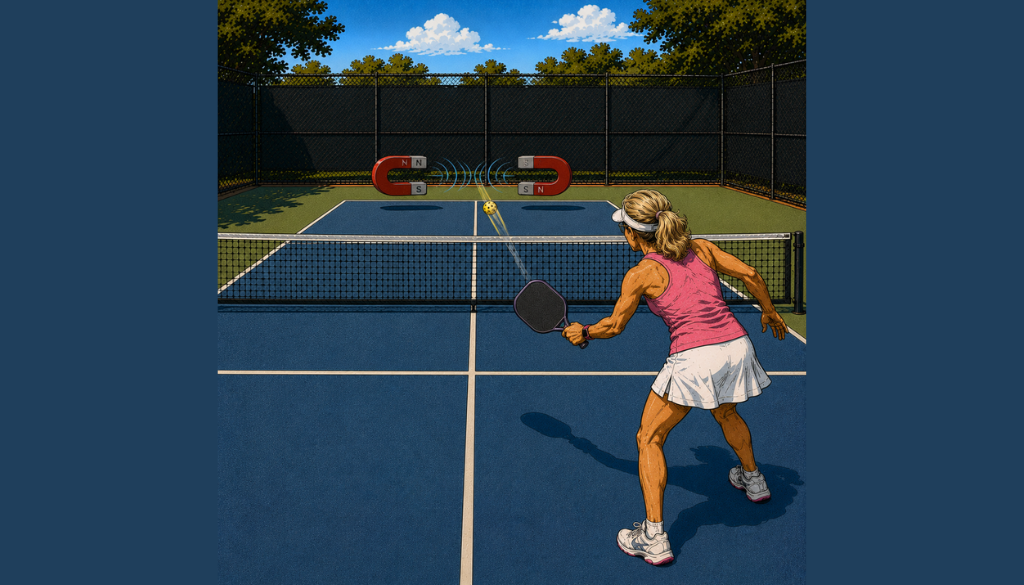
The Middle Magnet Drill teaches players to see that seam and use it intentionally. Instead of scoring for winners, players score only when they successfully direct the ball through the middle target. The result is a drill that builds accuracy, patience, and a better understanding of why the middle works so often in doubles.
Why This Drill Matters
Most players know the phrase “down the middle solves the riddle.” But knowing the phrase is not the same as recognizing the target during a rally.
The seam is constantly moving. It changes when opponents shift, stack, protect a sideline, favor a forehand, or leave one player slightly behind the other. Sometimes the best middle ball is aimed directly between two bodies. Other times it is aimed toward the inside hip of one player because that is where responsibility becomes unclear.
The Middle Magnet Drill gives players repeated chances to identify that space and hit it without forcing the ball. It also teaches an important tactical lesson: the middle is effective not because opponents always collide or miss, but because it usually gives them fewer comfortable options.
A ball directed toward the seam often limits the return angle. It may also force the receiving team to hit from a crowded position instead of extending freely toward the sideline. Even when the shot comes back, the next ball is often more predictable.
Setting Up the Drill
This drill works best with four players, but it can also be adapted for two.
For the four-player version, all players begin at the kitchen line. Place two small cones, flat markers, or pieces of tape on the court to create a middle channel between the receiving team. The channel should be broad enough to reward purposeful middle placement without demanding perfect accuracy.
A useful starting width is approximately three to four feet. The exact measurement is less important than having a clear target both teams can see.
Begin with cooperative dinking. A shot earns one point when it travels through the middle channel and lands in the kitchen. The rally continues after a successful shot.
If the ball passes outside the channel, lands out, or is hit into the net, no point is awarded. Depending on the variation, the rally may continue or restart.
The Basic Scoring Rule
A team earns one point only when the ball:
- Passes through the designated middle channel.
- Lands legally in the kitchen or designated target area.
- Is controlled well enough that the rally can continue.
The third rule matters. The purpose is not to stab at the seam and hope for an accidental winner. Players should learn to use a middle target while maintaining enough control to stay in the rally.
Start with a cooperative goal of 10 successful middle shots. Once both teams can reach that number consistently, move to streak scoring or a competitive version.
What Counts as the Middle?
The middle is not always the exact centerline of the court.
In doubles, the more useful definition is the seam between the two opponents. That seam may sit directly over the centerline, but it can shift several feet depending on where the players are standing.
If one opponent is pulled wide, the middle target moves with them. If both players slide toward one sideline, the open seam may appear closer to the other half of the court. If one player is protecting a forehand, the best target may be the inside hip rather than the open space between the two bodies.
This is why the drill should not become a mechanical exercise in hitting the painted centerline. Players need to look up, read the opponents’ positions, and direct the ball toward the actual seam.
Why the Middle Creates Pressure
A middle ball can create several different problems at once.
First, it can create hesitation. Both players may believe the other person should take the ball, especially when it travels near their inside hips.
Second, it can jam the player who does take it. A ball near the body is harder to attack cleanly than one that arrives comfortably outside the body.
Third, it reduces angles. A return hit from the middle usually has fewer sharp crosscourt options than a ball contacted near the sideline.
Finally, it can make the next shot easier to anticipate. When you direct the ball through the seam, the reply is often more likely to come back through the middle or toward a smaller set of available targets.
The middle does not guarantee a winner. Its value is that it often makes the opponents’ next shot less comfortable and more predictable.
What to Focus On
The first priority is margin.
Do not aim for a seam so narrow that every attempt becomes a low-percentage shot. Use the broad channel created by the markers and learn to hit through it consistently.
The second priority is observation. Watch how the receiving team moves after every shot. The middle target changes as the players shift, so your eyes should move from the ball to the opponents before contact.
The third priority is height. A middle dink that floats well above the net may still be attackable. The target does not excuse poor shot quality. Your ball should travel through the seam while staying low enough to prevent an easy speed-up.
Finally, stay patient. The middle is a pressure target, not a command to force every ball into the same place. Wait until you are balanced and the seam is available.
The Hidden Lesson: Middle Is a Moving Target
The most valuable part of this drill is learning that the middle must be read, not memorized.
Players often treat targeting as if the court contains permanent boxes. They decide to hit crosscourt, down the line, or through the center before the rally develops.
But doubles positioning changes from shot to shot.
The best middle ball may be between the players on one exchange and toward one player’s inside foot on the next. The drill teaches you to notice those adjustments and choose a target based on where the opponents actually are.
That skill carries directly into games. Once you start seeing the seam, you will notice how often it appears during dinking, resets, volleys, returns, and third shots.
Common Mistakes
The first mistake is confusing the middle with the painted centerline. The centerline is only a reference. The true target is the space or indecision point between the opponents.
Another mistake is hitting harder simply because the target is in the middle. Pace can be useful, but the drill is about placement first. A controlled ball into the seam often creates more trouble than a fast ball that sits up.
Players also tend to stare at the target too early. That can make the shot predictable and pull attention away from the incoming ball. Read the opponents, return your eyes to the ball, and use a normal compact stroke.
Do not assume every middle ball will produce confusion. Some teams communicate well and have clear rules about who takes the seam. Against those teams, the target can still be useful because it limits angles and crowds the contact point.
Finally, avoid forcing the middle when the ball is pulling you wide or leaving you off balance. A smart target becomes a poor choice when the shot itself is not under control.
Beginner Variation
Use four players at the kitchen and make the middle channel generous.
Dink cooperatively and count every ball that travels through the channel and lands in the kitchen. The rally continues even when a shot misses the target.
Work together to reach 10 points, then 20. This version gives players time to see the seam and learn the target without worrying about winning the rally.
Intermediate Variation
Narrow the middle channel slightly and use streak scoring.
The team must make three successful middle shots in a row to complete the round. A legal dink outside the channel keeps the rally alive but resets the streak to zero.
Because the opponents will naturally shift as the rally continues, players must adjust the target rather than repeatedly aiming at the same painted location.
Advanced Variation
Remove the physical markers and use the opponents’ actual seam as the target.
A shot earns a point only when both teams agree that it was directed through the moving middle or toward an inside hip that created a crowded contact point.
After three successful middle shots, the rally becomes live. Players may continue dinking, speed up, or attack any available ball.
This variation connects the drill to real play because the middle becomes a way to build pressure rather than the only place players are allowed to hit.
Two-Player Variation
Two players can run the drill crosscourt or straight ahead by creating a center target with two cones on the opposite side.
One player feeds a variety of controlled balls while the hitter tries to direct each return through the marked channel. After 10 balls, switch roles.
This version cannot recreate the hesitation between two opponents, but it still trains the visual target, paddle control, and ability to direct the ball away from the sidelines.
A Simple 15-Minute Session
Spend the first three minutes dinking cooperatively with a wide middle channel. Do not score. Focus on seeing the seam and controlling the ball through it.
For the next four minutes, count successful middle dinks and work together to reach 20.
Then spend four minutes using the intermediate streak variation. Try to complete five separate streaks of three.
Use the final four minutes on the advanced version. Remove the markers, let the seam move naturally, and make the rally live after three successful middle shots.
At the end, notice which balls were easiest to direct through the seam. Were you more accurate when balanced? Did the target become clearer after one opponent moved wide? Did your middle balls stay low, or did they become attackable when you tried too hard to be precise?
Those answers show whether your main issue is recognizing the target, controlling the paddle, or waiting for the right opportunity.
Final Thought
The middle is not a magic target, and it will not win every rally by itself.
What it does provide is margin, reduced angles, crowded contact points, and occasional confusion between partners. That combination makes it one of the most useful places to send the ball in doubles.
The Middle Magnet Drill teaches you to stop treating the seam as an accidental target. You learn to see it, adjust as it moves, and use it without sacrificing control.
Because the more often you can make two opponents solve the same ball, the less often either one gets to hit the shot they wanted.