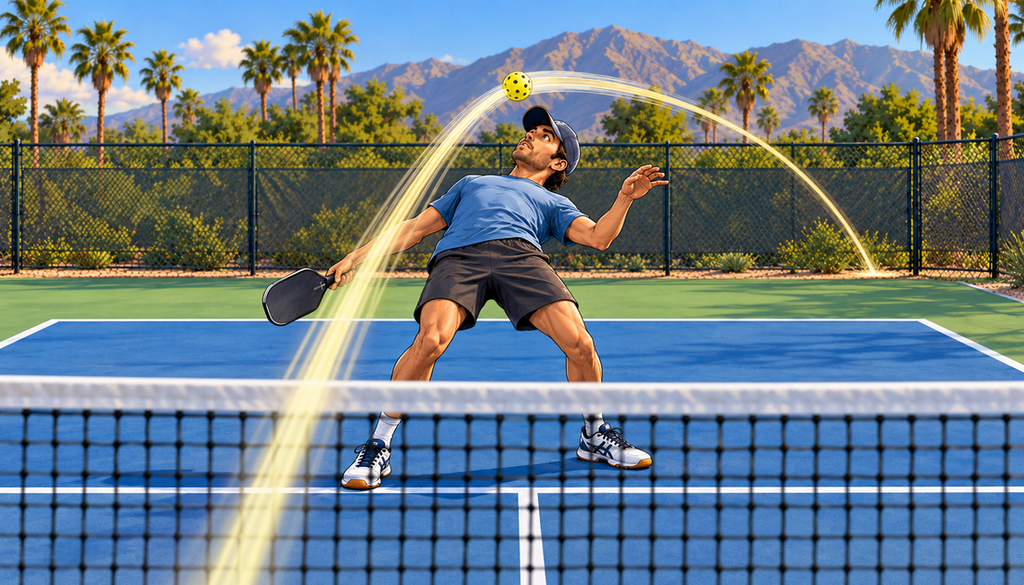


Doubles strategy is usually discussed in terms of what a shot does to the opponents. A deep return keeps them back. A good dink makes them hit up. A ball to the feet makes the next shot more difficult.
There is another way to judge a shot that gets much less attention: what does it do for the person standing next to you?
Every ball changes the next situation for all four players. A shot that looks good on its own can leave a partner defending a difficult angle or dealing with a ball at the feet. A less ambitious shot may give that same partner an easy volley or a predictable ball through the middle.
Good doubles players are not only trying to hit effective shots. They are also making the court easier for their partner to play.
1. Keep the Ball Low When Your Partner Is Moving Forward
When a partner is advancing toward the kitchen, the quality of the ball sent to the opponents matters enormously.
A low drop or reset forces the opponent to contact the ball from a lower position. That makes it harder to hit aggressively at the advancing partner and may provide enough time for both players to continue forward.
A higher ball creates the opposite situation. The partner may be halfway through the transition area when the opponent gets a comfortable volley.
This is one reason trying to attack while a partner is still moving forward can be risky. Even a reasonably good attack may come back quickly. The partner has less time to get balanced and may have to play the next ball from the feet.
When one player is moving, a lower, slower ball can give the entire team time to improve its position.
2. Use the Middle to Reduce the Angles
A ball through the middle can do more than create confusion between opponents.
It can also simplify the next shot for your partner.
Sending the ball sharply toward a sideline can open a wider angle on the reply. If the opponent gets there comfortably, the next ball may be directed away from your partner or pulled sharply across the court.
A ball through the middle generally gives the opponents fewer extreme angles to work with. The reply may still be good, but the range of likely responses becomes smaller.
That predictability helps both players.
There are certainly times to use sharp angles. But when the team is defending, recovering, or trying to regain a good formation, reducing the opponents’ options can be more useful than creating a difficult angle of your own.
3. Don’t Speed Up a Ball Your Partner Isn’t Ready For
A speed-up changes the rally for both players.
The player attacking knows the ball is about to accelerate. The partner may not.
If the partner is off balance, recovering from a previous shot, looking toward another part of the court, or simply not in a good ready position, suddenly starting a hands battle can leave that player reacting late.
Before speeding up, there is value in knowing whether the team is ready for the exchange.
That does not require turning to look at the partner before every attack. Doubles players develop awareness of where their partner is and what happened on the previous shot.
If the partner was just pulled wide or is still recovering toward the kitchen, another neutral ball may be the better choice. Once both players are balanced and ready, the same attack may make much more sense.
4. Give Your Partner Room to Recover
When a partner is pulled toward the sideline, the next shot can either help with the recovery or make it harder.
Suppose a player is sent wide for a dink. The partner now has more middle to protect while the player works back toward position.
Sending another sharp angle from that stretched position may keep the rally moving quickly and leave little time to recover. A controlled ball toward the middle can accomplish something different. It keeps the point neutral while giving the team a little more time to restore its spacing.
The same idea applies when a partner has been pushed backward or forced to scramble for a ball.
The next shot does not always need to create offense. Sometimes its most useful job is buying enough time for the team to become organized again.
5. Avoid Giving the Opponent an Easy Ball at Your Partner
Players naturally think about protecting themselves from attackable balls. In doubles, they also have to consider where an opponent is likely to send the next attack.
A high dink in front of one opponent may not come back to the player who hit it. The opponent may attack the partner instead.
This is especially important when the partner is in a vulnerable position. If the partner has been pulled wide, is slightly behind the kitchen line, or has a weaker defensive position on that side, a loose ball can put that player under immediate pressure.
No one can prevent every attack. Mistakes happen, and opponents will create opportunities of their own.
But shot selection should include the likely consequence for the partner. A ball that is relatively safe for the hitter may create a much harder problem several feet away.
6. Make the Next Ball More Predictable
Some of the best doubles shots are valuable because they narrow what the opponent can reasonably do next.
A low dink toward an opponent’s backhand may produce a fairly predictable reply. A ball at the feet may force the opponent to lift. A deep return can make it difficult to create an aggressive third shot.
That information helps the partner prepare.
Instead of being ready for everything, the partner can anticipate a smaller group of likely responses. The feet can be positioned better, the paddle can be ready, and the next ball may feel slower simply because it is less surprising.
This is one of the quieter advantages of good shot selection. The shot does not have to win the point. It can make the next part of the rally easier to read.
The Mistake: Judging a Shot Only by What It Does to the Opponent
A shot can bother an opponent and still create a difficult situation for the team that hit it.
A sharp angle may force an opponent to run but open a large section of court. A hard speed-up may surprise the opponent but catch the hitter’s partner unprepared. An aggressive ball may create pressure while the partner is still trying to get to the kitchen.
That does not make those shots wrong. It means their value cannot be judged in isolation.
Before choosing a more aggressive option, consider what the rally is likely to look like one shot later.
Sometimes the best shot for a partner is the same shot that puts the most pressure on an opponent.
Sometimes it is the one that gives the partner another second.
Drill: Set Up Your Partner
Play cooperative or competitive doubles points with one change to the scoring.
A team receives an extra point whenever one player’s shot clearly creates an easier next ball for the partner. That might be a low ball that produces a pop-up, a middle ball that creates a predictable reply, or a reset that gives the partner time to recover into position.
The extra point is not awarded for winners. The emphasis is on creating a better next ball for someone else.
After each rally, briefly identify the shot that made the partner’s job easier or harder. This helps players begin seeing the connection between one player’s decision and the other player’s next contact.
As the drill becomes more natural, remove the extra scoring and play normal games while keeping the same objective.
Final Thoughts
Doubles partners cannot control each other’s shots, but they can influence how difficult those shots are going to be.
Keeping the ball low can protect a partner who is moving forward. Using the middle can reduce angles. Waiting to speed up can give a partner time to get ready. A neutral ball can allow the team to recover, and a well-chosen target can make the opponent’s response more predictable.
None of those choices will appear as a winner on the score sheet.
But making a partner’s next shot easier often makes the shot after that easier too.
And that is how two players begin playing like a team rather than simply sharing the same side of the court.