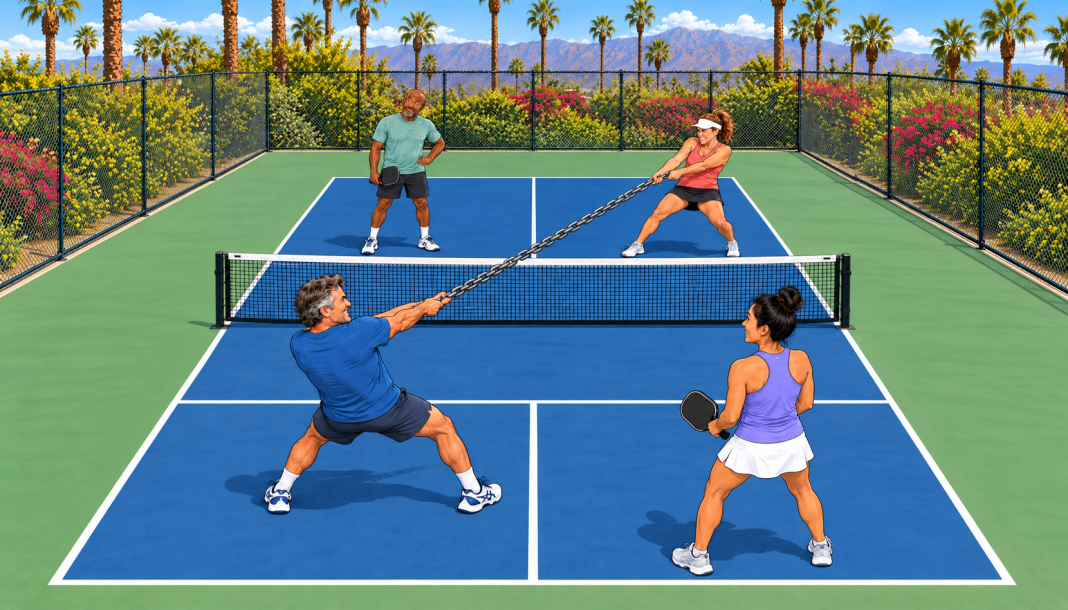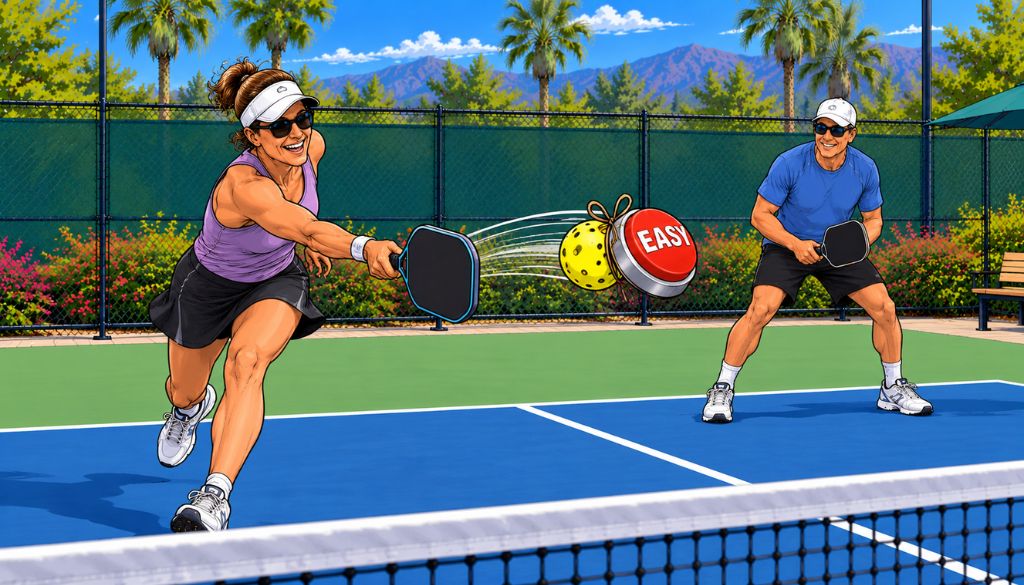


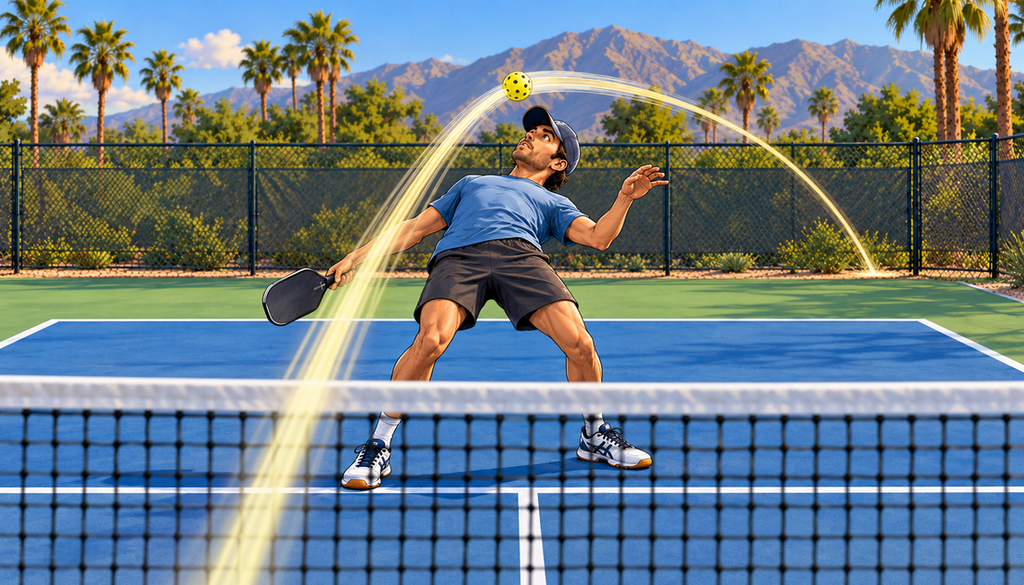
One of the hardest shots in pickleball may be the one a player decides not to hit.
The ball comes toward the body or shoulder, the paddle is right there, and instinct takes over. Even when the ball is probably heading long or wide, making contact feels safer than trusting it to go out.
That instinct costs points.
Good players are not simply better at hitting balls. They are also better at recognizing which balls do not need to be hit. Sometimes the best defense against a hard drive, speed-up, or awkward angle is to move out of the way and let the opponent’s shot finish the point for you.
The decision has to happen quickly, but there are several situations when letting the ball go deserves serious consideration.
1. A Hard Drive Is Still Rising
A hard drive can feel threatening because of its speed, but speed is not the only thing that matters. The ball’s trajectory provides valuable information.
If a drive crosses the net high and is still rising as it reaches the kitchen, there is a good chance it will continue beyond the baseline unless something brings it down.
Players often volley these balls simply because they can reach them. The result may be a difficult contact above the shoulders against a ball that was already headed out.
The height of the contact is an especially useful clue. A ball arriving around chest level may still need to be played depending on its trajectory. Once a hard ball is climbing toward the shoulders or head, the odds that it will land in become much smaller.
Learning to recognize that flight takes practice. The important question is not whether the ball is reachable. It is whether the ball needs to be reached.
2. A Speed-Up Is Aimed Too High
Speed-ups happen from much closer to the net, so there is even less time to decide.
The opponent attacks, the ball comes toward the upper body, and the natural response is to block or counter. But a speed-up launched from below net height has to travel upward to clear the net. If it is still climbing when it reaches the other side, it may not have enough court left to come back down.
This is particularly worth watching when an opponent attacks a low dink.
Attacking from below the net is already difficult because the ball must be lifted. If the opponent tries to generate a lot of pace at the same time, the margin becomes smaller.
Players who automatically put the paddle on every speed-up can rescue an opponent from a poor decision.
Sometimes the winning response is no response at all.
3. You’re Being Pulled Beyond the Sideline
Not every ball that can be reached should be played.
A sharp crosscourt dink or angled volley may pull a player toward the sideline. The closer the ball gets to the boundary, the more important it becomes to judge where it is actually going rather than chasing automatically.
Reaching outside the court for a ball that was headed wide does more than keep an opponent’s mistake alive. It can also pull the player completely out of position.
This is especially common when players are already moving toward the ball. Momentum makes it feel natural to continue reaching, even when the ball’s path has carried it beyond the sideline.
Watch the trajectory before extending the paddle. If the ball is continuing away from the court and there is not enough angle to bring it back inside the line, let it finish traveling.
The sideline can defend that shot better than you can.
4. You’re Trying to Protect Yourself From a Ball That’s Going Out
Fast balls directed at the body create a different problem.
A player may recognize that a ball is high but still make contact because it feels as though the paddle is needed for protection. The paddle comes up, the ball clips it, and what would have been an opponent’s error becomes a live ball or a mistake by the defending player.
When possible, moving the body can be a better choice.
A ball headed toward the shoulder or just outside the body may only require a small turn or lean to get out of its path. The player can protect the face while still allowing an obviously high ball to pass.
This is not an instruction to dodge every hard ball at the last second. Personal safety comes first, and there will be balls that arrive too quickly or too directly to do anything except protect the body.
But as players become better at reading trajectory, they often discover that some balls they were blocking defensively never needed to be played.
The Mistake: Deciding Based Only on Height
“Shoulder high, let it fly” is a useful reminder, but it is not a rule that works on every ball.
A ball’s height at one moment does not tell the whole story.
A slower ball can be high and still drop inside the baseline. Topspin can bring a ball down faster. A ball contacted from farther back has more court available to descend. Wind can also affect what happens outdoors.
Trajectory matters more than a single height measurement.
Is the ball rising or falling? How hard was it hit? Where did the opponent contact it? How much court does it have left before the baseline?
The more of those clues a player notices, the less the decision depends on guessing.
Drill: Call It Before It Reaches You
Start with one player at the kitchen line and a partner feeding drives from deeper in the court.
The feeder intentionally mixes balls that will land in with balls that will travel beyond the baseline. The player at the kitchen must call “in” or “out” before deciding whether to hit.
For the first round, do not keep score. The purpose is simply to compare the call with where the untouched ball actually lands.
Then add a scoring system. Award one point for correctly letting an out ball go and one point for correctly playing a ball that would have landed in. Subtract a point for touching an out ball or allowing an in ball to pass.
Next, move the feeder closer and practice the same decision with controlled speed-ups. Finally, play normal points and keep track of how many opponent errors are saved by unnecessary contact.
The drill becomes much more useful when players see where the balls they normally volley would actually have landed.
Final Thoughts
Letting a ball go requires a different kind of confidence from hitting one.
A player has to read the trajectory, make a decision, and then resist the urge to put the paddle on a ball that is close enough to reach.
Hard drives that are still rising, poorly placed speed-ups, balls traveling beyond the sideline, and high attacks toward the body can all become free points when players learn to leave them alone.
Not every close ball should be abandoned, and no simple rule can replace reading its flight.
But opponents will hit enough balls out on their own.
There is no reason to hit them back in.